

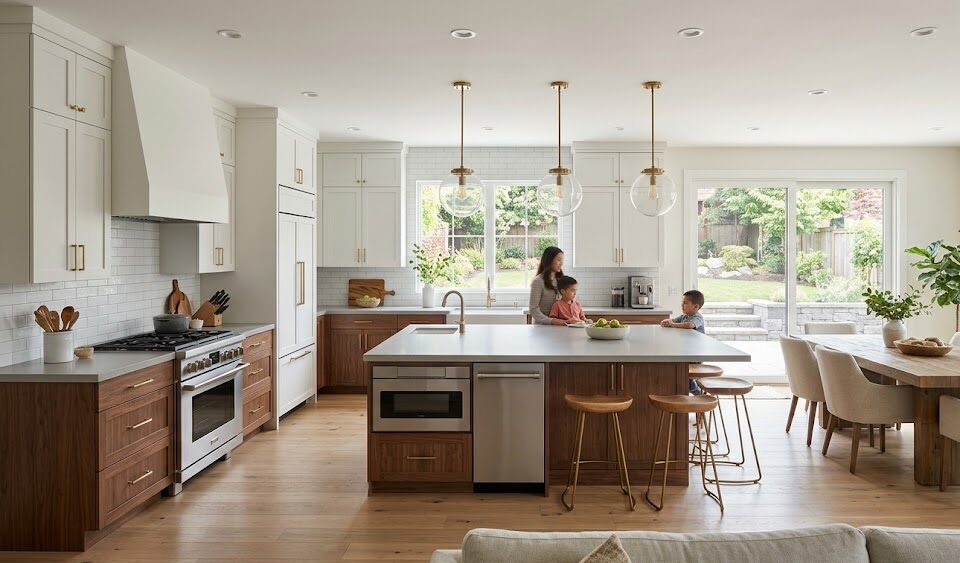
Design and Layouts for Kitchens: Transforming Your Culinary Space
A kitchen can be beautiful and still feel “off” every single day.
Most kitchen frustration isn’t caused by the countertops or cabinet color. It’s caused by layout: the fridge that blocks a walkway, the dishwasher that shuts down traffic, the island that looks great but creates pinch points, or the pantry that’s far from prep.
In this homeowner-friendly guide, you’ll learn how to plan kitchen layout design so your remodel supports real life:
- how to choose a layout that fits your space and routines (not just trends),
- how to plan kitchen workflow using work zones and traffic flow,
- how to “stress test” your design for door swings, aisle widths, and seating,
- how to plan storage around prep, cooking, dishes, and pantry use,
- and the checklist we use to lock layout decisions before cabinets and appliances are ordered.
The Fortress Builders is a Utah design–build company built on “strength through structure.” That means we don’t start with finishes. We start with a clear plan that aligns your vision, budget, and build timeline—so the kitchen works as well as it looks.
Helpful links while you plan:
What “kitchen layout design” really means (in plain English)
Kitchen design and layouts are about creating a space where people can cook, clean, eat, and move without collisions. A good layout:
- reduces steps during cooking,
- keeps traffic out of the cook zone,
- creates enough landing space near key appliances,
- and makes storage match your routines.
Homeowner takeaway: Layout is the “invisible upgrade.” It’s what makes a kitchen feel bigger and easier—without adding square footage.
Start with your routines: the fastest way to design a kitchen that fits
Before you pick a layout, define what your household actually does in the kitchen. These questions feel basic—but they drive better decisions than any trend board:
Kitchen workflow planning questions (answer these first)
- How many cooks? One primary cook, or two people cooking together regularly?
- Peak-time traffic: Do kids and guests pass through the kitchen to reach the backyard, pantry, or stairs?
- Eating pattern: Quick breakfasts only, or daily meals + homework + entertaining?
- Mess tolerance: Do you want clutter hidden (pantry/appliance garage) or is “lived-in” fine?
- Storage pain points: What is always on the counter today (and why)?
- Daily bottleneck: What’s the one moment when your kitchen feels the worst (dishwasher open, fridge in the way, no landing zone, etc.)?
If you want a deeper routine-first framework, this guide helps you categorize your kitchen by zones:
Work triangle vs. work zones: the modern way to plan movement
Traditional kitchen planning often focuses on the triangle between sink, stove, and fridge. It’s still useful, but many modern kitchens perform better when planned as work zones.
Common kitchen work zones (and what should live there)
- Prep zone: knives, cutting boards, mixing bowls, trash/compost, prep tools.
- Cooking zone: pots/pans, utensils, oils/spices, sheet trays near the range/cooktop.
- Clean-up zone: sink + dishwasher + dish storage that makes unloading easy.
- Pantry zone: dry goods, snacks, small appliances, bulk storage.
- Coffee/snack zone: morning routines and kid access (ideally away from the cook zone).
Why zones help: They reduce cross-traffic. Your cooking doesn’t get interrupted by someone grabbing a snack or refilling a water bottle.
Traffic flow: the “hidden deal-breaker” in kitchen remodel layouts
Many kitchens fail not because they’re too small—but because the traffic path cuts through the work area.
Three traffic patterns that create daily friction
- Through-traffic behind the cook: people pass between the range and the island to get somewhere else.
- Pantry across the cleanup zone: every meal requires crossing the sink/dishwasher area.
- Seating blocks the route: stools are placed in the main path from fridge to pantry or from kitchen to backyard.
Door swings and walkways are usually where this shows up. Related:
Kitchen layout types: how to choose the right one for your space
There’s no one “best” layout. The right choice depends on your footprint, traffic paths, and whether your kitchen needs to support seating and entertaining.
Galley kitchens
Galley layouts can be incredibly efficient—if the aisle width and appliance door swings are planned correctly. If you’re considering a galley or improving one, see:
L-shaped and U-shaped kitchens
L and U layouts can support great work zones and storage. The key is deciding where the “open side” should face and how seating fits without blocking aisles.
One-wall kitchens (often in smaller homes or basements)
One-wall kitchens need smart storage, strong lighting, and careful appliance sizing. The tradeoff is typically limited work separation.
Open-concept kitchens
Open concept can be fantastic—but only if you manage noise, sightlines, and “kitchen clutter.” If you’re debating removing walls, use:
Clearances: the measurements that prevent pinch points
Clearances are where layouts win or lose. A plan can look great until two doors open at once: dishwasher + fridge, oven + pantry, etc.
Key clearance zones to validate
- Main walkways: pathways through the kitchen to get from room to room.
- Work aisles: space between island and perimeter, or between opposing counters.
- Appliance operation space: what happens when doors open.
- Seating clearance: stools + knee space + pass-through behind seated people.
For the full homeowner-friendly breakdown and common failure points:
- Kitchen Door and Walkway Clearances: Avoiding Pinch Points
- Kitchen Island Size Guide: Clearances, Seating, and Storage
Island vs. peninsula vs. no seating: how to choose the right social setup
Seating is one of the most common “layout pressure points.” It’s easy to over-prioritize seating and accidentally break the work aisles.
When an island is the right move
- You have enough space to keep work aisles comfortable.
- You want a central prep zone and more storage.
- The island won’t block door swings or main traffic paths.
When a peninsula is better
- The kitchen footprint is tight, but you want seating.
- You want to define a boundary between kitchen and living area.
- You need to protect work aisles from being narrowed by an island.
When skipping seating is the smartest choice
- Your kitchen is primarily a work kitchen, and seating would clog flow.
- You already have a nearby dining space that works well.
- You’re prioritizing more storage, better workflow, or wider aisles.
If you want the deeper breakdown (including banquettes), see:
Storage planning: design the inside first, then the doors
The fastest way to make a kitchen feel organized is to plan storage around zones and daily habits—then choose cabinetry to support that plan.
Plan storage around these “high-frequency” items
- Daily dishes + glasses: close to dishwasher unload path.
- Trash and recycling: in the prep zone, not across the room.
- Small appliances: either planned storage (pantry/appliance garage) or intentional counter placement.
- Pots/pans: drawers near the cooktop/range.
- Snacks: a kid-friendly zone that doesn’t cut through cooking.
Pantry decisions are often the make-or-break piece of storage planning. If you’re deciding pantry type:
Appliance planning: the layout must match door swings and landing zones
Appliances shape the kitchen more than most people expect. A “great layout” can fail if appliance doors block walkways or there’s no landing space to set things down.
Landing zones (the overlooked comfort upgrade)
- Fridge landing zone: a spot to set groceries quickly.
- Sink landing zone: room to stack dishes or prep ingredients.
- Cooktop/range landing zone: a safe place for hot pans.
For appliance placement rules and layout pitfalls:
Small kitchen design: how to make tight kitchens feel calmer and bigger
Small kitchens can be great—when you stop trying to force them to behave like large kitchens. The winning strategy is usually:
- maximize usable counter space (not just “counter length”),
- use drawers and smart storage for efficiency,
- keep appliances scaled appropriately,
- and avoid adding elements (like oversized islands) that shrink walkways.
A homeowner-friendly layout “stress test” (do this before you order cabinets)
Here’s a simple way to test whether a kitchen remodel layout will feel good in real life:
Kitchen layout stress test checklist
- Two people test: Can two people work without bumping (prep + cook, unload + cook)?
- Dishwasher test: With the dishwasher open, can someone pass behind it?
- Fridge test: Can the fridge door open fully without hitting stools/island corners?
- Oven test: With oven door open, is the main walkway blocked?
- Snack test: Can kids grab snacks without cutting through the cook zone?
- Landing zones: Is there a place to set groceries, dishes, and hot pans without crossing traffic?
- Trash placement: Is trash in the prep zone (not across the room)?
- Seating overlap: Do stools block a doorway or primary path?
If you’re still early in planning, start with:
Design principles that keep kitchens feeling timeless (without feeling boring)
“Timeless” isn’t a single style. It’s a set of decisions that age well:
- Good proportions: island size and walkway spacing that feel comfortable.
- Consistent alignments: cabinet lines, hardware placement, and lighting alignment.
- Durable materials: chosen for real-life cleaning and wear.
- Layered lighting: the kitchen looks good and works at night.
- Hidden clutter strategy: pantry and storage that prevents counters from becoming permanent storage.
How Fortress Builders approaches kitchen design and layout
Fortress Builders is design–build, which means we plan the layout with construction realities in mind—so the design you approve can be built cleanly, on schedule, and with fewer surprises.
What we prioritize in layout planning
- Workflow: work zones designed around your routines.
- Traffic control: keep through-traffic out of the cook zone.
- Clearances: validate aisle widths, door swings, and seating overlaps early.
- Storage: plan the inside of cabinets around what you actually use.
- Systems coordination: appliances, ventilation, lighting, and electrical planned before orders.
Explore related kitchen service and planning pages:
- Kitchen Appliances & Ventilation
- Kitchen Lighting & Electrical
- Kitchen Flooring & Surfaces
- Cabinets & Countertops
FAQ: kitchen design and layouts (quick answers)
| Question | Answer | What to verify |
|---|---|---|
| What is the best kitchen layout design? | The best layout is the one that matches your routines: work zones, traffic control, and clearances that support daily use. | Door swings, aisle widths, seating overlap, and appliance specs before ordering. |
| Should I use work zones or a work triangle? | Work zones often work better for modern family kitchens because they reduce cross-traffic and support multiple users. | Map how people move during peak times (breakfast/dinner), not just a “single cook” scenario. |
| How wide should walkways be in a kitchen? | It depends on whether the space is a pass-through walkway or a work aisle with appliances opening into it. | Test the layout with dishwasher/fridge/oven doors open. Use: Clearances guide. |
| Is an island always worth it? | No. Islands are great when they add usable prep/storage without creating pinch points. In tight kitchens, peninsulas or no seating may work better. | Validate aisle widths and stool clearance. Use: Island size guide. |
| What should I decide before ordering cabinets? | Finalize layout, appliances, ventilation, electrical/lighting plan, and the storage strategy by zones. | Confirm appliance specs and any permitting/electrical requirements with qualified professionals and local authorities when applicable. |
Want a second set of eyes on your kitchen layout before you commit?
Fortress Builders can help you validate your kitchen design for workflow, clearances, door swings, and storage zones—so your finished kitchen feels comfortable, not crowded.
Request a Design Consult Kitchen Planning Checklist View Kitchen Portfolio
Bring a rough floor plan (even hand-drawn), a list of appliances you’re considering, and your top pain points. We’ll help you lock a layout that supports real life.