

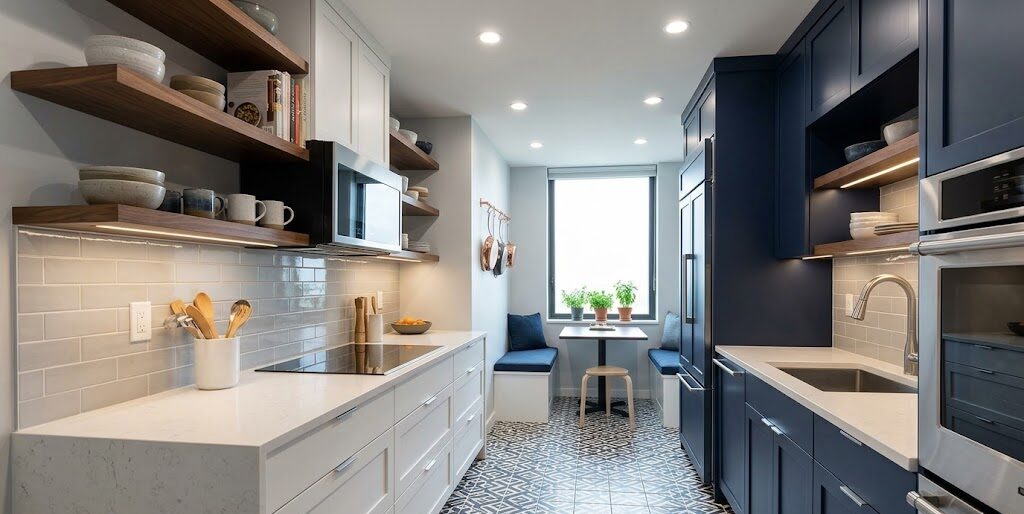
Galley kitchen remodel ideas: storage, light, and traffic flow
Galley Kitchen Remodel Ideas: Storage, Light, and Traffic Flow
Galley kitchens get a bad reputation because they can feel tight, dark, and “always in the way.” But the truth is: a galley layout can be one of the most efficient kitchens you can own—when it’s planned intentionally.
This homeowner-friendly guide breaks down galley kitchen remodel ideas that improve:
- Storage (without making the space feel narrower)
- Light (natural and layered lighting that makes the room feel bigger)
- Traffic flow (so the kitchen stops feeling like a hallway)
Helpful internal pages while you plan:
- Kitchen Remodeling in Utah: Built to Last
- Design and Layouts for Kitchens
- Kitchen Remodel Planning Checklist for Utah Homeowners
- Work Triangle vs. Work Zones
- Pantry Design Ideas
- Built-In Appliances Planning
- Kitchen Lighting & Electrical Designed for Real Life
- Cabinets and Countertops
- Durable Kitchen Flooring & Surfaces
- Kitchen Remodel Portfolio in Utah
- Request a Design Consult
Why galley kitchens feel hard (and why the layout can actually be a strength)
A galley kitchen is essentially two parallel runs (or one run plus a wall) with a walkway between them. The layout can feel cramped when:
- the walkway is too narrow for two people,
- upper cabinets block light,
- appliances create bottlenecks,
- and storage is shallow or poorly zoned.
But when planned well, galley kitchens shine because they reduce steps. Your prep zone, cook zone, and clean-up zone can sit within a few feet—meaning the kitchen works like a compact workshop. The goal of a remodel is to keep the efficiency while fixing the stress points.
Homeowner takeaway: Most galley kitchen frustrations aren’t “galley problems.” They’re clearance, storage zoning, and lighting problems—and those are fixable.
Start here: clarify goals, budget, and what you’re really trying to fix
Before you move walls or order cabinets, get specific about what isn’t working today. In galley kitchens, “feels tight” can mean multiple different issues.
Common galley pain points (choose your top 3)
- Traffic conflicts: people passing through while someone cooks
- Not enough prep counter: especially near sink or cooktop
- Storage overload: small cabinets, awkward corners, no pantry strategy
- Darkness: not enough lighting layers or blocked natural light
- Appliance bottlenecks: fridge or dishwasher doors blocking the walkway
- Bad workflow: prep-to-cook-to-clean requires crossing the aisle repeatedly
If you want a structured way to define scope before design decisions, use the Kitchen Remodel Planning Checklist.
Galley kitchen layout options: which direction fits your home?
Most galley remodels fall into one of these planning paths. Your best option depends on the adjacent rooms, load-bearing walls, and how your household uses the kitchen.
Option 1: Keep the galley, improve the zones
This is often the best value option. You keep the core footprint but upgrade storage, lighting, and appliance placement to remove friction.
Option 2: “Open one side” (partial open concept)
Removing a portion of one wall (or replacing uppers with open shelving) can dramatically improve light and perceived space. If wall changes are involved, confirm structural requirements with qualified professionals and local authorities.
Option 3: Convert to an L-shape or U-shape (when feasible)
If there’s an opportunity to expand into an adjacent space (dining room, oversized pantry, etc.), you may be able to change the layout entirely. This can improve storage and prep space but increases scope and coordination.
Quick decision filter: If your galley already has decent perimeter space but feels “tight,” you likely need better clearances and appliance planning, not a full layout conversion.
Traffic flow: the measurement that determines whether a galley kitchen feels good
Traffic flow is the defining constraint in a galley kitchen. You’re balancing two needs:
- Enough aisle space for people to pass (and for appliance doors)
- Enough counter/cabinet depth to make storage and prep functional
What to check in your current kitchen
- Width of the main aisle (cabinet face to cabinet face)
- Where the fridge door swings (does it block the aisle?)
- Dishwasher door clearance (can someone pass while it’s open?)
- Oven door clearance (does it block the whole path?)
- Entry points (how many ways do people enter/exit?)
If you need help measuring for a remodel plan, reference: Kitchen Layout Measurement Guide: How to Measure for Design and Quotes.
Storage ideas that work in galley kitchens (without making it feel narrower)
In a galley kitchen, storage has to be strategic. The best upgrades usually don’t add “more cabinets.” They add better storage per inch.
1) Prioritize deep, usable storage where it matters
- Drawer bases for pots, pans, dishes, and prep tools
- Pull-out trash/recycling near the sink or prep zone
- Tray storage near ovens (baking sheets, cutting boards)
2) Use vertical space intentionally (not just more uppers)
Upper cabinets are useful, but too many can make a galley feel boxed in. A better approach is to blend:
- select upper cabinets where needed,
- open shelving in small doses (for lightness),
- and a focused pantry strategy.
3) Build a real pantry plan
In a galley kitchen, pantry planning often solves half the clutter. Compare options here: Pantry Design Ideas: Walk-In vs. Cabinet Pantry vs. Butler’s Pantry.
4) Consider appliance garages / small appliance zones
Toaster, blender, coffee gear—these items can destroy counter space. A small appliance zone with outlets inside a cabinet (planned correctly) can keep counters clear.
For cabinet planning and durability considerations, see: Cabinets and Countertops.
Light: how to make a galley kitchen feel bigger without changing the footprint
Galley kitchens often feel smaller than they are because they’re under-lit. The fix is usually a combination of layout decisions plus layered lighting.
1) Reduce “upper cabinet canyon” effect
If both sides are lined with uppers, consider:
- removing uppers on one side (in select areas),
- shorter uppers with a lighter finish,
- or adding glass-front uppers strategically.
2) Add under-cabinet lighting (one of the highest-ROI upgrades)
Under-cabinet lighting improves function and makes counters feel more open. If you’re planning lighting and power changes, use: Under-Cabinet Lighting Done Right: Bright Counters Without Glare.
3) Use three lighting layers
- Ambient: overall room lighting
- Task: prep lighting where you actually chop and cook
- Accent: adds warmth and reduces “tunnel” feeling
More on planning: Kitchen Lighting & Electrical Designed for Real Life.
4) Choose reflective, forgiving finishes
In a narrow space, light bounces matter. Countertops, backsplash materials, and paint sheen can change perceived brightness. If you’re choosing countertops for durability and maintenance, see: Quartz vs. Granite vs. Porcelain Countertops.
Appliance planning: the fastest way to fix bottlenecks in a galley kitchen
In a galley layout, appliances can turn the aisle into a dead end. The most common culprits are:
- fridges placed in the “center of traffic,”
- dishwashers that block the only walkway,
- range/oven doors that collide with opposite cabinets.
Plan appliances early
Even if you don’t know exact models yet, decide the appliance “size class” (30 vs 36 range, counter-depth vs standard fridge, etc.) before cabinet ordering. Related planning guide: Built-In Appliances: Layout Tips for Fridges, Wall Ovens, and Microwaves.
Ventilation matters in narrow kitchens
In smaller, tighter kitchens, effective ventilation can noticeably improve comfort. If you’re choosing a hood system, see: Range Hood CFM Sizing: How to Choose Ventilation That Works.
Work zones: how to keep the galley from becoming a hallway
Galley kitchens often fail when they become the main route from one room to another. The goal is to protect your work zones so you can cook without constant collisions.
Use “work zones” thinking
Instead of forcing the classic triangle, set up zones that match how you actually cook. Learn the difference here: Work Triangle vs. Work Zones.
Zone checklist for galley kitchens
- Prep zone: counter space + knives + boards + trash nearby
- Cooking zone: cooktop/range + utensils + spices + pans
- Clean-up zone: sink + dishwasher + dish storage nearby
- Pantry zone: food storage + small appliances
Rule of thumb: avoid placing the fridge where it forces every snack run through the main cook/prep aisle.
Materials and finishes: what holds up best in a high-traffic galley kitchen
Galley kitchens see a lot of movement. Durable finishes reduce maintenance stress.
Flooring that survives real life
Choose flooring that handles spills, traffic, and easy cleaning. Related guide: Durable Kitchen Flooring for Utah Homes: Tile, LVP, Hardwood, and More.
Countertops and edges
In narrow kitchens, counters take a beating. Compare durability and maintenance in: Quartz vs. Granite vs. Porcelain Countertops.
Cabinet hardware consistency
Small kitchens show details more. Consistent hardware placement can make cabinetry look intentional. See: Cabinet Hardware Placement: Heights, Spacing, and Pro-Level Consistency.
Decision tips: what to lock before ordering cabinets and appliances
Galley kitchens punish late changes because everything is tightly coordinated. Before ordering, lock:
- Appliance widths and door swings (at least size class)
- Sink size and location
- Dishwasher placement and clearance
- Cabinet depths (standard vs deeper bases)
- Lighting plan (ambient + task + under-cabinet)
- Ventilation plan (if range changes)
If you only do one thing: get a written layout plan that includes appliance sizes, aisle clearances, and storage zones. That’s how you prevent the “it looked fine on paper” regret.
Conclusion: a galley kitchen can feel premium when the plan is disciplined
Galley kitchens don’t need to be tight, dark corridors. With the right plan, they become efficient, bright kitchens that support real routines. Focus your remodel energy on the three levers that move the needle most:
- Storage that actually fits your habits (zones, drawers, pantry strategy)
- Light that makes the space feel open (layers + under-cabinet lighting)
- Traffic flow that protects the work zone (clearances + appliance planning)
Want a second set of eyes on your galley kitchen plan?
If you’re planning a galley kitchen remodel in Davis or Weber County, Fortress Builders can help you confirm clearances, tighten your work zones, and create a layout that looks great—and functions better every day.
Request a Design Consult Explore Kitchen Remodeling View Kitchen Portfolio
Before you start demo or order cabinets, run through the Kitchen Remodel Planning Checklist.