

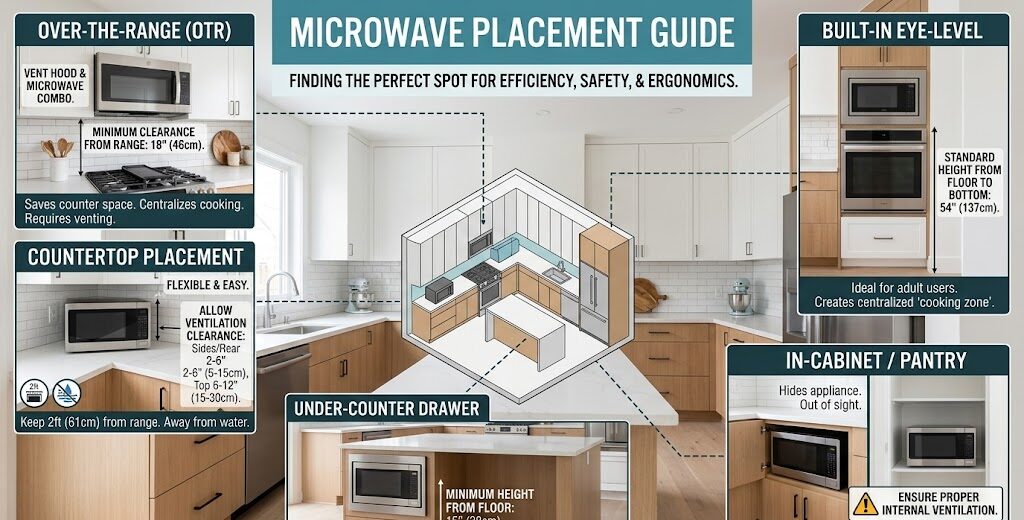
Microwave Placement Guide: Drawer, Built-In, or Over-the-Range?
Microwave placement seems small—until you live with it every day.
In a kitchen remodel, the microwave is one of those “always used” items that quietly affects workflow, safety, counter space, and the way your cabinetry functions. Put it in the wrong spot and you’ll feel it: awkward reaching, blocked walkways, steam/grease buildup, lost storage, or kids who can’t use it safely.
In this homeowner-friendly microwave placement guide, you’ll learn:
- the real tradeoffs between a microwave drawer, a built-in microwave, and an over-the-range microwave,
- how placement changes your kitchen workflow (prep, cooking, dishes, snacks),
- what to check for clearance, ventilation, and electrical requirements (without guessing),
- common planning mistakes that cause frustration after install,
- and a practical checklist to lock decisions before ordering cabinets and appliances.
The Fortress Builders is a Utah design–build company built on “strength through structure.” Every project starts with a detailed design blueprint that aligns vision, budget, and timeline—so decisions like appliance placement get locked early (before cabinets are ordered and change orders get expensive).
Helpful internal pages while you plan:
Why microwave placement matters more than you think
Most microwave conversations start with aesthetics (“I don’t want it on the counter”). The better conversation starts with daily behavior:
- Who uses it most? Kids reheating snacks? Adults doing quick lunches? A household that uses it occasionally?
- When is it used? Breakfast rush, after-school snacks, dinner prep, late-night reheats.
- What’s the traffic pattern? Does your snack path cut through the cook zone?
- How much counter space do you need? If counter space is tight, “getting the microwave off the counter” can be a real win.
Homeowner takeaway: The best microwave placement is the one that supports your household’s real workflow—not the one that looks best on Pinterest.
First decision: What role does the microwave play in your kitchen?
Before you choose drawer vs built-in vs over-the-range, decide what the microwave is for in your home. Most households fall into one of these buckets:
1) Snack station microwave (high-use, kid-heavy)
Microwave is used multiple times per day for snacks, quick meals, oatmeal, leftovers, and simple cooking.
Design goal: keep it out of the cook aisle so kids don’t cross behind someone at the range.
2) Prep-support microwave (medium-use, adult-heavy)
Microwave is used for softening butter, steaming vegetables, reheating coffee, quick defrosting.
Design goal: place it near a landing zone with space to set hot items down.
3) Occasional-use microwave (low-use, “hide it” priority)
Microwave is used but not central. The household cares more about clean lines and storage.
Design goal: hide it without creating awkward reach or unsafe height.
Quick self-check: In your current kitchen, where do people stand when using the microwave, and what are they usually doing right after (grab snack, stir, carry to table, reheat and plate)? That “next step” tells you the best zone.
Microwave placement options at a glance
Most remodels choose one of these main approaches:
- Microwave drawer (base cabinet / island / perimeter base)
- Built-in microwave (in a tall cabinet, appliance wall, or cabinet niche)
- Over-the-range microwave (mounted above the range, often with a vent fan)
- Concealed options (appliance garage, pantry/butler’s pantry, or behind a pocket door)
- Countertop microwave (valid in some homes, but usually a space tradeoff)
Option 1: Microwave drawer (pros, cons, and best use cases)
Microwave drawers are popular because they can be placed in a base cabinet (including islands) and keep sightlines clean. They also place hot items lower—which can be safer than overhead microwaves for many households.
Pros of a microwave drawer
- Accessible for kids and shorter adults (when placed thoughtfully).
- Safer hot-item handling: you’re typically lifting up and out rather than down from above shoulder height.
- Great for snack stations: can be located away from the cook zone.
- Clean look: no appliance sitting on the counter.
Cons of a microwave drawer
- Uses base cabinet real estate (you lose drawers/storage where it sits).
- Potential traffic conflict if placed in the main work aisle or right next to the dishwasher.
- Bending/stooping can be annoying for some users (especially if it’s used constantly).
- Cost can be higher than basic countertop or over-the-range units.
Best placements for a microwave drawer
- Snack zone (often near pantry storage but not in the cook aisle).
- Island end where traffic is lighter and there’s a landing zone nearby.
- Perimeter base cabinet near a prep counter (if you have enough aisle width).
Drawer microwave rule: It should be easy to use without blocking the main walkway. If “microwave open” stops someone from walking through the kitchen, it will feel annoying fast.
Option 2: Built-in microwave (tall cabinet or appliance wall)
A built-in microwave can mean a microwave in a cabinet niche, a tall cabinet, or integrated into an appliance wall (sometimes alongside a wall oven). This is often chosen for clean lines and ergonomic placement.
Pros of a built-in microwave
- Ergonomics: can be placed at a comfortable height (no bending).
- Clean design: integrates well into an appliance wall.
- More base storage preserved compared to a drawer microwave.
- Pairs well with “work zones” if placed near the right counter.
Cons of a built-in microwave
- Height mistakes can be unsafe (hot soup at chest/face height is not fun).
- Can create a traffic pinch point if placed in a narrow pass-through.
- Cabinetry must be designed for the exact appliance (dimensions, trim kits if needed, ventilation clearances).
Where built-in microwaves work best
- Appliance wall with a nearby landing zone for hot dishes.
- Near a prep zone if you microwave as part of cooking frequently.
- Butler’s pantry or secondary kitchen space when you want a cleaner main kitchen (verify power/ventilation and workflow).
Related planning resource: Built-In Appliances: Layout Tips for Fridges, Wall Ovens, and Microwaves.
Option 3: Over-the-range microwave (when it works—and when it doesn’t)
Over-the-range microwaves are common because they save counter space and combine two functions (microwave + vent fan). They can be a good budget and space solution, but there are real tradeoffs.
Pros of over-the-range microwaves
- Saves counter space without sacrificing base cabinet storage.
- Often cost-effective compared to built-in solutions (depending on model).
- Simple placement logic in many standard kitchens.
Cons of over-the-range microwaves
- Ergonomics and safety: lifting hot liquids down from above can be risky, especially for kids or shorter adults.
- Ventilation performance varies: some units are not ideal as your primary range ventilation solution.
- Grease and steam: the microwave surface is in the splash/steam zone of cooking.
- Not always compatible with your cooking goals, especially if you’re investing in better ventilation.
If ventilation is a major part of your remodel plan, start with: Kitchen Appliances & Ventilation Upgrades and consider reading: Range Hood CFM Sizing.
Over-the-range reality check: If you cook often, care about quiet ventilation, or want premium performance, you may prefer a dedicated hood and put the microwave elsewhere.
The “hidden microwave” approach: pantry, appliance garage, or cabinet niche
Many homeowners want the microwave out of sight. You can achieve that in a few ways, but the details matter.
Common “hidden” placements
- Appliance garage (counter-height cabinet with a door).
- Butler’s pantry (secondary prep zone).
- Cabinet niche with ventilation and correct clearance.
What you must verify (non-negotiables)
- Manufacturer clearance requirements for the exact microwave model.
- Electrical requirements and outlet placement (avoid cords running awkwardly across surfaces).
- Ventilation and heat management (especially inside enclosed cabinetry).
- Door interference: a cabinet door that blocks the unit or forces awkward reaching defeats the purpose.
Microwave placement by kitchen workflow: where it belongs in the “zones” model
If you use a work-zones approach (prep, cooking, cleaning, pantry, serving), the microwave typically belongs in one of these zones depending on your household:
Snack / pantry zone (best for families with kids)
- Microwave placed near pantry storage and a small counter landing zone.
- Keeps kids out of the cook aisle during dinner prep.
- Works well with a drawer microwave or a built-in niche.
Prep zone (best for frequent cooking)
- Microwave near the main prep counter for steaming/softening/quick heating.
- Must not block the prep aisle when in use.
Secondary kitchen / butler’s pantry zone (best for clean sightlines)
- Moves clutter and reheating out of the main kitchen.
- Requires enough counter space and a workflow that still feels convenient.
Helpful foundation if you haven’t set zones yet: Work Triangle vs. Work Zones.
Clearances, door swings, and “microwave conflicts” to avoid
Microwave mistakes tend to show up as conflicts with other doors and walkways.
Before you finalize placement, check these conflicts:
- Microwave vs. dishwasher: Can someone pass when both are open/being used?
- Microwave vs. fridge: Does microwave use block the fridge “grocery landing” path?
- Microwave vs. seating: Are stools or chairs in the way (especially on islands)?
- Microwave vs. main walkway: Does use block the route to the backyard, hallway, or mudroom?
- Hot landing zone: Is there counter space to set a hot bowl or plate immediately?
If you’re auditing the entire kitchen for pinch points, see: Kitchen Door and Walkway Clearances: Avoiding Pinch Points.
Ventilation and electrical notes (don’t guess—verify)
Microwaves are appliances with specific installation requirements. These details vary by model and by jurisdiction, so your plan should treat them as “verify and document” items, not assumptions.
Electrical
- Some microwaves require dedicated circuits; others share circuits depending on load and code requirements.
- Outlet placement should be planned so cords aren’t exposed or pinched.
- Any changes to wiring should be coordinated with qualified professionals.
Ventilation (especially over-the-range)
- Over-the-range microwaves may vent recirculating or externally depending on your setup.
- External venting usually requires duct planning (and sometimes permits/inspections) depending on scope.
- Ventilation performance expectations should be matched to your cooking habits.
Important note: Electrical, ventilation, and permit requirements can vary by location and project scope. Always follow manufacturer installation instructions and confirm requirements with qualified professionals and local authorities.
Budget and cabinet-order implications (why microwave decisions should be early)
Microwave placement affects cabinet design, electrical rough-ins, and sometimes ventilation routing. If you decide late, you risk:
- cabinet redesign (and potential reorder),
- moving outlets after drywall,
- awkward filler panels or reduced storage,
- or a “temporary placement” that becomes permanent.
This is why Fortress Builders emphasizes early planning and a locked layout before ordering. Start with: Kitchen Remodel Planning Checklist and Timeline and What to Expect.
Decision guide: which microwave placement is best for your household?
Choose a microwave drawer if…
- kids use the microwave often,
- you want a snack station away from the cook zone,
- you value clean counters,
- and you’re okay trading some base storage for better workflow.
Choose a built-in microwave if…
- you want comfortable height and an appliance wall look,
- you prefer keeping base drawers for storage,
- you have a good landing zone nearby,
- and you’re ready to design cabinetry around the exact unit.
Choose an over-the-range microwave if…
- counter space is tight and budget matters,
- the household can safely use a higher-mounted microwave,
- and your ventilation needs align with what the unit can deliver (or you’ve confirmed the vent plan).
Choose a “hidden microwave” solution if…
- you value clean sightlines and dislike appliance clutter,
- you have a pantry/butler’s pantry or appliance garage that truly supports daily use,
- and you will verify ventilation and clearance requirements for the exact unit.
Microwave Placement Checklist (use this before cabinet order):
- Workflow zone: Is it placed in the snack zone, prep zone, or secondary zone that matches how you live?
- Landing zone: Is there counter space immediately next to it for hot items?
- Traffic: Does microwave use block a main walkway?
- Door swings: Does it conflict with fridge/dishwasher/oven/pantry doors?
- Height safety: Can all intended users safely remove hot liquids?
- Storage impact: What drawers/cabinets are you giving up?
- Electrical: Is outlet/circuit planning aligned with the chosen unit?
- Ventilation: If OTR, is the vent plan correct and code-compliant for your jurisdiction?
- Spec check: Have you reviewed the manufacturer install guide for clearance requirements?
Common microwave placement mistakes (and how to avoid them)
Mistake 1: Putting the microwave in the cook aisle “because it fits”
If kids use it, they’ll cross behind the cook. Even adults will add traffic at the worst times.
Fix: Put it in a snack/pantry zone or away from the range when possible.
Mistake 2: No landing space
Hot bowls need a place to land. Without it, spills and awkward handling increase.
Fix: Ensure a counter surface is adjacent to the microwave opening direction.
Mistake 3: Choosing “hidden” without ventilation planning
A cabinet microwave can overheat or perform poorly if the installation isn’t designed correctly.
Fix: Follow manufacturer requirements and confirm with qualified pros.
Mistake 4: Over-the-range microwave as a “default” when ventilation is a priority
If you’re investing in a better cooking experience, your ventilation plan should lead the decision.
Fix: Start with hood/vent requirements, then place the microwave elsewhere if needed.
Want a second set of eyes on your kitchen appliance plan before you commit?
Microwave placement is one of those “small” decisions that affects daily comfort for years. If you’re planning a kitchen remodel in Davis or Weber County, Fortress Builders can help you lock the right placement early—so cabinetry, electrical, and workflow all align before ordering materials or starting demo.
Request a Design Consult Explore Kitchen Remodeling Built-In Appliances Planning
Bring your appliance list (or links), a rough floor plan, and how your family uses the kitchen day-to-day. We’ll help you plan a microwave placement that fits your workflow—not just your cabinets.