

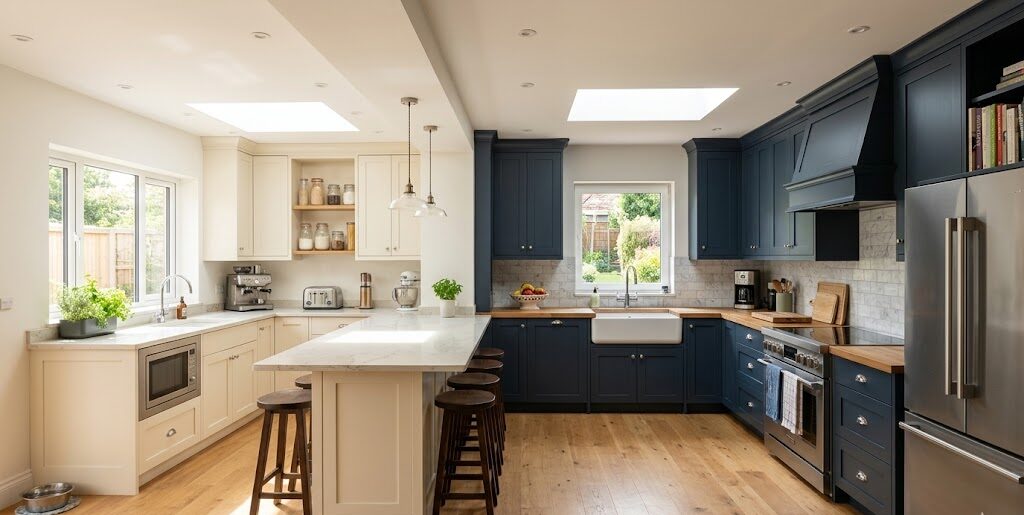
L-shaped vs. U-shaped kitchen layout: pros, cons, and best fit
L-Shaped vs. U-Shaped Kitchens: Pros, Cons, and Best Fit
Choosing a kitchen layout isn’t a “design trend” decision—it’s a daily-life decision. Your layout determines how easily you cook, how often the kitchen feels crowded, where storage lands, and whether your remodel solves the real problems (or just looks nicer).
In this guide, we’ll compare the two most common “workhorse” layouts—L-shaped and U-shaped—and help you decide which is the best fit based on:
- Traffic flow and how people move through the space
- Work zones (prep, cooking, cleanup, pantry)
- Storage and counter space
- Seating (islands vs. peninsulas)
- Clearances and appliance door swings
Helpful internal pages while you plan:
- Kitchen Remodeling in Utah: Built to Last
- Design and Layouts for Kitchens
- Kitchen Remodel Planning Checklist for Utah Homeowners
- Work Triangle vs. Work Zones
- Kitchen Island Size Guide: Clearances, Seating, and Storage
- Built-In Appliances Planning
- Cabinets and Countertops
- Kitchen Lighting & Electrical Designed for Real Life
- Kitchen Appliances & Ventilation Upgrades
- Kitchen Remodel Portfolio in Utah
- Request a Design Consult
The “best” kitchen layout is the one that matches your routines
If you’ve ever toured a beautiful kitchen that still felt awkward, you already know this truth: layout is function first. The right layout depends on how your household actually uses the kitchen, including:
- how many people cook at the same time,
- whether the kitchen is a pass-through to other rooms,
- how often you host,
- and whether you need seating (island/peninsula) or pure work space.
If you want a structured way to define scope before comparing layouts, start with: Kitchen Remodel Planning Checklist for Utah Homeowners.
Quick definitions (so we’re talking about the same thing)
What is an L-shaped kitchen?
An L-shaped kitchen uses two adjacent walls (or two runs) to form an “L.” It often works well in open layouts because it leaves one side open to a dining or living area—making it easier to add an island or keep traffic flowing.
What is a U-shaped kitchen?
A U-shaped kitchen uses three connected runs (three sides of the “U”). It typically delivers more counter space and storage than an L-shape, and it can create a strong, contained work zone—when the clearances are right.
Homeowner takeaway: L-shapes usually win on openness and traffic flow. U-shapes usually win on storage and counter space. The “best fit” depends on clearances, appliance planning, and whether you need seating.
L-shaped kitchens: where they shine (and where they fall short)
Pros of an L-shaped kitchen
- Great for open-concept spaces: keeps the kitchen connected to adjacent rooms.
- Flexible seating options: often allows an island (or a peninsula in tighter homes).
- Good traffic flow: people can pass through without walking directly through the main work zone (if planned well).
- Efficient for one cook: easy to set up prep-cook-clean zones with short steps.
Cons of an L-shaped kitchen
- Can lack continuous counter space: depending on window/door placements.
- Corner storage challenges: corners can become “dead space” without smart solutions.
- Less total storage than U-shaped: fewer base cabinets overall in many footprints.
Best fit scenarios for an L-shape
- You want an island and have room for clearances.
- Your kitchen is part of the main social space (family room/dining room nearby).
- The kitchen is a common “pass-through” and you need flow more than extra cabinetry.
If an island is in play, use this before committing: Kitchen Island Size Guide: Clearances, Seating, and Storage.
U-shaped kitchens: where they shine (and where they fall short)
Pros of a U-shaped kitchen
- Maximum counter space: ideal if you cook often and want lots of prep area.
- Strong storage capacity: more base cabinet and upper cabinet opportunities.
- Defined work zone: can feel like a “chef’s workspace” that stays organized.
- Great for multiple zones: prep on one leg, cooking on another, cleanup on the third.
Cons of a U-shaped kitchen
- Clearance-dependent: if the aisle is too tight, it feels cramped fast.
- Can feel closed off: especially if uppers wrap all three sides.
- Traffic conflicts: if the kitchen is a pass-through, people end up crossing the work zone.
Best fit scenarios for a U-shape
- You cook frequently and want more counter and storage than an L-shape can provide.
- Your kitchen isn’t the main traffic hallway of the home.
- You want a strong “work triangle” or “work zones” layout within a contained footprint.
For zoning vs triangle thinking, see: Work Triangle vs. Work Zones.
Traffic flow: the deal-breaker in both layouts
Here’s the most common remodel regret: choosing a layout that looks great on paper but feels crowded because doors, drawers, and people collide.
Traffic questions to answer before choosing L vs U
- Does anyone need to walk through the kitchen to reach a main room (garage entry, backyard door, hallway)?
- How many people are typically in the kitchen during peak moments (morning, dinner, hosting)?
- Do you want the cook to be in the conversation (open layout), or do you prefer a more contained workspace?
Simple rule: If your kitchen is a major pass-through, an L-shape (or an L with a peninsula) often feels better than a deep U that blocks circulation.
Work zones: how to compare layouts using real routines
To compare L-shaped vs U-shaped kitchens, don’t start with aesthetics. Start with zones:
The four zones to plan (even in small kitchens)
- Prep zone: primary counter space + knives, boards, trash nearby
- Cooking zone: range/cooktop + utensils, oils/spices, pans
- Cleanup zone: sink + dishwasher + dish storage
- Pantry zone: food storage + small appliances
Related planning guide: Pantry Design Ideas: Walk-In vs. Cabinet Pantry vs. Butler’s Pantry.
How L-shaped kitchens typically zone best
- Prep and cleanup share one leg (sink centered).
- Cooking occupies the other leg (range with landing space).
- Pantry/fridge live near the “entry” so snacks don’t cross the cook zone.
How U-shaped kitchens typically zone best
- Prep on one leg, cooking on the second, cleanup on the third.
- Pantry can anchor an end, keeping storage close but out of the main aisle.
Storage and corners: the “hidden math” of layout choice
U-shapes usually win on raw storage volume. But storage only helps if it’s usable.
Corner cabinet reality
Both layouts can create corner challenges. In U-shaped kitchens, corners are almost guaranteed. In L-shaped kitchens, you often have one major corner.
To keep corners from becoming wasted space, plan:
- drawer-heavy base cabinets,
- purpose-built corner solutions,
- and cabinet interiors that match your storage habits.
Cabinet planning resource: Cabinets and Countertops.
Seating decisions: island vs peninsula (and why it changes the layout choice)
If you want seating, your layout choice narrows quickly. Many homes can support:
- L-shape + island (best if there’s room), or
- U-shape + peninsula (when an island would crowd the aisle).
Before committing, compare clearances and seating counts with: Kitchen Island Size Guide.
Homeowner takeaway: If your kitchen is medium-to-small and you must have seating, a peninsula often “fits” better than forcing an island into an aisle that can’t support it.
Appliance planning: door swings and clearances decide comfort
Appliances can make or break both layouts. The biggest offenders are fridges and dishwashers—because their doors block the aisle.
What to lock early
- Fridge type: counter-depth vs standard depth
- Fridge placement: does it interrupt the main work zone?
- Dishwasher placement: can someone pass when it’s open?
- Range location: is there landing space on both sides?
Planning guide: Built-In Appliances: Layout Tips for Fridges, Wall Ovens, and Microwaves.
Ventilation and layout go together
If your remodel changes the cooking location, confirm ventilation early (ducting and make-up air requirements can vary). Related reads:
- Range Hood CFM Sizing: How to Choose Ventilation That Works
- Make-Up Air in a Kitchen Remodel: What It Is and When You Need It
Note: ventilation, make-up air, electrical, and permit requirements can vary—confirm details with qualified professionals and local authorities.
Lighting and electrical: avoid the “beautiful but dim” kitchen
Both L and U layouts can suffer from shadowy counters if lighting isn’t planned in layers. A good layout still needs:
- ambient lighting (overall),
- task lighting (prep/cook zones),
- under-cabinet lighting (the most noticeable upgrade for function).
Planning page: Kitchen Lighting & Electrical Designed for Real Life.
How-to resource: Under-Cabinet Lighting Done Right: Bright Counters Without Glare.
Comparison cheat sheet: which layout is best for you?
Choose an L-shaped kitchen if:
- your kitchen needs to stay open to adjacent rooms,
- traffic flow matters more than maximum storage,
- you want an island (and can support clearances),
- your household cooks socially and wants connection.
Choose a U-shaped kitchen if:
- you want maximum counter space and storage,
- your kitchen isn’t a major pass-through,
- you prefer a defined work zone,
- a peninsula fits better than an island in your footprint.
What to lock before ordering cabinets and starting demo
Whether you choose L or U, late changes are where budgets and timelines get painful—especially after cabinets are ordered.
Before ordering cabinets, lock:
- Appliance sizes + door swings (especially fridge/dishwasher)
- Sink size + placement
- Cooktop/range placement + ventilation plan
- Island or peninsula dimensions (if any)
- Work zones (prep/cook/cleanup/pantry)
- Lighting plan + outlet locations
Pro move: do a “tape-on-the-floor walkthrough” using your planned island/peninsula outline and appliance door arcs. If it feels tight during a pretend walkthrough, it will feel worse in real life.
Conclusion: choose the layout that reduces daily friction
An L-shaped kitchen and a U-shaped kitchen can both be excellent. The difference is whether the layout matches your home’s traffic patterns and your daily routines.
When in doubt, choose the layout that gives you:
- clear, protected work zones,
- appliance clearances that don’t create bottlenecks,
- storage that fits your habits,
- and lighting that makes the kitchen comfortable to live in.
Want a second set of eyes on your kitchen layout?
If you’re remodeling in Davis or Weber County, Fortress Builders can help you compare layout options, validate clearances, and build a plan that works before you order cabinets or start demo.
Request a Design Consult Explore Kitchen Remodeling View Kitchen Portfolio
To prep for a consult, run through: Kitchen Remodel Planning Checklist.