

Dishwasher Placement Rules: Clearances, Door Swings, and Loading Flow
A well-planned kitchen remodel saves time, money, and daily frustration—and dishwasher placement is one of those details that seems minor until it interrupts the way the kitchen works every single day.
Many homeowners focus first on cabinets, countertops, appliances, and finishes, which makes sense. But the dishwasher is one of the most frequently used appliances in the room, and where it sits affects unloading, cleanup, sink access, traffic flow, cabinet drawers, and whether two people can use the kitchen comfortably at the same time.
This guide explains dishwasher placement rules in plain English so homeowners can make the decision before it creates awkward door conflicts or inefficient cleanup flow. You will learn how to choose placement based on how your household cooks and hosts, what to confirm about clearances and door swings, what utility planning matters early, and why these details should be coordinated before cabinet ordering and demo begin.
The Fortress Builders approaches remodeling through one core principle: strength through structure. Every kitchen project starts with a design blueprint that aligns client goals, layout decisions, utility planning, and build sequence before materials are ordered. That structure is what turns dishwasher placement from an afterthought into a smooth part of the kitchen’s everyday rhythm.
- How dishwasher placement rules affect cleanup flow and kitchen comfort
- What to confirm about sink relationship, drawer access, and unloading ergonomics
- How open dishwasher doors affect traffic paths and nearby appliances
- What utility planning matters for power, water, and drainage
- Why dishwasher location should be locked before cabinet release and demo
Why dishwasher placement matters more than many homeowners expect
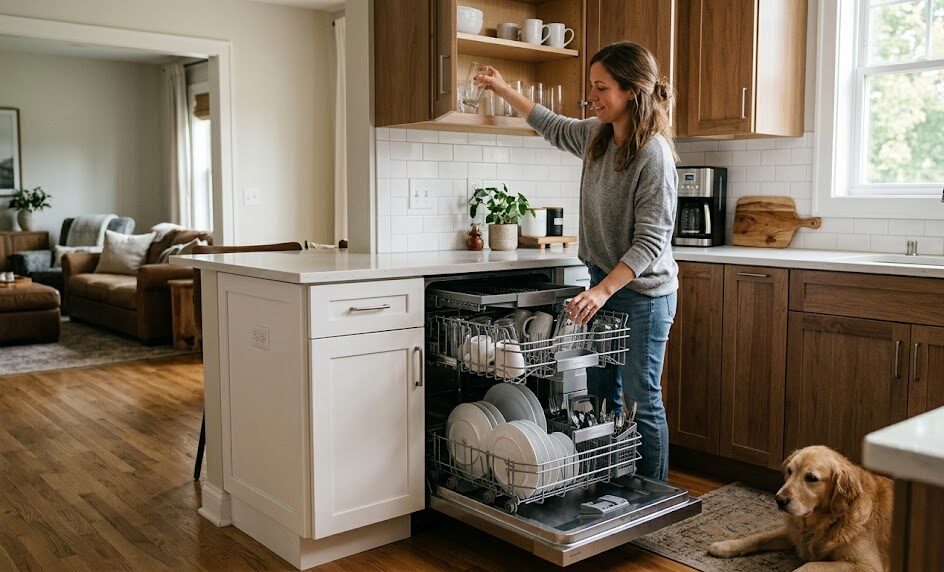
Because the dishwasher is so familiar, it is easy to assume its location will simply “work itself out” near the sink. But a dishwasher is not just another base cabinet appliance opening. When the door is open, it changes the room. It affects walking space, where people can stand, how dishes get scraped and loaded, whether lower cabinets remain accessible, and how smoothly the cleanup zone functions during busy moments.
That makes placement important not just for code-aware installation, but for real daily convenience. A dishwasher in the wrong place may still technically work, but it can create small frustrations over and over again—especially in tight kitchens, busy family homes, or layouts where multiple people cook and clean at the same time.
Cleanup Efficiency
The closer the dishwasher is to the right sink and prep zone relationship, the easier it usually is to scrape, rinse, and load dishes smoothly.
Door Interference
An open dishwasher can block walkways, trap another person at the sink, or conflict with nearby drawers and appliances.
Unloading Convenience
Dishwasher placement affects how easily dishes return to drawers, upper cabinets, and nearby storage without crossing the room repeatedly.
Traffic Flow
In active kitchens, dishwasher location can either support the flow of the room or become a repeated bottleneck.
Cabinet Planning
The appliance opening influences surrounding drawer stacks, sink-base design, and how adjacent storage is used daily.
Utility Coordination
Power, water, drainage, and hose routing all become easier when the dishwasher is placed intentionally from the start.
Choose the location based on how your household actually cleans up
The cleanest way to evaluate dishwasher placement is to start with behavior. How the household cooks, clears, rinses, and unloads dishes matters far more than generic rules in isolation. In some homes, one person handles most cleanup. In others, multiple family members are loading and unloading throughout the day. Some homes entertain frequently and generate large cleanup surges. Others mostly need a dishwasher zone that quietly supports daily meals without disrupting the prep area.
Who loads the dishwasher most often?
If one person primarily handles cleanup, the layout should support that person’s typical routine. If several people unload dishes regularly, cabinet proximity and aisle space become even more important.
How does the household deal with dishes before loading?
Some homes rinse heavily. Others scrape and load directly. Some households stack dishes near the sink before loading. Those habits affect how close the dishwasher should be to the sink and whether the kitchen has enough standing room for both tasks to happen comfortably.
What happens during busy cooking or hosting moments?
Holiday meals, dinner parties, and large family dinners are often when weak dishwasher placement becomes obvious. The best location is the one that still works when the kitchen is under pressure.
Picture the end of your busiest dinner. Where are plates scraped, where are glasses set down, who is at the sink, and who is opening the dishwasher? The best placement usually becomes clearer when you follow that sequence honestly.
| Household Cleanup Pattern | What It Often Suggests |
|---|---|
| One-Person Cleanup | Usually works best when sink, trash, and dishwasher are tightly coordinated in one efficient zone |
| Multi-Person Cleanup | Often benefits from more aisle space and fewer conflicts between the open dishwasher and active sink use |
| Frequent Hosting | Usually demands stronger loading flow and less interruption to walkways during big cleanup moments |
| Daily Family Traffic | Often needs a dishwasher location that does not cut off major kitchen paths when the door is open |
From your approved interlink set, the most relevant supporting pages here are Work Triangle vs. Work Zones, Design and Layouts for Kitchens, and Kitchen Island Size Guide.
Clearances, door swings, and why “it fits” is not the same as “it works”
A dishwasher opening can look perfectly acceptable on a cabinet plan and still create real irritation in the finished kitchen. That is because the appliance footprint changes dramatically once the door is open. Now the room has a lowered obstacle, a person standing in front of it, and usually another person or task nearby at the sink or cleanup zone. This is where dishwasher placement rules stop being theoretical and become about actual usability.
Open-door clearance matters
The kitchen needs enough room for the dishwasher door to open without blocking the entire path behind it or trapping someone at the sink. This becomes especially important in galley kitchens, narrow aisles, and island layouts with tighter clearances.
Nearby drawers and cabinet doors still need to function
The dishwasher should not prevent adjacent drawers from opening conveniently or create awkward moments where two parts of the cleanup zone cannot be used at the same time.
Opposing appliances can create conflict
Refrigerators, oven doors, trash pullouts, and nearby pantry doors all need to be considered in relation to the dishwasher. A kitchen can feel surprisingly cramped once multiple doors are open, even if each appliance technically “fits.”
- Can the dishwasher door open fully without blocking the main walkway?
- Can someone still work at the sink when the dishwasher is open?
- Do nearby drawers, trash pullouts, and cabinet doors still open comfortably?
- Will the open dishwasher conflict with a refrigerator, oven, or pantry door nearby?
- Does the kitchen still feel navigable when cleanup is actively happening?
Approved interlinks from your shared set that help reinforce this section are Built-In Appliances Planning, Kitchen Island Size Guide, and Work Triangle vs. Work Zones.
Loading flow and unloading flow: the dishwasher should support both
Many homeowners think mostly about loading when choosing the dishwasher location, but unloading matters just as much. The best dishwasher placement supports the full cycle: scraping, loading, washing, unloading, and putting items away without unnecessary crossing and backtracking.
Loading should feel natural from the sink
Most dishwashers work best when they are located close enough to the main cleanup sink that dirty dishes can move from counter or sink edge into the machine without awkward turning or dripping across the floor.
Unloading should support nearby storage
If dishware, glasses, utensils, and cookware all live far from the dishwasher, every unload becomes more work than it needs to be. That does not always mean every cabinet must be directly adjacent, but the relationship should be considered intentionally.
Trash and dishwasher often work as a pair
Because scraping and sorting happen before loading, the relationship between trash pullout, sink, and dishwasher often shapes how smooth the whole zone feels.
After the dishwasher finishes a cycle, can someone unload plates, glasses, and utensils without crossing into the prep zone repeatedly or blocking the kitchen longer than necessary?
Loading Efficiency
Works best when the dishwasher is close enough to the cleanup sink to reduce awkward twisting and drips.
Unloading Efficiency
Improves when dish storage and utensil drawers are positioned thoughtfully in relation to the dishwasher.
Trash Coordination
Scraping dishes feels easier when the trash pullout is part of the same general cleanup zone.
Family Use
If multiple people help with unloading, placement should support shared use instead of forcing everyone into one tight corner.
From your approved interlinking set, useful related pages here are Pantry Design Ideas, Cabinets and Countertops, and Semi-Custom vs. Custom Cabinets.
Standard near-sink placement is common for a reason—but not always enough by itself
There is a reason dishwashers are so often installed directly next to the sink. For many kitchens, that is still the most practical solution. It keeps cleanup activities close together, simplifies utility runs, and supports a familiar workflow. But “next to the sink” is not a complete placement strategy by itself. Left side or right side can matter. The exact relation to the sink base, trash pullout, corner cabinets, and surrounding drawers can matter too.
Same-zone placement usually reduces steps
That is one reason it remains such a common rule of thumb. Dirty dishes move in one direction, and utility planning stays simpler.
Side selection can still affect convenience
Depending on handedness, dish flow, cabinet locations, and how the household stands at the sink, one side may feel noticeably more natural than the other.
Corner conditions deserve extra attention
When the sink or dishwasher sits near a corner, cabinet door conflicts and standing-room issues can become much more noticeable.
- the sink is the main cleanup sink, not just a prep sink
- the open dishwasher does not block the primary path through the kitchen
- nearby drawers and trash still function comfortably
- corner cabinets and sink-base access do not create conflict
- unloading supports where dishes actually live after washing
Plan utilities early: power, water, and drainage matter more when cabinets are involved
Dishwasher placement is often easiest to change on paper and much harder to change once rough-ins, cabinet ordering, and sink-base decisions are underway. That is why utilities deserve attention early. Even if the dishwasher seems straightforward, the location still depends on proper access to power, water supply, and drainage, as well as a clean routing strategy that supports the final cabinet layout.
Water supply and drain routing
The dishwasher usually benefits from being close enough to the sink base that water and drain connections can be handled cleanly. That does not mean there is only one acceptable layout, but it does mean the farther the appliance moves from the sink zone, the more intentional the plumbing plan needs to be.
Electrical coordination
Power still needs to be located appropriately for the final dishwasher opening and surrounding cabinet conditions. This should be coordinated early enough that the electrical plan supports the final layout instead of adapting to it late.
Cabinet and sink-base planning
Sink-base design, trash placement, and nearby drawer stacks all interact with the appliance and with the routing of its connections. That is why dishwasher planning belongs inside the broader kitchen blueprint rather than being treated as a single appliance choice.
| Utility Topic | Why It Matters |
|---|---|
| Water Supply | The dishwasher needs a clean, coordinated connection that works with the sink base and final cabinet plan |
| Drainage | Drain routing should support the layout without creating avoidable complexity later in the remodel |
| Electrical Placement | The final opening and cabinet arrangement should align with safe, planned power access |
| Cabinet Coordination | Dishwasher location affects the sink base, nearby drawers, trash pullouts, and lower-cabinet functionality |
Only using links from your approved interlink set, the most relevant support pages here are Kitchen Lighting & Electrical Designed for Real Life, Cabinets and Countertops, and Kitchen Remodel Planning Checklist.
Dishwasher placement also affects prep space and sink usability
Homeowners often think of the dishwasher only as part of cleanup, but its location also changes how the sink zone works while food prep is happening. In many kitchens, prep and cleanup overlap. Someone is washing produce while someone else is unloading the dishwasher. Someone is filling a pot while someone else is scraping plates. That is where layout decisions become real-life comfort issues.
Prep sink versus cleanup sink
If the kitchen has more than one sink, the dishwasher should usually be associated with the sink that handles the bulk of dish cleanup rather than being assigned by default to whichever sink is most visually convenient on the plan.
Sink access during open-door use
One of the most common frustrations in a poorly planned kitchen is a dishwasher that makes the main sink difficult to use whenever it is open. That issue often seems small until it happens several times a day.
Countertop landing and staging
Dish placement before and after washing depends on nearby counter support. If the sink zone lacks enough workable landing space, the dishwasher may feel harder to use efficiently no matter where it sits.
When the dishwasher is open and dishes are being loaded, can someone still use the main sink and nearby counter comfortably—or does the whole cleanup side of the kitchen stall?
Small kitchens, galley kitchens, and island kitchens each need different dishwasher thinking
Dishwasher placement rules are not one-size-fits-all because kitchen layouts are not one-size-fits-all. The same appliance location that works beautifully in a larger L-shaped kitchen may feel terrible in a narrow galley. Likewise, a dishwasher near an island may work well in one plan and block the room in another. The shape of the kitchen matters.
Small and narrow kitchens
These kitchens often need more discipline around open-door clearance and sink coordination because aisle width is limited and every obstruction matters more.
Island kitchens
When the dishwasher sits facing or adjacent to an island, the key question becomes whether the door cuts into the circulation path or crowds the main prep area when open.
Larger kitchens
Bigger kitchens can still have poor dishwasher placement if the appliance is too far from the cleanup sink or too disconnected from dish storage. More square footage does not automatically fix a weak cleanup zone.
Galley Kitchens
Need extra attention to aisle width and open-door interference because one appliance door can affect the whole room.
Island Kitchens
Should be checked carefully for how the dishwasher interacts with island seating, circulation, and prep activity.
L-Shaped Kitchens
Often work well when the cleanup zone is grouped intentionally and corner conflicts are resolved early.
Larger Open Kitchens
Still need good dishwasher-to-sink and dishwasher-to-storage relationships or cleanup can become more tiring than necessary.
Approved interlinks from your set that fit well here are Kitchen Island Size Guide, Work Triangle vs. Work Zones, and Design and Layouts for Kitchens.
Ordering timelines and why the dishwasher location should be locked early
One of the most common remodeling mistakes is letting dishwasher placement remain vague while sink-base details, drawer stacks, and utility rough-ins are already getting finalized. That is how avoidable layout problems happen. The best time to solve dishwasher placement is while the kitchen is still flexible enough to respond cleanly—not after cabinets are released or demolition is already moving.
Do not treat the dishwasher like a filler decision
Because it often sits near the sink, some plans treat it as the appliance that will simply go wherever space remains. That usually underestimates how much it affects the whole cleanup zone.
Coordinate the full cleanup wall or cleanup zone
Sink base, trash pullout, dishwasher, dish storage, and nearby counter landing should be treated as one functional composition rather than separate cabinet choices.
Lock appliance assumptions before cabinet release
Even if the dishwasher is a more standardized appliance than some others, the layout around it still needs to be finalized early enough that the cabinetry and utility planning actually support it.
- which sink is the main cleanup sink
- where the dishwasher sits in relation to trash, sink, and dish storage
- how the door behaves when open in the actual aisle width
- how nearby drawers, appliances, and cabinet doors function at the same time
- how water, drainage, and electrical planning support the final opening
From your approved interlink list, the strongest supporting pages here are Kitchen Remodel Planning Checklist, Cabinets and Countertops, and Built-In Appliances Planning.
Common dishwasher placement mistakes homeowners can avoid
Putting it near the sink without checking the open-door impact
Near-sink placement is often smart, but only if the door does not shut down the rest of the cleanup zone when opened.
Ignoring unloading flow
A dishwasher can load well but still feel frustrating if dish storage is scattered too far away from it.
Creating conflicts with trash or adjacent drawers
The cleanup zone works best when scraping, rinsing, loading, and drawer access all support each other instead of competing.
Letting the dishwasher block major walkways
This issue shows up especially in narrower kitchens and island layouts where open doors change the room dramatically.
Leaving the decision too late
Dishwasher placement should be part of the original layout strategy, not a leftover space decision after cabinets are mostly resolved.
How Fortress Builders would approach dishwasher placement in a real kitchen remodel
A strong design-build process would not treat the dishwasher as a basic appliance opening to solve later. It would place the dishwasher inside the broader logic of the cleanup zone: sink placement, trash strategy, dish storage, utility routing, traffic flow, and how the household actually cleans up after meals.
That usually means walking through the everyday routine, testing open-door behavior against the real layout, and making sure the kitchen still feels comfortable when the dishwasher is being loaded or unloaded. In one home, the standard near-sink location is absolutely right. In another, small shifts in side selection, trash placement, or dish-storage arrangement make the difference between a kitchen that feels smooth and one that always feels slightly in the way.
That is why small placement decisions matter. A dishwasher is used too often to be left to guesswork.