

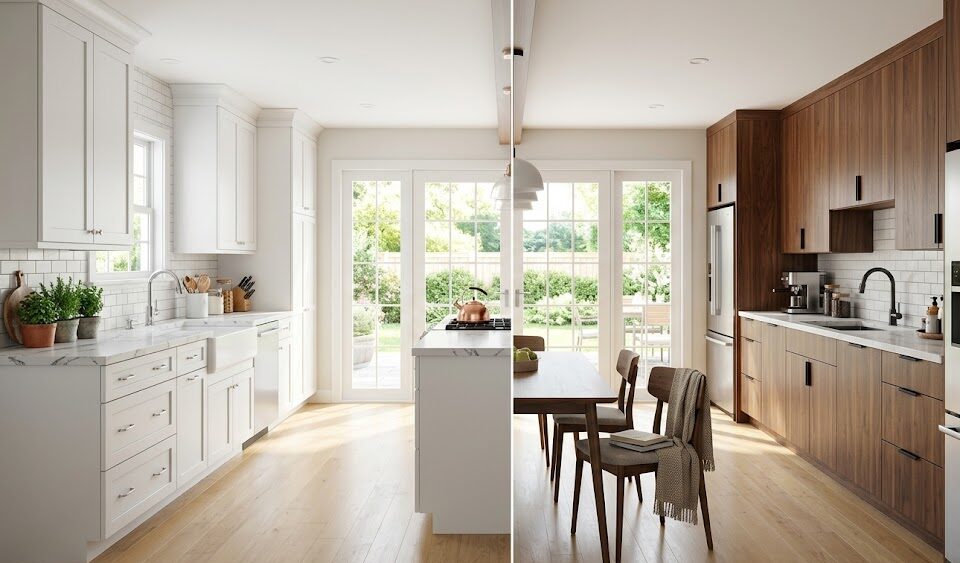
Shaker vs. Slab Cabinets: Style, Cleaning, and Longevity
Cabinet doors do more than set the “look” of a kitchen. They influence how your kitchen feels day-to-day: how often you wipe fingerprints, whether grease collects in corners, how visible wear becomes over time, and whether your kitchen reads as timeless or trend-driven.
If you’re choosing between shaker vs slab cabinets, you’re really choosing a combination of:
- visual style (classic detail vs modern simplicity),
- maintenance (how easy they are to keep clean),
- finish durability (painted vs stained vs specialty finishes),
- hardware and function (how pulls/knobs change the look and usability),
- and how cabinet style pairs with countertop selection, backsplash, lighting, and overall kitchen layout.
In this homeowner-friendly guide, you’ll learn:
- what “shaker” and “slab” actually mean (and the common variations),
- how each style performs for cleaning and real-life wear,
- how to choose based on your home’s architecture and your tolerance for maintenance,
- finish and construction details that affect longevity more than door style alone,
- and a decision checklist to lock your choices before ordering cabinets.
The Fortress Builders is a Utah design–build company built on “strength through structure.” That means we plan your kitchen as a system—layout, cabinets, appliances, lighting, surfaces—so the finished space holds up and feels effortless to live in.
Helpful internal pages while you plan:
- Kitchen Remodeling in Utah: Built to Last
- Cabinets and Countertops: Making the Right Choices
- Semi-Custom vs. Custom Cabinets: What You’re Really Paying For
- Quartz vs. Granite vs. Porcelain Countertops
- Cabinet Hardware Placement: Heights, Spacing, and Consistency
- Kitchen Remodel Planning Checklist
- Request a Design Consult
Shaker vs. slab: what you’re actually choosing
What are shaker cabinets?
Shaker doors are a five-piece door style: a flat center panel framed by rails and stiles (the “border” pieces). The look is clean and simple, but it still has a visible profile and shadow line—one of the reasons it reads as “timeless” in many homes.
What are slab cabinets?
Slab doors are a single, flat panel with no frame profile. The style reads modern, minimal, and “quiet.” Slab is often paired with modern hardware, integrated pulls, or full-height cabinetry to create a continuous plane.
Homeowner takeaway: The biggest visual difference isn’t “traditional vs modern.” It’s shadow lines. Shaker adds intentional shadow lines (frame profile). Slab minimizes them.
Style fit: which door looks right in your home (without chasing trends)
Cabinets are one of the hardest things to “swap later,” so the best approach is to match door style to the home’s architecture and your preferred design direction.
Shaker tends to fit well when your home leans…
- transitional (classic bones, clean updates),
- traditional (more trim detail, warm materials),
- farmhouse / rustic-modern (balanced with simple profiles),
- or when you want a “safe” style that pairs well with many countertops and backsplashes.
Slab tends to fit well when your home leans…
- modern (clean lines, minimal trim, big planes),
- contemporary (high-contrast materials, streamlined fixtures),
- Scandinavian / Japandi (quiet, warm minimalism),
- or when you want cabinetry to disappear so other elements (countertops, lighting, views) lead the design.
Fast “fit check” question:
- If you walk through your home, do you notice trim and detail (baseboards, casings, paneling), or do you notice clean planes and minimal profiles?
If your home has a lot of detail, shaker often harmonizes. If your home is clean and minimal, slab often feels more intentional.
Cleaning and maintenance: what real kitchens reveal over time
Most homeowners don’t regret cabinet style because of “looks.” They regret it because of maintenance friction—especially around kids, cooking grease, and daily handprints.
Which is easier to clean: shaker or slab?
In general, slab is easier for quick wipe-downs because there are fewer edges and corners. Shaker has a profile where dust and grease can collect (especially near the cook zone and around handles).
But… slab shows some things more
Slab doors create large uninterrupted surfaces. Depending on finish and lighting, they can show:
- fingerprints (especially on dark colors or high sheen),
- light scratches (depending on material and finish),
- and any waviness/imperfection in cheaper substrates more readily than shaker.
Shaker hides “small life” better
Shaker’s frame and panel breaks can help camouflage minor dings and daily wear—especially in matte or textured finishes.
Reality check: “Easy to clean” depends as much on the finish (matte vs satin vs gloss) as it does on shaker vs slab.
Longevity: door style matters less than construction and finish
Homeowners often ask which door style “lasts longer.” The more useful answer is: both can last beautifully if the cabinet construction, door build, and finish system are solid.
Key construction details that affect longevity
- Door material: solid wood, MDF, veneer over engineered core, thermofoil, laminate, etc.
- Joinery: how shaker frames are joined (and whether they resist loosening over time).
- Finish system: quality of paint/stain/topcoat and how it’s cured.
- Hardware quality: hinges and drawer slides (soft-close, weight ratings, adjustability).
- Box construction: plywood vs particleboard, thickness, edge banding quality.
If you want the bigger “cabinet quality” picture first, start here: Semi-Custom vs. Custom Cabinets: What You’re Really Paying For.
Painted vs stained: the finish choice that changes everything
Door style is only half the story. Finish determines how cabinets age, how easy they are to touch up, and how much “patina” you’ll see over time.
Painted cabinets (common for both shaker and slab)
- Pros: wide color range; brightens kitchens; pairs well with many countertops and backsplashes.
- Tradeoff: touch-ups can be tricky to blend perfectly; high-traffic areas can show wear.
Stained or natural wood cabinets
- Pros: warmth; grain can hide minor wear; patina can look intentional.
- Tradeoff: color matching later can be harder; strong grain may influence the style direction.
Homeowner guidance: If you want the lowest “shows-everything” maintenance, many families prefer matte to satin finishes in mid-tone colors, regardless of shaker or slab.
Note: Specific finish durability depends on manufacturer finish systems and your household use. Ask for finish samples and care guidance.
Shaker variations: traditional vs thin shaker vs petite shaker
“Shaker” is a family, not a single look. The width of the frame (rails/stiles) changes the vibe dramatically.
- Traditional shaker: wider frame, more classic.
- Thin shaker: slimmer frame, more modern.
- Petite shaker: very slim profile; can read almost like slab from a distance.
Thin shaker as a bridge between shaker and slab
If you want modern simplicity but worry slab feels too stark, thin shaker is often the “best of both worlds” option: cleaner than traditional shaker, but still with a frame that adds subtle dimension.
Slab variations: flat panel doesn’t always mean “boring”
Slab cabinets can be:
- painted slab (clean, minimal, often modern),
- wood veneer slab (warm modern; grain becomes the “texture”),
- laminate slab (durable and consistent; great for busy kitchens),
- high-gloss slab (very modern but higher fingerprint visibility),
- integrated pull slab (finger pull rails or recessed pulls).
Homeowner takeaway: If you like slab but worry about fingerprints, prioritize matte/low-sheen finishes and choose hardware that reduces direct hand contact on the door face.
Hardware changes the outcome more than most homeowners expect
Hardware is not an afterthought. The same shaker door can look traditional with knobs—or modern with long pulls and clean placement. The same slab door can look sleek with integrated pulls—or more approachable with simple handles.
General hardware tendencies
- Shaker + classic pulls/knobs: more traditional or farmhouse.
- Shaker + long modern pulls: transitional-modern.
- Slab + minimal pulls: modern.
- Slab + integrated pulls: very modern, but requires careful planning for comfort and cleaning.
For alignment and “pro-level consistency,” see: Cabinet Hardware Placement.
How cabinets connect to countertops (and why it matters early)
Cabinet style should harmonize with countertop material and edge profile. This is where kitchens can accidentally look mismatched.
Shaker pairs well with
- quartz with subtle veining,
- warmer natural stones,
- more classic backsplash layouts,
- and edge profiles with a bit of softness.
Slab pairs well with
- clean, consistent quartz or porcelain slabs,
- waterfall islands (when appropriate),
- simpler backsplash approaches,
- and crisp edge profiles.
Countertop comparisons here: Quartz vs. Granite vs. Porcelain Countertops. If you’re considering waterfall edges, see: Waterfall Islands: Pros, Cons, and When They Make Sense.
Common ordering mistakes (and how to avoid them)
Mistake 1: Choosing door style before confirming the home’s “design direction”
Homeowners sometimes pick slab because it feels current, then realize the rest of the home is trim-forward and traditional. Or they pick traditional shaker and wish they’d gone thinner for a more updated look.
Fix: Decide whether you want the kitchen to match the home or intentionally contrast it—then choose the door style that supports that decision.
Mistake 2: Not testing cleaning reality
Bring a sample door (or finish sample) home if possible. Put it near your sink or cook zone for a week. See what you notice: fingerprints, smudges, grease, dust, cleaning effort.
Mistake 3: Ignoring lighting
Cabinet style and finish behave differently under different lighting. Slab doors can show reflections more. Shaker shadow lines can feel heavier in low light if the frame is wide.
If you’re updating lighting, start here: Kitchen Lighting & Electrical Designed for Real Life.
Mistake 4: Underestimating what cabinet quality costs
A slab door can look stunning—until the substrate and finish system don’t hold up. Shaker can look timeless—until the joinery loosens or the finish chips easily.
Use this framework to stay grounded: Semi-Custom vs. Custom Cabinets.
Decision checklist: shaker vs slab cabinets (simple, practical)
Use this checklist before you finalize cabinet orders:
- Home style: Does your home lean trim-forward/traditional, or clean/minimal?
- Maintenance tolerance: Are you okay cleaning profile edges (shaker), or do you want the fastest wipe-down (slab)?
- Finish choice: Painted, stained, veneer, laminate—what matches your household’s wear level?
- Color reality: Dark + glossy shows fingerprints more; matte/satin mid-tones tend to hide more.
- Shaker variant: Traditional, thin, petite—what frame width feels right?
- Hardware plan: Pull length/style + placement (this can modernize shaker or soften slab).
- Countertops: Does your countertop choice harmonize with the cabinet style and edge profile?
- Lighting: Will your lighting reveal reflections or shadows in a way you’ll enjoy long-term?
- Longevity priority: Are you prioritizing “timeless” or “modern minimal,” and are you comfortable with that for 10–20 years?
How Fortress Builders helps homeowners make the call (without guesswork)
Door style decisions go smoother when they’re made inside a full plan—layout, storage zones, finishes, appliances, lighting, and budget alignment. That’s why our process starts with a design blueprint that prevents expensive late-stage changes.
Explore the kitchen service pathway: Kitchen Remodeling in Utah: Built to Last. If you’re still in the early planning phase, the checklist here helps you organize decisions: Kitchen Remodel Planning Checklist.
Want a second set of eyes before you order cabinets?
Choosing between shaker and slab is easier when you see the full kitchen plan: your home’s style, your lighting, your countertop direction, and your real maintenance tolerance.
If you’re remodeling in Davis or Weber County, Fortress Builders can help you validate the cabinet style, finish, hardware, and layout details before orders are placed—so you avoid costly change orders and end up with a kitchen that holds up in real life.
Request a Design Consult Explore Kitchen Remodeling Cabinets & Countertops
Bring inspiration photos you love (and a few you don’t), plus any countertop samples you’re considering. We’ll help you choose a cabinet direction that matches your home and stays satisfying for years.