

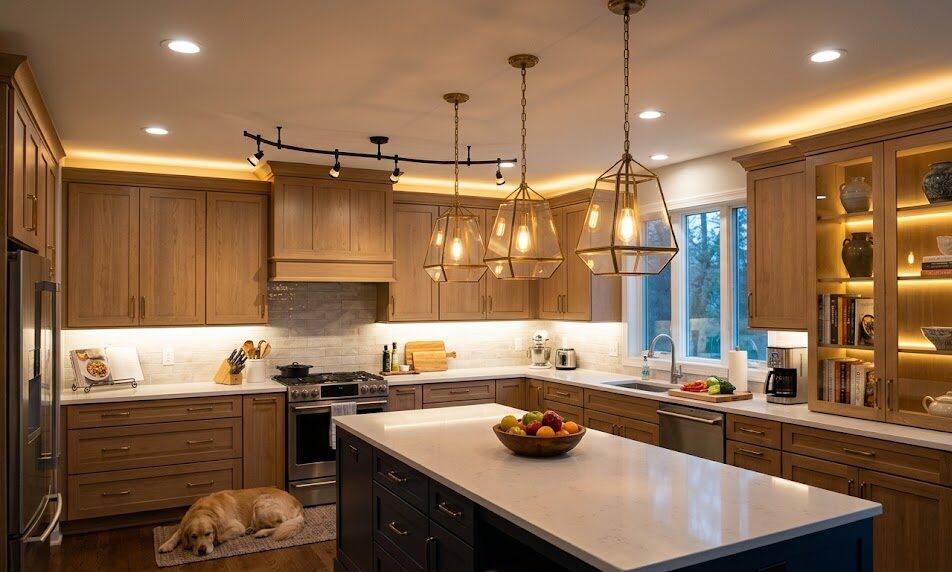

Kitchen Lighting Layers: Recessed, Pendants, and Task Lighting That Works Together
A well-planned kitchen remodel saves time, money, and daily frustration—and lighting is one of the clearest examples of that.
Homeowners often choose fixtures late, after cabinets, islands, and electrical decisions are already moving forward. That is understandable because lighting feels visual at first. But the most successful kitchen lighting plans are not just about how the room looks at night. They are about how the room works in the morning, during meal prep, while kids do homework at the island, when guests are gathered nearby, and during late-night cleanup when harsh overhead light suddenly feels like too much.
This guide explains kitchen lighting layers guide planning in plain English and focuses on the decisions that matter before you commit. You will see how to build a layered plan with ambient, task, and accent lighting; where placement commonly goes wrong; how switch and outlet locations should support real routines; which controls and upgrades actually improve daily life; and what to confirm before electrical rough-in begins.
The Fortress Builders approaches remodeling through one core principle: strength through structure. Every kitchen project starts with a design blueprint that aligns layout, utilities, materials, and daily-use priorities before materials are ordered. That structure matters with lighting because a beautiful fixture cannot rescue a weak lighting plan, but a strong plan can make the entire kitchen feel calmer, brighter, and more intentional every day.
- How to build a layered kitchen lighting plan that supports real life
- Why recessed lights, pendants, and task lighting each play a different role
- What placement basics help reduce glare, shadows, and visual clutter
- How outlet and switch locations should match real routines instead of generic layouts
- What to confirm before electrical rough-in so the plan works as built
Why layered kitchen lighting matters more than many homeowners expect
A kitchen usually has to do more jobs than almost any other room in the house. It is a place for cooking, prep, serving, cleanup, gathering, talking, working, and moving through the home quickly at different times of day. That is why one type of light almost never handles the room well on its own. A ceiling full of recessed lights may make the room bright, but that does not mean it will feel comfortable or flattering. A set of beautiful pendants may look great over the island, but they do not automatically give the counters the practical light needed for prep. Under-cabinet lighting can make work surfaces much easier to use, but it cannot carry the whole room by itself.
Layered lighting works because it treats the kitchen as a set of overlapping needs instead of a single brightness problem. That is what allows the room to shift naturally from morning routine to active cooking to evening gathering without always feeling overlit, underlit, or visually awkward.
Ambient Lighting
Provides the overall light level that helps the room feel bright, navigable, and comfortable at a baseline.
Task Lighting
Targets the areas where people actually work, such as counters, sinks, prep zones, and some island surfaces.
Accent Lighting
Adds warmth, depth, and visual interest so the kitchen feels intentional rather than flat and purely functional.
Flexible Control
Layered lighting allows the kitchen to support multiple moods and uses instead of operating like an all-on or all-off room.
Better Comfort
Balanced layers often reduce glare and harshness because no single fixture type has to do all the work.
More Livable Design
Good lighting planning supports the way the room actually gets used, not just the way it looks in a finish schedule.
Build the lighting plan in layers: ambient, task, and accent
The clearest way to plan kitchen lighting is to separate it into three roles. Once those roles are clear, fixture choices become easier because homeowners stop asking one light source to solve the entire room.
Ambient lighting: the base layer
Ambient lighting is what lets the room feel generally lit when someone walks in. In many kitchens, recessed lights help carry much of that work. The point is not to carpet-bomb the ceiling with fixtures. The point is to give the room an even, comfortable baseline so movement and everyday use feel natural.
Task lighting: where work actually happens
Task lighting should support the places where people prep food, wash dishes, read labels, or use the kitchen in more focused ways. Under-cabinet lighting is often one of the most effective examples because it puts light exactly where hands and eyes need it. Sinks, perimeter counters, islands, and beverage zones may all need task-focused support depending on the kitchen layout.
Accent lighting: what gives the room depth and warmth
Accent lighting often includes pendants, display lighting, toe-kick or niche lighting in some designs, and other choices that help the kitchen feel more layered and livable. Accent does not mean unnecessary. It means the lighting contributes to atmosphere, visual rhythm, and the sense that the room was intentionally composed.
If one fixture type is being asked to light the entire kitchen alone, the plan is probably doing too little in one place and too much in another.
| Lighting Layer | Main Job in the Kitchen |
|---|---|
| Ambient | Creates an overall base level of light for comfort, circulation, and general room brightness |
| Task | Supports actual work at counters, sinks, prep zones, and islands |
| Accent | Adds depth, mood, and visual structure so the kitchen feels more intentional and less flat |
| Controls | Helps those layers respond to time of day, activity level, and household routine |
Recessed lighting: what it does well and where it often goes wrong
Recessed lights are often the default starting point for kitchen lighting, and that makes sense. They can provide clean ceiling lines, broad coverage, and a fairly flexible way to build the room’s ambient layer. But because they are so common, they are also easy to overuse. Many kitchens end up with more recessed lights than they really need and still manage to put light in the wrong places.
Where recessed lights usually help
They are often effective for overall room brightness, circulation zones, open areas between fixtures, and as part of a balanced ceiling plan that supports the rest of the lighting layers.
Where recessed lights often fall short
If they are placed without thinking about upper cabinets, counter depth, or where people actually stand to work, they can create shadows directly on prep surfaces. They can also feel clinical or overly harsh if the room relies on them too heavily.
Why spacing and alignment matter
A recessed plan should relate to the kitchen layout, not just to the ceiling. The room looks better and works better when fixture positions respect the cabinets, island, sink, and walking paths instead of treating the ceiling like a random grid.
- Use recessed lights to support the whole room, not to replace every other lighting layer
- Plan them in relation to cabinets and counters, not just open floor area
- Avoid assuming more fixtures automatically means better lighting
- Think about glare on shiny surfaces and shadowing on prep zones
- Coordinate the pattern with the layout so the ceiling feels intentional
Pendants over islands and peninsulas: beautiful, useful, and easy to overdo
Pendants are often the fixtures homeowners notice first because they play a large visual role in the kitchen. They help define islands and peninsulas, add scale and personality, and contribute strongly to the room’s style. But their function matters too. Pendants are not just jewelry. They can support island use, create softer focal light, and help balance the room visually when planned well.
Pendants should match the island’s role
If the island is mainly a prep and gathering zone, pendants can support both practical visibility and atmosphere. If the island is large, seating-heavy, or a major focal point, pendant scale and spacing become even more important.
Too many pendants can crowd the room
More is not always better. A kitchen can quickly feel visually busy if the pendants compete with cabinetry, hood details, and other finishes instead of complementing them.
Height matters as much as fixture style
Pendants need to support sight lines, conversation, and normal standing use at the island. A fixture that is technically attractive can still feel wrong if it hangs too low or creates glare at eye level.
When someone sits at the island, works at the island, and looks through the kitchen into the next room, the pendants should feel helpful and beautiful—not like obstacles suspended in the middle of the view.
Visual Focal Point
Pendants often help define the island as a centerpiece without requiring more decorative clutter elsewhere.
Soft Functional Light
They can support everyday use over an island, especially when paired with strong task lighting elsewhere.
Scale and Rhythm
The right number and size help the kitchen feel balanced; the wrong choice can make it feel crowded fast.
View Preservation
Well-hung pendants support the room visually without interrupting conversation or sight lines more than necessary.
Task lighting is where kitchen lighting often improves the most
For many homeowners, the biggest daily upgrade comes not from adding more ceiling fixtures, but from getting the task lighting right. This is what turns the kitchen from “bright enough” into actually easy to use. The most common example is under-cabinet lighting because it places illumination exactly where perimeter work surfaces need it.
Why under-cabinet lighting matters so much
Without it, people often rely on ceiling lights that are positioned behind them while they work. That creates shadows on the counters and makes prep surfaces harder to read comfortably. Under-cabinet lighting helps fix that directly.
Task lighting should match real work zones
Prep counters, sinks, coffee stations, baking areas, and even some pantry-adjacent zones can all benefit from better focused lighting depending on how the household uses the room.
Task lighting should feel integrated, not improvised
When it is planned early, task lighting can disappear visually while improving the whole room. When it is treated as an afterthought, it often feels tacked on or misses the places that matter most.
- perimeter prep counters
- main cleanup sink
- coffee or beverage zones
- baking and mixing areas
- any island zone where focused work happens regularly
Placement basics that help avoid glare, harshness, and frustrating shadows
Lighting problems in kitchens are often not fixture problems. They are placement problems. A recessed plan can look fine on paper and still cast awkward shadows. Pendants can feel stylish in elevation and still create eye-level glare. Under-cabinet lighting can technically be present and still miss the most useful parts of the counter if it is not positioned thoughtfully.
Think from the user’s position, not the ceiling plan alone
Homeowners stand at counters, at sinks, at islands, and in front of pantries. That means lighting should be evaluated from those working positions rather than only from a top-down drawing.
Watch for shadows at the counters
If the ceiling light sits too far behind the person working, the body blocks the light and the countertop becomes shadowed. This is one reason task lighting is so valuable.
Glare can make a bright kitchen feel worse, not better
Reflective counters, glossy backsplashes, shiny hardware, and direct exposed bulbs can all turn a bright plan into an uncomfortable one if placement is not handled carefully.
| Common Lighting Problem | What Often Causes It |
|---|---|
| Counter Shadows | Ceiling fixtures placed behind the person working instead of supporting the actual task zone |
| Eye-Level Glare | Pendants or exposed light sources hanging at awkward heights or angles |
| Flat, Harsh Room | Too much reliance on one fixture type, especially overhead recessed lighting alone |
| Dark Working Areas | Task lighting omitted or treated as secondary instead of essential |
Good lighting does not start with “Where do these fixtures fit?” It starts with “Where do people stand, work, sit, and move—and what kind of light do they need in those positions?”
Outlet and switch locations should match real routines, not generic assumptions
Lighting is only part of the electrical plan. Switch placement, grouping, and outlet locations all influence whether the kitchen feels intuitive to use. This is where homeowners often discover that a beautiful fixture plan is not enough if the controls do not match how the household moves through the room.
Switches should follow entry and use patterns
If someone enters from the garage, from a mudroom, or from a main hall, the first lighting controls should make sense for that real path. The room should not require a confusing sequence of switch hunting to reach the right setting.
Task and ambient layers should be controllable separately
This is one of the most practical upgrades homeowners can make. Separate control means the kitchen can feel bright for prep and softer for evenings without forcing everything on or off together.
Outlets should support appliance zones and countertop reality
Small-appliance use, charging, coffee stations, and other daily tasks all depend on power planning that reflects how the kitchen will really operate after the remodel.
- Which entry points are used most often?
- Can the homeowner activate the right layer of light quickly at those entries?
- Are island, perimeter, and cleanup-zone lights independently controllable?
- Do outlet locations support the appliances and routines the family actually uses daily?
- Are there enough power locations in the places where clutter tends to collect now?
Controls and upgrades: dimmers, scenes, and smart switches that actually help
Once the layers are right, controls are what make the lighting plan feel truly useful. Homeowners sometimes assume smart control is just a luxury add-on, but even simple dimming and thoughtful grouping can make a major difference in how the kitchen feels from morning to night.
Dimmers are often one of the most worthwhile upgrades
They allow the same fixtures to support active prep and calmer evening use without feeling locked into one intensity all the time.
Scene-based thinking helps even without a complicated smart system
The kitchen often needs different settings for cleaning, prep, casual mornings, entertaining, and night use. Planning with those scenes in mind usually leads to better switch grouping and better daily comfort.
Smart controls can help when they solve a real problem
If the household genuinely benefits from automation, scheduling, app control, or easier coordination with the rest of the home, smart switches may be worthwhile. But the strongest plans still work well even if the technology is ignored and the room is used manually.
Dimmers
Often deliver the biggest daily improvement for the least complexity because they make the same fixtures more flexible.
Separate Zones
Allow the island, task lights, and overall room light to respond differently depending on the moment.
Scene Thinking
Helps the kitchen support real routines such as morning coffee, meal prep, cleanup, and late-night pass-through use.
Smart Switches
Can be worthwhile if they solve a daily convenience problem, but they work best as an enhancement to a good base plan.
A kitchen should not need every light on full power every time someone enters the room. Good controls let the lighting respond to the moment instead of forcing one setting for everything.
Lighting should also work with materials, finishes, and the way the kitchen reflects light
A lighting plan never exists in isolation. Countertops, cabinet finish, backsplash sheen, flooring, and even hardware influence how light behaves in the room. That is one reason a beautiful lighting concept can change once materials are chosen more specifically.
Glossy finishes reflect more aggressively
Shiny tile, polished counters, glass, and brighter metals can all increase glare if lighting angles and intensity are not handled carefully.
Darker materials may need more targeted support
Darker cabinetry and countertops can make the room feel moodier and richer, but they often benefit from more intentional task lighting and better layer balance.
Warmth and contrast matter
The best kitchens often feel bright enough to work in while still staying visually warm. That is usually a product of layered planning rather than a single powerful ceiling strategy.
- how much glare the room produces
- how bright counters and walls appear
- whether the kitchen feels warm or clinical
- how visible shadowing becomes in work zones
- how much the lighting layers need to support one another
What to confirm before electrical rough-in begins
Electrical rough-in is one of the moments when the lighting plan stops being conceptual and starts becoming physically real. That is why the most important lighting decisions should be made before this point rather than after. Once the rough-in begins, the kitchen becomes less forgiving of vague intentions.
Fixture types should be chosen clearly enough to place correctly
The plan does not need every final decorative detail resolved perfectly, but the general strategy should be firm enough that recessed locations, pendant positions, task-light wiring, and control groupings can all be built correctly.
Switch grouping should be tested against real routine
This is one of the best times to mentally walk through morning entry, prep, cleanup, and nighttime use to make sure the controls still make intuitive sense.
Electrical planning should coordinate with the full kitchen, not just the lights
Because outlets, appliances, pendants, under-cabinet lighting, and cabinet installation all influence one another, the rough-in should reflect a coherent whole-room plan rather than a set of isolated decisions.
| Before Rough-In, Confirm: | Why It Matters |
|---|---|
| Layer Strategy | Ambient, task, and accent lighting should already have clear roles in the plan |
| Fixture Placement | Recessed, pendants, and task lighting should align with the real layout, not rough assumptions |
| Switch Grouping | The room should be controllable in a way that fits the household’s real entry and use patterns |
| Outlet Planning | Power needs should reflect countertop appliances, charging needs, and island use realistically |
| Coordination | Lighting should be coordinated with cabinets, appliances, and material selections before the room hardens around them |
If the lighting plan still feels vague when rough-in starts, the kitchen is already losing one of the best opportunities to make the room feel intuitive and polished later.
Common kitchen lighting mistakes homeowners regret later
Using recessed lights as the whole plan
The room may end up bright, but still shadowy at the counters and flat in overall atmosphere.
Choosing pendants for style only
Pendants affect views, glare, island use, and room balance, so they should be selected as functional pieces as well as decorative ones.
Skipping under-cabinet lighting
This is one of the most common missed opportunities in kitchens that otherwise look beautiful but feel harder to work in daily.
Ignoring switch grouping until late
Even a good fixture plan can feel clumsy if the controls do not match the way the household actually enters and uses the room.
Planning the lighting separately from the kitchen
Lighting works best when it is designed with the layout, materials, cabinets, and electrical plan—not after them.
How Fortress Builders would approach a kitchen lighting plan in a real remodel
A strong design-build process would not treat lighting as a late decorative package. It would place lighting inside the broader kitchen plan: layout, cabinetry, appliance zones, material reflectivity, electrical rough-in, and the real routines of the household. That is how the room ends up functioning well, not just photographing well.
That usually means starting with how the kitchen will be used, then matching the layers to those routines. The room needs a baseline ambient plan, focused task support where work actually happens, and accent lighting that gives the kitchen warmth and identity. From there, the fixture layout, switch strategy, and control upgrades can all be coordinated while the room is still flexible enough to respond.
The result is not simply a kitchen with nice lighting fixtures. It is a kitchen that feels comfortable to enter, easier to work in, and more beautiful at every hour of the day.