

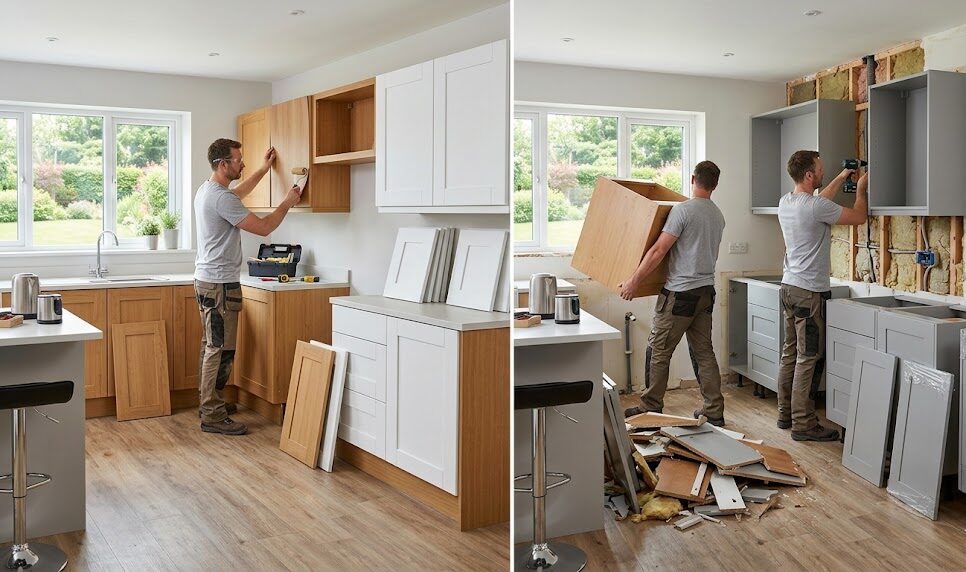
Cabinet Refacing vs. Replacing: Which Makes Sense for Your Kitchen?
If your kitchen looks dated, cabinets are usually the first thing your eyes blame. But “new cabinets” is not one decision—it’s a fork in the road.
For many Utah homeowners, the real question is: Do we keep the cabinet boxes and update the look (refacing), or do we start over with new boxes (replacement)?
In this homeowner-friendly guide, you’ll learn how to choose between cabinet refacing vs replacing based on what actually matters long-term:
- durability (will the boxes and hardware hold up?),
- storage and function (drawers, pull-outs, trash, pantry logic),
- layout flexibility (can you fix the workflow problems?),
- finish options (paint, veneer, new doors, stain, modern materials),
- and how cabinets affect countertop selection, sink choices, and installation surprises.
The Fortress Builders is a Utah design–build company built on “strength through structure.” That means every remodel starts with a detailed plan—so you can avoid expensive change orders and end up with a kitchen that performs as well as it looks.
Helpful internal pages while you plan:
First, define the real decision: “Do we like the layout?”
Before you compare bids or door styles, answer one question honestly:
If you kept the exact same cabinet layout, would your kitchen still frustrate you?
If the answer is “yes,” replacement (or at least partial replacement) often makes more sense—because refacing keeps the cabinet boxes and usually keeps the layout.
If the answer is “no” and your layout is fundamentally working, refacing can be a smart way to refresh the kitchen faster—especially when the cabinet boxes are solid.
If you’re unsure whether your frustrations are “layout problems” or “storage problems,” this framework helps: Work Triangle vs. Work Zones.
What cabinet refacing actually includes
Cabinet refacing is typically a “keep the bones, change the look” approach. The scope varies by provider, but most refacing projects include:
- New doors and drawer fronts (new style, new finish).
- New veneer or laminate on exposed cabinet box faces (the “skin”).
- New hardware (pulls/knobs) and often new hinges.
- Sometimes new drawer boxes or drawer slides—depending on the package.
- Occasionally new crown, toe-kick, panels, or trim to match the updated look.
Key limitation: Refacing usually keeps the existing cabinet boxes in the same locations. You can improve function with inserts and some drawer upgrades, but you typically can’t “fix” a bad layout without some level of replacement.
What cabinet replacement actually includes
Replacement is the “start over” approach. It typically includes:
- Removing existing cabinets (and sometimes soffits, depending on the home).
- Installing new cabinet boxes, doors, and drawer systems.
- New opportunities for storage engineering (deep drawers, pull-outs, pantry systems, trash solutions, corner solutions).
- More flexibility to change the layout and appliance locations (when coordinated correctly).
Replacement is also where you get more freedom to coordinate countertops, sink placement, and appliance integration—because the cabinets define the “platform” those items sit on. See: Cabinets and Countertops.
The “quick decision” matrix: refacing vs replacing
Refacing usually makes sense when…
|
Replacement usually makes sense when…
|
Durability: the cabinet box is the truth (doors are just the outfit)
When homeowners compare cabinet refacing vs replacing, durability is often misunderstood. Doors can be replaced. Veneer can be upgraded. But if the cabinet boxes are weak, no door style will fix the underlying performance.
Signs your cabinet boxes may be “good candidates” for refacing
- Boxes feel solid and square (doors align reasonably well).
- No major water damage under the sink (no swelling, soft spots, or moldy odor).
- Shelves aren’t bowing significantly under normal kitchen loads.
- Face frames are not cracked or splitting.
- Drawer openings still hold alignment (drawers don’t constantly bind).
Signs replacement is safer (or inevitable)
- Water damage (especially under sink or around dishwasher area).
- Swollen particleboard, delaminating surfaces, or persistent musty smell.
- Boxes are visibly out of square (large gaps, crooked door lines that hinge adjustment can’t fix).
- Structural failure: loose bases, failing toe-kicks, sagging cabinet runs.
- Repeated repairs that keep coming back (a sign the underlying box construction is tired).
Homeowner takeaway: If the cabinet boxes are compromised, refacing can be a short-lived “make it look better” move that still leaves you with a kitchen that feels old in daily use.
Function: storage upgrades are where replacement earns its keep
A lot of homeowners start this decision thinking “style.” Then they live in the new kitchen and realize the real win was function.
What refacing can improve (functionally)
- Soft-close hinges (if the boxes can accept them properly).
- New hardware placement that improves usability.
- Some drawer upgrades (slides, occasionally new drawer boxes).
- Pull-out inserts and organizers that retrofit into existing boxes.
What replacement can improve (functionally)
- More drawers (the #1 usability upgrade for most kitchens).
- Better trash/recycling solutions integrated into the layout.
- Corner solutions that reduce wasted space.
- Cleaner, more intentional zones: prep/cook/clean-up/pantry.
- Better appliance integration (panels, fillers, clearances, landing zones).
If you’re already planning a kitchen that’s “built for real life,” it’s worth reviewing layout and zones first: Design and Layouts for Kitchens.
Layout flexibility: the biggest “hidden” difference
If your kitchen has any of these frustrations, refacing may not solve the root issue:
- traffic flow cuts through the cook zone,
- dishwasher blocks the main walkway,
- fridge door collides with an island or seating,
- not enough landing zone near the range or sink,
- pantry placement forces constant cross-traffic.
Replacement is where you can redesign the cabinet runs, change island size, add a pantry wall, or shift storage zones. If you want to sanity-check “layout vs storage” problems, this is a useful starting point: Work Triangle vs. Work Zones.
Important note: If you change appliance locations, ventilation routes, or add circuits, permit and inspection requirements can vary by jurisdiction and scope. Confirm requirements with qualified professionals and local authorities.
Countertops and sinks: why cabinets are not an isolated decision
Cabinet refacing vs replacing affects countertop and sink decisions more than most people expect:
- Countertop template: the counter is fabricated to fit the cabinet layout and sink cutout. If cabinets change later, countertops often cannot be reused.
- Sink mounting: undermount vs drop-in depends on countertop material and cabinet sink base configuration.
- Dishwasher alignment: cabinet openings and end panels affect whether appliances sit flush and look intentional.
If countertops are part of your plan, review material tradeoffs first: Quartz vs. Granite vs. Porcelain Countertops.
Practical rule: If you plan to replace cabinets “someday,” avoid investing in high-end countertops now unless you’re confident the cabinet layout will not change.
Timeline and disruption: what families experience in real life
Timelines vary widely depending on scope, vendor availability, and how much of the kitchen is being touched. In general, homeowners experience the difference like this:
Refacing disruption (often shorter and more contained)
- Cabinet boxes stay in place, so fewer “domino effects.”
- Less structural/rough-in work.
- Still involves noise, dust, and access limits, but often with a quicker “back to normal” moment.
Replacement disruption (more comprehensive, but more transformative)
- More demolition and more trades involved.
- Often intersects with electrical and lighting planning.
- More opportunities for “hidden conditions” (walls, floors, old wiring) that need professional decisions.
If you’re living at home during the project, this planning mindset helps regardless of approach: Timeline and What to Expect.
Cost drivers: what actually moves the number (without guessing)
Prices vary by cabinet size, finish choice, hardware, and labor conditions. Instead of chasing an “average cost,” focus on the cost drivers that reliably shift your options.
Refacing cost drivers
- Door/drawer front material and finish (painted vs stained vs specialty finishes).
- Number of doors and drawers (drawer-heavy kitchens cost more but often function better).
- Veneer/skin complexity (end panels, exposed sides, trim details).
- Hardware and hinge upgrades (soft-close, concealed hinges).
- Repairs needed to make existing boxes “reface-ready.”
Replacement cost drivers
- Cabinet class (stock vs semi-custom vs custom). Start here: Semi-Custom vs. Custom Cabinets.
- Layout changes (moving sink, adding island, expanding pantry run).
- Storage features (pull-outs, organizers, specialty solutions).
- Finish complexity (painted finishes, specialty stains, custom color matching).
- Adjacent scope (lighting, electrical upgrades, ventilation routing, flooring transitions).
Best way to stay grounded: Decide your “non-negotiables” first (durability, drawers, pantry logic, layout improvements), then choose the least-wasteful way to get them (reface vs replace). Shopping finishes before priorities is how budgets drift.
Resale and buyer appeal: what matters (without hype)
Homeowners often ask, “What’s better for resale?” The honest answer is: it depends on your home’s price band, buyer expectations in your neighborhood, and whether the kitchen’s function matches modern use.
Refacing can be a strong resale move when
- the layout is already competitive,
- the cabinets look fresh and consistent,
- and the overall kitchen presents as clean, bright, and updated.
Replacement tends to win when
- the kitchen layout is outdated or dysfunctional,
- storage is clearly insufficient (especially lack of drawers),
- or the existing cabinets show visible wear that undermines buyer confidence.
Common surprises (and how to avoid them)
Surprise #1: “Refacing revealed box problems we couldn’t ignore”
Sometimes refacing starts and you discover water damage, out-of-square runs, or weak bases. That can force partial replacement or a change in plan.
How to reduce risk: Inspect the sink base and dishwasher-adjacent base carefully before committing.
Surprise #2: “We thought refacing would fix storage”
Refacing can make the kitchen look new, but it doesn’t automatically improve storage logic. If your daily pain is functional (not aesthetic), plan function first.
Surprise #3: “Countertops triggered a chain reaction”
New counters often reveal that cabinet runs aren’t level, sink base is compromised, or appliances don’t sit cleanly. A plan that coordinates cabinets and countertops reduces this friction. See: Cabinets and Countertops.
Surprise #4: “Hardware placement made refacing harder than expected”
Changing hardware style (knobs to pulls, or different pull lengths) can expose old holes or require careful planning for consistent alignment. If you’re changing hardware placement, this guide helps: Cabinet Hardware Placement.
A homeowner-friendly evaluation checklist (use this before you get quotes)
Cabinet Refacing vs Replacing Checklist
- Box condition: Any swelling, rot, or soft spots (especially under sink)?
- Alignment: Are runs reasonably square, or are doors fighting major gaps?
- Layout: Would you keep the cabinet layout if money were no object?
- Storage pain: Is your biggest pain “looks” or “function” (drawers, pantry, trash, corners)?
- Countertops: Are you also replacing counters now? (If yes, cabinets matter more.)
- Appliances: Any appliance changes planned (range hood, fridge size, dishwasher location)?
- Timeline tolerance: Do you need minimal disruption, or can you handle a full reset?
- Finish expectations: Are you chasing a “brand new kitchen” feel, or a clean refresh?
- Long-term plan: Is this your forever kitchen, or a strategic update for the next chapter?
Three “best-fit” scenarios (so you can recognize yourself)
Scenario A: “Our layout works—we just hate the look.”
Likely direction: Refacing (assuming boxes are solid).
Why: You can modernize style, hardware, and finish without paying for layout changes you don’t need.
Scenario B: “The kitchen feels tight and dysfunctional.”
Likely direction: Replacement (or significant partial replacement).
Why: Workflow and storage zones usually require layout and cabinet box changes to solve.
Next step: start with layout planning: Design and Layouts for Kitchens.
Scenario C: “We want better storage, but can’t do a full remodel.”
Likely direction: Hybrid approach.
What it can look like: Keep some cabinet runs and reface them, but replace problem areas (like the sink base, a pantry wall, or an island) to add drawers and functional storage.
Hybrid remodels can be very effective when they’re planned as a system (clearances, fillers, countertop transitions, and appliance alignment) rather than “patchwork.” If you’re considering a hybrid, a design consult can help prevent mismatched finishes and expensive surprises.
Pre-order planning: fillers, clearances, and the details that make cabinets look “intentional”
Whether you reface or replace, the “pro look” comes from planning details that homeowners often don’t see until install:
- Fillers: small spacing panels that allow doors and drawers to open without hitting walls or appliances.
- Clearances: appliance door swings, walkway widths, and island seating spacing.
- Panels: end panels and appliance panels (where applicable) that make the kitchen look finished, not pieced together.
- Hardware consistency: aligned pulls and knobs that look deliberate.
If you’re making cabinet decisions alongside appliance planning, start here: Built-In Appliances: Layout Tips for Fridges, Wall Ovens, and Microwaves.
How Fortress Builders approaches this decision (a clean process)
In a design–build process, the cabinet decision is not isolated. It’s evaluated alongside:
- layout and workflow zones,
- storage requirements for the household,
- countertop and sink habits,
- appliance and ventilation needs,
- and the timeline reality of living in the home.
To see the service pathway, start here: Kitchen Remodeling in Utah: Built to Last.
Want a second set of eyes before you commit to refacing or replacing?
If you’re remodeling in Davis or Weber County, Fortress Builders can help you evaluate your cabinet boxes, clarify whether the layout should change, and choose a cabinet strategy that matches your budget and your long-term plan.
Request a Design Consult Explore Kitchen Remodeling Cabinets & Countertops
Bring photos of your current cabinets (inside and out), plus a list of what annoys you daily. We’ll help you choose the option that improves function, avoids rework, and looks intentional when it’s done.