

Smart Kitchen Upgrades: Under-Cabinet Sensors, Smart Switches, and Scenes
A well-planned kitchen remodel saves time, money, and daily frustration, and smart lighting controls are one of the clearest places where that shows up in everyday life.
Many homeowners are interested in smart upgrades, but they do not always want a kitchen that feels overcomplicated or dependent on technology for basic tasks. That is a smart instinct. The best kitchen upgrades are usually the ones that make the room easier to use without making the room harder to live with. Under-cabinet sensors, smart switches, dimmers, and lighting scenes can absolutely add convenience, comfort, and polish, but only when they are built into a strong lighting plan from the beginning.
This guide explains smart kitchen upgrades for lighting controls in plain English and focuses on what to decide before you commit. It covers layered lighting, under-cabinet sensors, smart switches, scene-based lighting, outlet and switch placement, and what to confirm before electrical rough-in. The goal is not to add gadgets for the sake of novelty. The goal is to build a kitchen that responds more naturally to the way the household actually cooks, cleans, gathers, and moves through the room.
The Fortress Builders approaches remodeling through one core principle: strength through structure. Every project begins with a design blueprint that aligns layout, lighting, electrical planning, and build sequence before materials are ordered. That structure matters here because smart controls work best when they are enhancing a good kitchen plan, not trying to rescue a weak one later.
- How smart kitchen lighting upgrades work best when layered into a real remodel plan
- Why under-cabinet sensors, dimmers, and smart switches can improve daily use without overcomplicating the kitchen
- How to avoid glare, awkward control placement, and lighting plans that feel too technical for normal routines
- What lighting scenes actually help in a kitchen and which ones are less important
- What to confirm before electrical rough-in so the smart features support the room cleanly
Why smart kitchen lighting controls matter more than homeowners sometimes expect
The kitchen usually has to support more different tasks than almost any other room in the house. It may be bright and active in the morning, highly task-focused during meal prep, softly lit during dinner, and lightly used at night for a snack, a drink, or a quick cleanup pass. That range of activity is why kitchen lighting often feels frustrating when it is too rigid. If the room only has one “on” setting and one “off” setting, it is much harder to make the kitchen feel comfortable at every hour.
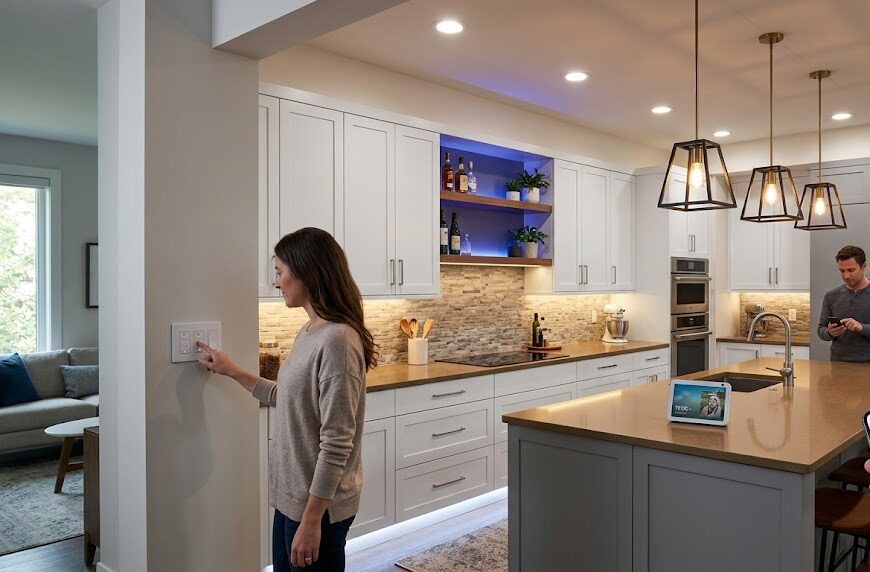
Smart lighting upgrades can help because they allow the room to respond more naturally. Under-cabinet sensors can make prep zones feel immediately usable. Dimmers can soften harsh evening light. Smart switches can keep the room intuitive while still offering flexibility. Scenes can make the whole kitchen shift modes with less effort. But those upgrades only feel worthwhile when they support real household patterns instead of adding technological complexity for its own sake.
More Flexible Light
Smart controls make it easier for the same kitchen to feel bright enough for prep and softer for evening use without constant manual adjustment.
Better Daily Convenience
Thoughtful sensors and scene settings can reduce friction in the small routines homeowners repeat every day.
Less Harshness
Dimming and zoning help the kitchen feel more comfortable than an all-on, all-off lighting plan.
Improved Task Support
Under-cabinet lighting and smart controls can make real work zones easier to use when hands are busy and the room is active.
Cleaner Control Logic
Well-planned switches and scenes can simplify the experience rather than complicate it.
Higher Satisfaction
The best smart upgrades tend to be the ones homeowners appreciate quietly over time, not the ones that demand attention constantly.
Build the smart plan on top of layered lighting, not instead of it
The smartest kitchen lighting system in the world cannot fix a weak base plan. That is why smart controls should always sit on top of a layered lighting strategy rather than replace one. In most kitchens, that means thinking in three layers: ambient, task, and accent. The smart controls only feel good because each layer already has a clear job.
Ambient lighting is the base layer
Ambient lighting helps the room feel generally lit and easy to move through. In many kitchens, recessed lighting carries much of this work. Smart controls can improve that layer, but they should not be expected to solve placement mistakes or coverage gaps.
Task lighting supports where work really happens
Under-cabinet lighting is often the most useful example here because it puts light exactly where counters are being used. Sensors and dimmers become powerful because they are improving a layer that already matters in daily life.
Accent lighting helps the room feel intentional
Pendants, display lighting, and softer detail lighting can all benefit from scene control and dimming, especially when the kitchen shifts from active use to gathering space.
If the lighting plan would feel weak without the smart features, the room likely needs better base planning before it needs more technology.
| Lighting Layer | What Smart Controls Can Improve |
|---|---|
| Ambient | Dimming, scene changes, and smoother shifts between bright daytime use and softer evening use |
| Task | Sensor activation, easier counter visibility, and more convenient control when the kitchen is actively in use |
| Accent | More intentional atmosphere, visual warmth, and flexible mood-setting without fully lighting the whole room |
| Controls | Independent zoning so the kitchen does not have to behave like one giant switch |
That is why smart-control thinking works best when tied directly to the broader lighting and electrical plan, the logic behind under-cabinet lighting, and the room’s overall layout and use patterns.
Under-cabinet sensors: when they help and when they are unnecessary
Under-cabinet lighting is already one of the most practical upgrades in a kitchen because it improves counter visibility right where people prep, read labels, and work with their hands. Adding sensors to that layer can make the upgrade feel even more convenient, but only when the sensor behavior matches how the kitchen is actually used.
Where under-cabinet sensors often work well
Sensors can be helpful in kitchens where quick task access matters, especially in areas where someone may walk in with hands full or where the lighting is frequently used in short bursts. They can also be useful for softer nighttime navigation if configured thoughtfully.
Where they can feel less helpful
If the sensors trigger too aggressively, respond unpredictably, or activate lighting when the kitchen is not actually being used, the system can start feeling more like a nuisance than an upgrade.
The best sensor setups usually stay subtle
Good smart upgrades tend to fade into the background. If the homeowner spends too much time thinking about how to “manage” the sensor, the setup is probably not supporting the room as cleanly as it should.
- the kitchen has strong day-to-night use changes
- counter work zones are used frequently in short bursts
- hands-free convenience genuinely improves how the household uses the room
- the homeowner wants subtle nighttime navigation lighting
- the sensor logic can be set up predictably and not overreact to casual movement
These upgrades are especially worth discussing in the context of under-cabinet lighting design and the overall kitchen lighting and electrical strategy, because the control logic only feels good when the lighting placement itself is already working well.
Placement still matters: smart controls do not erase glare or bad lighting positions
One of the biggest misconceptions in smart-lighting planning is that the control system can solve placement problems. It cannot. A recessed light that creates shadows is still in the wrong place even if it is smart. A pendant that causes glare is still awkward even if it dims beautifully. A sensor that activates light in a poorly lit counter zone is still operating on top of weak coverage.
Task lighting still needs to hit the right surfaces
Smart controls feel most useful when the light they are controlling is already doing the right job in the right place.
Ambient lighting still needs proper room coverage
The kitchen should not depend on app control or scenes to hide the fact that the general lighting plan is too harsh, too sparse, or too poorly placed.
Glare and shadows are layout problems first
Controls can soften intensity, but they do not change whether the fixture was positioned intelligently in relation to cabinetry, work surfaces, and eye-level views.
Good Placement First
Smart controls work best when they are enhancing a lighting plan that already makes sense physically.
Shadows Still Matter
No amount of automation fixes a counter zone that was never lit properly in the first place.
Glare Still Matters
Dimming helps, but fixture height, angle, and location still determine whether the room feels comfortable to use.
Scenes Need Good Inputs
Lighting scenes only feel satisfying when each layer in the scene already behaves the way the room needs it to.
That is also why smart-upgrade planning belongs next to practical lighting articles like the under-cabinet lighting guide and broader kitchen-planning resources around remodel sequencing rather than floating separately as a pure tech decision.
Smart switches, dimmers, and why they often matter more than smart bulbs
Many homeowners think of smart lighting as a bulb decision first, but in a remodeled kitchen, the most satisfying upgrade often comes from smarter switching and dimming rather than from the bulbs alone. Switches shape how the room is actually used. They determine whether the kitchen feels intuitive or fussy, whether homeowners can control the layers logically, and whether the technology continues to work gracefully even if not everyone in the home wants to use an app.
Dimmers are usually one of the best-value upgrades
Dimmers often deliver more everyday comfort than homeowners expect. The kitchen can be bright during prep and noticeably softer in the evening without changing fixtures or relying on multiple awkward workarounds.
Smart switches often feel more intuitive than overcomplicated device control
Because they preserve familiar wall-control behavior while adding flexibility, smart switches can be easier for households to live with than more gadget-heavy systems.
Simple usually wins long-term
The strongest kitchens tend to use technology to reduce friction, not increase it. If the homeowner has to explain the lighting system to every guest or family member, it may be doing too much.
The best kitchen controls usually feel natural, fast, and forgettable. If they constantly call attention to themselves, they are probably overshooting the real need.
| Control Upgrade | Why Homeowners Often Like It |
|---|---|
| Dimmers | They make the kitchen more adaptable across prep, meals, gatherings, and nighttime use |
| Smart Switches | They preserve normal wall-switch behavior while adding flexibility and cleaner control logic |
| Zoned Controls | They let the kitchen’s ambient, task, and accent layers behave independently instead of all at once |
| App / Automation Features | They can be helpful when they support a real routine instead of replacing normal common-sense controls |
Lighting scenes: what they actually do well in a kitchen
Lighting scenes sound sophisticated, but in practice they are often just a way to group the room’s layers around real moments. That is why they can be valuable in a kitchen. The room usually needs different lighting behavior for breakfast, active cooking, cleanup, entertaining, and late-night pass-through use. A scene helps those shifts happen smoothly without the homeowner manually adjusting multiple switches every time.
Useful scenes are based on real routines
A “prep” scene, an “evening” scene, and a “night” scene usually make more sense than an endless list of abstract settings. The best scenes reflect the way the room is truly used.
Scenes should feel supportive, not theatrical
In a kitchen, usefulness usually matters more than novelty. Most homeowners do not need dramatic effects. They need the room to feel brighter when working and calmer when winding down.
Scenes work best when each lighting layer already has a purpose
If the room’s layers are not already well planned, the scenes can feel gimmicky because the lighting itself is not organized enough to respond well.
- a bright prep scene for cooking and counter work
- a softer evening scene for meals and conversation
- a cleanup scene that keeps task areas usable without overlighting the whole room
- a low nighttime scene for quick kitchen access
- a casual daytime scene that supports normal family use without maximum brightness
Those scene decisions usually work best when layered into the overall lighting and electrical plan and supported by the real arrangement of the room, including island use, work zones, and counter-focused lighting like under-cabinet fixtures.
Switches, outlets, and routines should still make sense without an app
One of the easiest ways to make a smart kitchen feel frustrating is to let the technology outrun the basic human logic of the room. Switches should still be where people expect them. Outlets should still support the routines that happen at the island, the coffee zone, and the prep counters. The room should still work gracefully if someone never opens an app or forgets how a scene is named.
Entry points still matter
If the homeowner enters from the garage, mudroom, or main hall, the first control points should support that actual path of movement. Smart features should add convenience there, not make the route more confusing.
Charging and countertop use still need real power planning
Lighting automation does not replace the need for good outlet placement. If the kitchen still has awkward charging zones or poorly placed outlets, the daily convenience picture is incomplete.
Manual control should remain intuitive
The smartest kitchens usually continue to work beautifully even when the automation is ignored. That is a sign the control system is built on strong fundamentals.
Manual First
The kitchen should still feel obvious and easy to use for someone standing in the room with no app open.
Entry Logic
Switches and smart control points should match the real doors and movement paths the household uses most.
Outlet Planning
Charging, appliances, and daily countertop use still need clean electrical support even in a highly controlled lighting plan.
Reduced Friction
Smart features are working well when they simplify routines instead of becoming routines of their own.
This is also where the broader electrical and outlet-planning decisions come back into view, which is why these upgrades should be considered alongside the more practical electrical questions already covered in your kitchen-planning content and in the Fortress Builders blog.
Which smart upgrades usually feel worth it to homeowners?
Not every kitchen needs every feature. In most remodels, the best-value smart upgrades are the ones that support the strongest daily routines with the least complexity. Homeowners often get more long-term satisfaction from a few thoughtful upgrades than from a technically impressive system that asks too much of them.
High-value upgrades often include dimming and zoning
These improve comfort immediately and do not depend on the homeowner changing how they already live in the room.
Under-cabinet control improvements often feel very useful
Because those lights help real work happen, giving them better control logic tends to produce daily value quickly.
Scene-based convenience is often strongest in open-concept homes
When the kitchen blends into adjacent living space, softer evening transitions and better layered control usually matter more.
If an upgrade makes the kitchen easier to use every single day without asking the homeowner to think about it much, it is usually a stronger investment than a flashier feature that rarely gets used well.
What to confirm before electrical rough-in begins
Electrical rough-in is where the smart-lighting plan becomes real. By this point, the room needs more than general interest in “doing something smart.” The team should understand which lighting layers exist, which controls need separate zoning, where the switch logic will live, and how sensors or scenes fit into the actual layout.
Know what the room needs to do
Prep, cleanup, gathering, nighttime navigation, and day-to-day entry should all be considered before the wiring strategy is finalized.
Coordinate switches with the real room layout
Because smart switches still need to make sense as ordinary controls, their placement should be resolved in relation to real entry points and actual use zones.
Keep the electrical plan connected to the whole remodel
The kitchen’s cabinetry, backsplash, under-cabinet lighting, island use, and outlet strategy should all be part of the same conversation rather than handled in isolation.
- which lighting layers the kitchen will have and what each one is supposed to do
- whether under-cabinet sensors are genuinely useful for the household’s routines
- how switches will be grouped and where they should be placed
- which scenes, if any, the homeowner actually wants to use regularly
- that outlets, task lighting, and lighting controls all support one coherent kitchen plan
If electrical changes, inspections, permits, or other project-specific requirements are involved, those details can vary by home and jurisdiction. Homeowners should confirm the final plan with qualified professionals and local authorities where applicable.
Common smart-kitchen mistakes homeowners regret later
Adding smart features before fixing the base lighting plan
Technology feels far less impressive when it is operating on top of poor placement, glare, or weak task lighting.
Making the controls harder than the room needs
A kitchen should not require a learning curve to turn on the right lights in a normal daily moment.
Overvaluing novelty and undervaluing reliability
The best upgrades are often the most stable and least dramatic, because they improve comfort every day without demanding attention.
Ignoring switch and outlet placement because “the app will handle it”
Good manual control is still essential in a kitchen, even when the room includes automation features.
Waiting too long to decide the smart strategy
Once rough-in is underway, the room becomes less flexible, and many of the best control decisions are harder to implement cleanly.
How Fortress Builders would approach smart kitchen lighting in a real remodel
A strong design-build process would not begin with “Which gadgets do you want?” It would begin with how the household uses the kitchen, what kind of light each zone needs, how the room should feel at different times of day, and what level of control complexity the homeowner will actually enjoy living with. That is how smart lighting becomes a thoughtful upgrade instead of a collection of disconnected features.
In one kitchen, the smartest choice may be simple: well-planned under-cabinet lighting, dimmers, and smart switches that preserve familiar wall control. In another, a few carefully chosen scenes and sensors may make a major difference because the kitchen serves as a high-traffic family hub from morning to night. The right answer depends on the room and the routines inside it.
The most important thing is deciding early enough that the wiring, switches, layout, and lighting layers can all support the plan cleanly.