

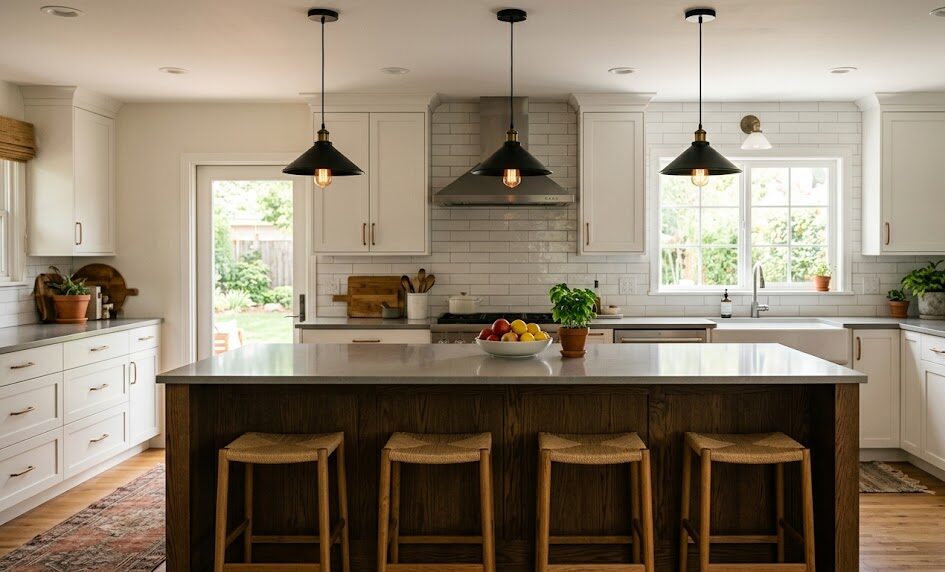

Pendant Light Spacing Over an Island: Height, Count, and Alignment
A well-planned kitchen remodel saves time, money, and daily frustration, and pendant spacing over an island is one of those details that looks simple until it starts affecting everything.
Pendant lights are often expected over a kitchen island now, but getting them right is less about following one magic number and more about balancing height, count, scale, spacing, and the way the island actually functions. The wrong pendants can crowd the room, block sight lines, cast glare, or make a carefully designed island feel visually off. The right pendants can define the island beautifully, support layered lighting, and make the whole kitchen feel more intentional.
This guide explains pendant light spacing over an island in plain English and focuses on the decisions worth making before electrical rough-in and fixture ordering. You will see how to think about height, fixture count, spacing between pendants, alignment with the island and surrounding cabinetry, layered lighting, switch locations, dimmers, and what should be confirmed before the build moves too far forward.
The Fortress Builders approaches remodeling through one core principle: strength through structure. Every project starts with a design blueprint that aligns layout, budget, lighting strategy, and build sequence before materials are ordered. That structure matters here because pendant mistakes are easier to prevent on paper than to correct after electrical work and ceilings are already in motion.
- How pendant count, spacing, and fixture size work together over a kitchen island
- Why height matters for views, glare control, and everyday comfort
- How to align pendants with island dimensions, seating, and surrounding cabinetry
- How pendants fit into a layered lighting plan with recessed and task lighting
- What to confirm before electrical rough-in so the final install feels intentional
Why pendant planning matters more than most homeowners think
Pendants are not just decorative accessories. Over an island, they shape how the kitchen feels from almost every angle. They help define the island as a focal point, influence sight lines through the room, add scale and rhythm to the ceiling, and affect how comfortable the island is for prep, seating, and gathering. That means pendant spacing is not a small styling issue. It is part of the kitchen layout itself.
When pendants are off, the whole island can feel slightly wrong even if the rest of the kitchen is well designed. A fixture that hangs too low may interrupt conversation or feel intrusive at eye level. Fixtures that are too small may disappear visually. Fixtures that are too large or too numerous may crowd the room and compete with the range hood, cabinetry, and backsplash. The strongest pendant plans feel balanced because they respond to the actual scale and use of the island, not because they copy a photo from another house.
Visual Balance
Pendants help anchor the island, but they need the right count and scale so they feel intentional rather than crowded or undersized.
Working Light
They can support island use, but only when height and placement avoid glare and awkward shadows.
Sight Lines
Pendants sit directly in one of the most visible parts of the room, so hanging height and spacing matter more than many homeowners expect.
Ceiling Composition
The way pendants relate to recessed lights, the hood wall, and the island can make the ceiling feel calm or chaotic.
Daily Comfort
Fixtures that look beautiful in a rendering still have to work around standing height, seated views, and active kitchen use.
Rough-In Accuracy
Once junction boxes are placed, the room becomes less forgiving, which is why pendant planning deserves early attention.
Start with the island’s actual role before choosing fixture count
The first question is not “Do we want two pendants or three?” The first question is what the island is doing in this kitchen. Is it mainly a prep surface? Is it mostly a seating and gathering zone? Does it hold a sink or cooktop? Is it long and narrow, or more compact? Does the kitchen already have strong statement features like a dramatic hood, waterfall ends, or open shelving that compete for attention?
Those answers shape everything else. A large island with broad seating and a lot of visual presence may support multiple pendants comfortably. A smaller island or a kitchen with several existing focal points may feel better with fewer fixtures or larger fixtures with more breathing room.
If the pendant plan is chosen before the island’s role, size, and traffic patterns are fully understood, the lighting is reacting to the room too late instead of helping define it correctly from the start.
| Island Characteristic | Why It Changes Pendant Planning |
|---|---|
| Long Seating-Focused Island | Often supports a longer lighting composition and can justify multiple pendants if scale and spacing stay balanced |
| Compact Prep Island | May need fewer or smaller fixtures so the island still feels useful and visually open |
| Island with Sink or Cooktop | Requires more attention to working light, glare control, and how pendants interact with active daily use |
| Strong Existing Focal Points | May push the lighting plan toward restraint so the room feels coordinated rather than overdesigned |
Because pendant decisions are tied closely to island proportions and circulation, they make the most sense when considered alongside the kitchen island size guide, overall kitchen design and layout planning, and the way the room is organized around work zones rather than as a purely decorative choice.
How many pendants should go over an island?
There is no one answer that fits every island, which is why the “always use two” or “always use three” advice falls apart quickly. The correct number depends on the length of the island, the size of the fixtures, the visual weight of the pendants, and how much negative space the room needs to breathe. Count and size work together. Three small pendants may feel lighter than two oversized pendants. One large statement fixture may work better than multiple fixtures in a simpler kitchen.
Two pendants often work well when balance is the goal
Two fixtures can create a clean, symmetrical composition without crowding the island. This is often appealing in kitchens where the hood wall, cabinetry, or waterfall island details already carry strong visual presence.
Three pendants can work well on longer islands
Three fixtures may help a longer island feel more evenly lit and more proportionate, especially when the pendants themselves are moderate in size. But three pendants only work when the island truly has the visual length to support them.
One fixture can still be the right answer in some kitchens
Not every island needs a row of pendants. A single statement fixture or a different ceiling-lighting strategy may be more appropriate in kitchens where simplicity, sight lines, or architectural restraint matter more.
- How long is the island relative to the rest of the room?
- How visually large are the pendants themselves?
- Does the kitchen already have another strong focal point such as a bold hood or waterfall island end?
- Will the pendants feel proportional when viewed from adjacent rooms?
- Is the goal softer visual rhythm or a stronger decorative statement?
Pendant spacing over an island: the gap matters as much as the fixture size
Spacing is where many pendant plans go wrong. Homeowners often choose fixtures they love and then discover that the space between them feels off. If pendants are too close together, they start looking crowded and can create an overly dense focal zone. If they are too far apart, the group stops reading as a composition and begins to feel disconnected from the island.
Good spacing usually feels even, intentional, and calm. It gives each pendant enough visual breathing room while still making the group feel connected to the island as a whole. The right gap depends on fixture diameter, island length, and how close the pendants sit to the island edges.
Think compositionally, not just mathematically
Measurement matters, but the final test is visual balance. The pendants should feel like they belong to the island, not like they were dropped onto the ceiling grid without regard to the room.
Edge distance matters too
The relationship between the outer pendants and the island ends is just as important as the space between the pendants. If the fixtures drift too close to the ends, the composition can feel stretched. If they cluster too tightly at the center, the island may look visually underlit and under-scaled.
Larger fixtures need more breathing room
Heavier pendants visually occupy more space even before their actual diameter is measured. That means the room often needs more restraint, not less, when fixtures get bigger or more sculptural.
Too Tight
Pendants start to feel crowded and visually heavy, especially when the fixtures already have substantial size or detail.
Too Wide
The group begins to lose its relationship to the island and can feel like separate objects rather than a coordinated composition.
Even Gaps
Spacing usually feels best when the pendants read as intentionally centered and proportionate to the island below.
Balanced Edges
The outside fixtures should feel comfortably contained within the island footprint instead of drifting to the extremes.
The goal is not simply to make the gaps equal. The goal is to make the whole group feel balanced in relation to the island, the room, and the sight lines beyond it.
How high should pendant lights hang over an island?
Height is one of the most important decisions in pendant planning because it affects both appearance and comfort. Pendants that hang too low can block views across the kitchen, interrupt conversation, and feel like obstacles over the island. Pendants that hang too high may lose their presence and stop helping define the island zone effectively.
The right height usually balances three things: how the pendants look from a distance, how they feel when someone is standing or sitting at the island, and how they work with the ceiling height of the room. This is one reason there is no universal hanging height that works in every kitchen. A taller ceiling often changes the visual answer, even if the island itself has not changed much.
View lines matter
Pendants are often installed in one of the most visible parts of the kitchen. If they cut through natural conversation sight lines or make the room feel visually lower than it is, the height is probably working against the space.
Task support still matters
Even though pendants are partly decorative, they also contribute to how the island feels during prep, serving, and casual everyday use. Hanging height should support that function without creating direct glare.
Ceiling height changes perception
In a taller room, the pendants may need more drop to feel connected to the island. In a lower-ceilinged room, too much drop can make the composition feel heavy very quickly.
- Do the pendants interrupt eye-level views through the room?
- Do they create glare when someone is seated or standing nearby?
- Do they still feel visually connected to the island rather than floating too high?
- Does the height feel balanced with the ceiling height and room scale?
- Will the pendants still work once stools, island decor, and real daily use are added?
Pendant alignment should relate to the island, not just the ceiling
Alignment is one of the details that separates a decent lighting plan from one that feels professionally resolved. Pendants should not only be centered in relation to one another. They should also relate thoughtfully to the island shape, the room’s architectural lines, and the key visual axes of the kitchen.
Center to the island, not just the room
If the island is the object the pendants are meant to define, then the fixtures should usually be composed around the island itself rather than around some unrelated ceiling or room-center logic.
Respect seating and sink locations
If the island includes seating, a prep sink, or a cooktop, those functions may change how the fixtures should align. The goal is to support the actual use of the island rather than chase perfect symmetry in a way that ignores what happens there.
Look at the room in elevation, not just plan view
Some alignment choices look correct from above but feel off when viewed from the entry, living room, or main cooking wall. That is why pendant planning often benefits from being evaluated in multiple perspectives before final rough-in.
| Alignment Question | Why It Matters |
|---|---|
| Centered to Island | Usually creates the strongest visual relationship between the pendants and the surface they are meant to define |
| Aligned with Seating | Can matter when the island functions heavily as a gathering zone and the pendants need to support that use |
| Aligned with Sink or Prep Area | May shift the composition if the island’s working function matters more than perfect decorative symmetry |
| Viewed from Adjacent Spaces | Ensures the pendants feel balanced not just from underneath, but from the most common real-life viewpoints |
Because alignment decisions are tightly linked to island use and the broader shape of the room, they are best resolved alongside the kitchen layout, island sizing, and even how nearby features like waterfall islands or statement cabinetry affect the room’s visual center of gravity.
Fixture size, visual weight, and style all affect spacing decisions
Homeowners sometimes treat pendant count and spacing like purely numerical questions, but fixture size and visual weight change the answer immediately. A simple glass pendant reads differently than a matte metal dome. A delicate fixture behaves differently than a sculptural one. Even when two pendants share the same diameter, one may feel far larger because of its material, silhouette, or visual density.
Large pendants change the whole composition
Bigger fixtures create more presence, which means the room often needs fewer of them or more generous spacing between them.
Open fixtures can feel lighter
Some pendants take up physical space without feeling visually dense, which can allow a composition to remain airy even with noticeable fixture size.
Style should match the rest of the kitchen
The pendants should feel like part of the kitchen’s language, not like imported statement pieces from a different design story. This matters even more when the island is already visually important.
Heavy Visual Weight
Usually needs more restraint in count, spacing, or both so the island zone does not feel overloaded.
Lighter Open Fixtures
Can sometimes support a more relaxed composition because they do not visually occupy space as aggressively.
Minimal Kitchens
Often benefit from simpler pendant forms so the island remains elegant without adding clutter overhead.
Feature-Rich Kitchens
May need pendants that support the room quietly rather than competing with every other strong design element.
Style and scale decisions usually become easier when considered alongside cabinet and countertop choices, the visual effect of hardware consistency, and the overall finish direction reflected in the kitchen remodel portfolio.
Pendants should work with the rest of the lighting plan, not try to do everything alone
One of the biggest mistakes in pendant planning is expecting the island pendants to solve all the lighting needs for the kitchen. They are only one part of the room’s lighting system. A strong kitchen usually layers ambient light, task light, and accent light so the room feels bright enough to use and warm enough to live in. Pendants often sit somewhere between task and accent: useful, beautiful, and incomplete on their own.
Recessed lighting still matters
The room often needs a broader ambient layer so the pendants do not have to carry the full burden of general brightness.
Task lighting matters where the real work happens
If the kitchen relies only on pendants for island function and only on recessed lights for counters, the room may still suffer from shadowing and imbalance. Under-cabinet lighting and other task-focused layers often improve usability dramatically.
Controls are what make the layers useful
Pendants usually feel best when they can be controlled independently from the rest of the kitchen lighting. That allows the room to shift from active prep to softer evening use without turning everything on or off together.
- pendants sized and spaced for the island itself
- ambient ceiling lighting that supports the room broadly
- task lighting for counters and work zones
- controls that let those layers work separately
- dimmers so the island can feel functional during prep and softer at night
That is why pendant planning works best when tied directly to the broader kitchen lighting and electrical plan and reinforced by practical articles like under-cabinet lighting done right rather than treated as a freestanding decorative decision.
Dimmers, switch locations, and scenes make pendant lighting more useful
Once pendant location is right, controls are what help the lighting feel flexible and livable. Many kitchens use the island for different tasks throughout the day, so a fixture that is bright enough for one moment may feel too strong in another. Dimmers usually make a major difference here because they allow the pendants to transition from active task support to a softer evening layer.
Switch placement should feel intuitive
If the pendants are a major layer in the kitchen, their controls should make sense in relation to how the room is entered and used.
Dimmers improve comfort quickly
Few lighting upgrades offer as much everyday return. They help the same pendants function more gracefully at breakfast, during prep, and later in the evening when full brightness can feel harsh.
Scene thinking helps even without complex smart systems
Many homeowners do not need elaborate technology. They simply need the island lights, task lights, and ambient lights to respond differently depending on what the room is doing.
A well-spaced pendant plan is only half finished if the homeowner cannot actually use the fixtures comfortably at different times of day.
What to confirm before electrical rough-in begins
Electrical rough-in is the point where the pendant plan becomes physically real. That means the basic decisions about count, approximate spacing, height strategy, and control grouping should already be clear enough that the electrical work supports the room correctly. Once boxes are placed, ceilings are finished, and the island is installed, the room becomes much less forgiving.
Know the intended fixture count and scale
The plan does not always need the final product selected to the last detail, but it should be far enough along that junction box locations make sense for the intended composition.
Confirm the island dimensions and final location
A pendant plan can drift quickly if the lighting was assumed before the island dimensions, overhangs, or seating pattern were truly locked.
Coordinate with the full lighting plan
Pendants should be roughed in alongside recessed lights, under-cabinet lighting, and switch grouping so the final room feels integrated rather than pieced together.
| Before Rough-In, Confirm: | Why It Matters |
|---|---|
| Island Dimensions | The pendant plan only works if the final island footprint, overhangs, and seating assumptions are accurate |
| Fixture Count | Box placement depends on whether the room is using one, two, or three pendants or a different strategy entirely |
| Approximate Fixture Size | Spacing and edge balance only feel right if the actual visual weight of the pendants was considered early |
| Control Grouping | Pendants should be able to work with the room’s ambient and task lighting instead of being forced into one all-or-nothing switch setup |
| View Lines | Rough-in should support a hanging height strategy that preserves comfort and sight lines through the room |
If electrical changes, rough-in details, inspections, or other project-specific requirements are part of the work, those details can vary. Homeowners should confirm the final plan with qualified professionals and local authorities where applicable.
Common pendant-light mistakes homeowners regret later
Choosing the fixture before understanding the island
A beautiful pendant can still be the wrong answer if the island size, use, and room balance were not considered first.
Using too many pendants
More fixtures do not always mean a better island composition. Sometimes they just make the room feel visually crowded.
Hanging them too low
Low pendants can interrupt views, crowd conversation, and make an otherwise open kitchen feel more obstructed than intended.
Treating pendants as the whole lighting plan
The island may look attractive, but the kitchen still needs ambient and task lighting to function properly as a real working room.
Waiting too long to resolve rough-in locations
Once the electrical work moves forward, the room becomes much less flexible, and corrections get harder fast.
How Fortress Builders would approach pendant spacing in a real kitchen remodel
A strong design-build process would not treat pendant spacing as a last-minute fixture choice. It would place the pendant plan inside the full kitchen strategy: the island size, seating and prep use, lighting layers, sight lines, switch controls, and the visual hierarchy of the room. That is how the pendants stop feeling like add-ons and start feeling built into the kitchen’s logic.
That usually means locking the island, understanding the fixture direction, and coordinating electrical planning before rough-in. In one kitchen, two pendants may be the most elegant solution because the room already has other strong focal points. In another, three smaller pendants may feel more proportional over a longer island. The right answer depends on the space, the scale, and the life happening in the room.
The most important thing is resolving those decisions early enough that the kitchen can support them cleanly instead of trying to adapt later.