

Kitchen Floor Transitions: Where to Stop Tile and How to Handle Doorways
A well-planned kitchen remodel saves time, money, and daily frustration, and floor transitions are one of those details that seem small until they affect how the whole kitchen feels.
This guide explains where to stop tile, how to handle doorways, and how to think through kitchen floor transitions before materials are ordered or demo begins. In most homes, the best transition point is not chosen by habit alone. It is chosen by layout, sight lines, door swings, flooring thickness, moisture exposure, long-term wear, and how the kitchen connects to the rest of the home. A good transition feels intentional and almost disappears. A weak one can make the floor look chopped up, create height issues underfoot, or turn a beautiful remodel into something that feels slightly unresolved every time you walk through it.
Kitchen floor transitions are not just about looks. They affect cleaning, durability, comfort, and whether one floor material supports the room better than another. A transition near a mudroom entry may need to prioritize water resistance. A transition into a living area may need to protect visual continuity. A doorway between tile and another material may need a trim strategy that handles thickness differences cleanly without becoming a tripping point.
The Fortress Builders approaches remodeling through one core principle: strength through structure. Every project starts with a design blueprint that aligns layout, materials, budget, and build sequence before the work moves forward. That matters here because the best floor transitions are planned with cabinetry, appliances, trim, doorways, and adjacent rooms in mind, not added as a last-minute patch after the main flooring decision is already locked in.
- How to decide where kitchen tile should stop and how transitions should relate to room boundaries and sight lines
- What matters most in doorways, openings, and connections to adjacent rooms
- How to coordinate material thickness, finished heights, and trim pieces so the floor feels intentional
- What to consider for durability, water resistance, cleaning, and comfort underfoot
- What should be confirmed before materials are ordered and demo begins
Why kitchen floor transitions matter more than many homeowners expect
Floors are one of the few things every person in the home experiences constantly. They are seen from a distance, felt underfoot, and exposed to daily wear in a way that cabinets or backsplashes are not. That means transitions between kitchen flooring and adjacent materials matter a great deal. A clean transition can make the kitchen feel integrated and professionally finished. A weak one can interrupt sight lines, create awkward elevation changes, and make even expensive materials look patched together.
In a kitchen remodel, transitions also have practical consequences. Kitchens deal with moisture, spills, grit, dropped objects, and heavy foot traffic. The place where one material stops and another begins often becomes a stress point. If that boundary is placed poorly, the floor may feel visually busy or may wear unevenly over time. If it is planned well, it supports both the kitchen’s design and its day-to-day performance.
Visual Continuity
The right transition point helps the kitchen feel connected to adjacent rooms instead of abruptly cut off.
Daily Durability
Transitions often sit in high-traffic zones, so their location and detailing affect how well the floor holds up.
Safety Underfoot
Height differences, trim choices, and doorway details can all affect whether a transition feels smooth or slightly hazardous.
Cleaning Simplicity
The more intentional the change between materials, the easier it often is to keep the floor looking neat and maintained.
Design Quality
Good transitions usually feel like part of the plan, not a correction added after the larger flooring decision was already made.
Budget Protection
Planning the transition early can help avoid rework, awkward trim fixes, or material waste later in the remodel.
Start with the kitchen’s boundaries, traffic patterns, and adjacent rooms
Before deciding exactly where tile or any other kitchen floor material should stop, it helps to step back and look at the full layout. Is the kitchen open to a dining room or family room? Does it connect to a mudroom, pantry, or laundry space? Are there multiple doorways? Is the kitchen part of a larger open-concept floor where one material might carry farther than expected? These questions usually matter more than any single rule of thumb.
In some homes, stopping tile at a doorway makes the most visual sense because the doorway already establishes a natural room break. In other homes, there may be no real doorway, and the transition has to be defined by cabinet lines, island alignment, or where the room naturally changes function. A transition that seems logical on paper can feel abrupt in person if it interrupts the way the spaces read together.
The best transition point is usually the one that respects the architecture of the home and the way people move through it, not just the place where it feels easiest to switch materials.
| Layout Condition | Why It Changes the Transition Strategy |
|---|---|
| Closed Kitchen with Doorways | Doorways often provide natural stopping points that make transitions feel cleaner and more intentional |
| Open-Concept Kitchen | The transition may need to follow functional zones, sight lines, or island alignment instead of a physical wall or door |
| Kitchen to Mudroom / Entry | Moisture, grit, and heavier wear may influence where the more durable or water-resistant floor should begin or continue |
| Kitchen to Dining or Living Space | Visual continuity often becomes more important, especially if the homeowner wants a calmer, less segmented look |
That is why transition planning is usually strongest when it is considered alongside the overall kitchen layout, the daily logic of work zones, and the broader sequence inside a kitchen remodel planning checklist.
Where to stop tile in a kitchen
Homeowners often ask whether tile should stop at the kitchen doorway, at the edge of cabinets, or continue farther into connected spaces. The honest answer is that it depends on how the kitchen relates to the rest of the home. In general, the best stopping point is the one that looks architecturally natural and performs well under daily use.
Doorways are often the cleanest stopping point
When there is a true doorway or cased opening, stopping the tile within that boundary often feels the most resolved. The transition is easier for the eye to understand because the architecture already defines a change between spaces.
Openings without doors need a more intentional visual rule
In open kitchens, the floor transition may need to align with cabinetry, an island, a wall return, or another strong visual marker. If the line lands in a place that feels random, the room can look segmented even if the materials themselves are attractive.
Function can matter as much as appearance
Some homeowners want tile to extend slightly beyond the kitchen because spills, pets, muddy shoes, or pantry access make that extra durability practical. In that case, the stopping point still needs to look deliberate.
- Is there an actual doorway that creates a natural room break?
- Does the transition line follow a visual feature such as a wall return or island edge?
- Would extending tile farther improve performance in a high-moisture or high-traffic zone?
- Will the stopping point still look intentional once appliances, furniture, and traffic patterns are in place?
- Does the transition support how the whole main-floor plan reads from room to room?
These decisions usually make the most sense when paired with a broader comparison of kitchen flooring options and the role of durable flooring and surfaces in the overall remodel.
How to handle doorways without making the transition look abrupt
Doorways are one of the most common places for a flooring transition, but not every doorway should be handled the same way. The details depend on whether the door is part of a primary sight line, whether the adjacent rooms use materials of similar thickness, and whether the transition needs to address changes in moisture exposure, sound, or comfort underfoot.
Centering the transition under the door is often a clean solution
When there is an actual swinging door, many homeowners prefer the transition to fall where it feels visually hidden or balanced when the door is closed. That way, each room appears to own its own floor material.
Wide openings require more visual discipline
If the doorway is very wide or is more of an opening than a traditional door, the transition often has to be anchored by trim, casing, or a strong layout line so it does not look arbitrary.
Different materials may need different trim logic
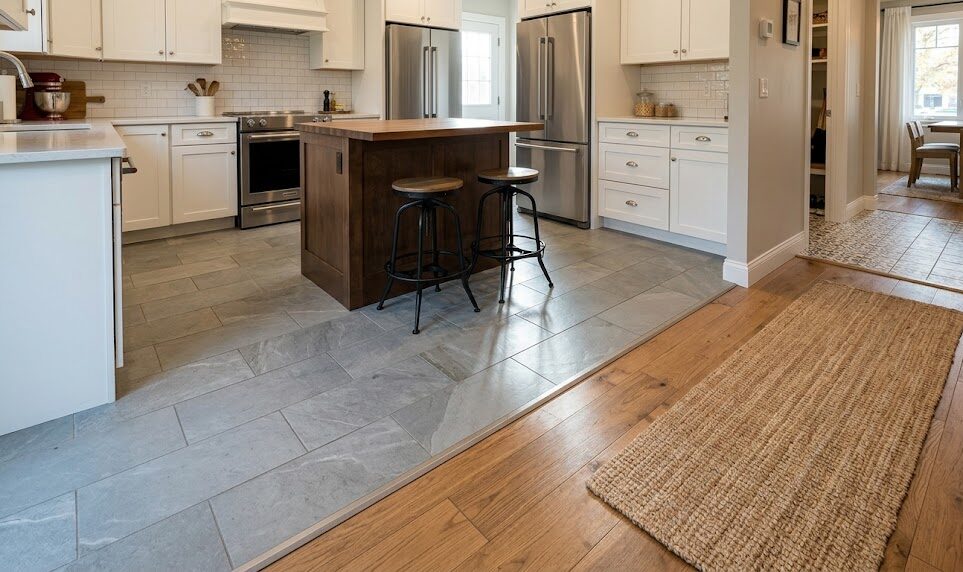
A tile-to-wood-look transition may need a different detail than a tile-to-LVP or tile-to-carpet transition. The cleaner the materials meet, the more professional the result tends to feel.
Traditional Doorways
Often allow the transition to sit within a clearly defined opening, which helps the change between materials feel intentional.
Open Cased Openings
Usually require stronger alignment with trim or room geometry so the transition does not feel random across the floor.
Kitchen to Hallway
May need extra care because the transition is often crossed frequently and seen from multiple approach angles.
Kitchen to Mudroom / Entry
Often benefits from transition details that support tougher wear, easier cleaning, and moisture resistance.
A good doorway transition usually feels tied to the opening itself. If it feels like a line dropped across the floor with no architectural reason behind it, it probably needs another look.
Thickness, finished heights, and trim details need early coordination
One of the most common reasons floor transitions feel awkward is that the materials were chosen without enough attention to finished thickness. Tile, underlayment, wood, LVP, and adjacent flooring products can all build up differently. Even small height differences become noticeable underfoot when they happen in a doorway or a frequent walking path.
Material buildup changes the transition strategy
Tile assemblies often sit differently than floating floors or hardwood systems, which means the finished height has to be considered before the transition piece is chosen.
Trim should support the materials, not rescue a bad height change
The best trim details feel like a clean part of the installation. If the trim has to compensate for a poorly planned height difference, the transition can start feeling bulky or improvised.
Cabinet, appliance, and adjacent-room decisions still matter
Finished floor heights can affect how the kitchen meets nearby rooms and even how certain appliances or toe-kick conditions feel once the remodel is complete.
| Transition Issue | Why It Needs Early Planning |
|---|---|
| Material Thickness | Different flooring systems build up differently, and small height changes become very noticeable in doorways |
| Trim Selection | The trim detail only feels clean when it matches the finished heights and material edges properly |
| Subfloor Preparation | Subfloor conditions often influence how easily one floor can transition into another without an awkward step |
| Appliance / Cabinet Coordination | Finished height changes can influence adjacent surfaces and how the remodel comes together at the floor line |
This is one reason flooring transitions should be planned together with the broader flooring and surfaces strategy and not treated as something to solve only after the main material has already been selected.
Durability, slip resistance, and comfort underfoot still matter at the transition
Kitchen flooring decisions are often driven by durability and water resistance, and that logic should continue right through the transition area. The stopping point between materials is not just a visual line. It is a working part of the floor that sees repeated traffic, dirt, moisture, and shifting loads from daily life.
Durability at the edge matters
Edges are vulnerable. The place where one floor ends and another begins often experiences repeated impact from shoes, dropped items, chairs, or cleaning tools. A transition detail should protect that edge rather than leave it feeling exposed.
Slip resistance can change from one surface to another
A kitchen tile floor may behave differently than an adjacent wood-look or vinyl surface, especially when wet. That change matters even more near entries or sink-heavy areas.
Comfort changes too
Some materials feel softer or warmer underfoot than others. That does not always change the transition location, but it can influence whether the homeowner wants the kitchen material to extend a little farther or stop more tightly at a clear room boundary.
- Will the exposed edges of the materials hold up to repeated traffic?
- Does the change in slip resistance feel safe, especially in wet or entry-adjacent areas?
- Will the kitchen material be comfortable enough underfoot in the zones where people stand the longest?
- Does the transition sit in a place that will collect grit, water, or heavy wear?
- Is the trim detail strong enough for everyday household use over the long term?
That is why this discussion often belongs next to the more complete comparison of durable kitchen flooring materials, since the transition should support the real performance of the floor, not just its visual appearance.
Open-concept kitchens need a different transition strategy than closed kitchens
Open-concept kitchens can make transition decisions harder because there may be no clear doorway to hide the material change. In those homes, the transition often has to feel justified by a shift in room function, an island line, a wall return, or another architectural cue. If the line lands in the middle of a broad open view with no clear logic, it can make the whole main level feel fragmented.
One continuous floor may create the calmest result
In some open layouts, continuing the same floor through the kitchen and adjacent spaces creates the best visual flow, especially when the homeowner wants the main level to feel larger and more unified.
Mixed materials can still work
They just need a stronger reason. The transition should line up with a real change in use, architecture, or maintenance priority so it feels deliberate rather than decorative for its own sake.
The island can influence the visual logic
In some kitchens, island placement or cabinetry lines help establish where a material change feels grounded. That does not mean the transition should automatically follow the island, but the island often affects how the floor reads through the room.
Unified Main Floor
Often feels calmer and larger, especially when the kitchen is fully open to dining and living areas.
Functional Zoning
Can justify different materials when the kitchen truly needs a different performance surface than the adjoining space.
Island-Related Alignment
Sometimes helps anchor the transition visually, but only if the line still makes architectural sense in the room.
Visual Calm
The less arbitrary the material change feels, the more refined the whole floor usually looks in an open layout.
Long-term maintenance and wear should influence where the floor changes
It is easy to choose a transition location based only on how it looks on day one. But the better question is how that spot will behave after a few years of use. Does it sit where dirt and grit are tracked constantly? Is it next to the sink or dishwasher zone where water is more likely? Is it in a doorway that sees constant foot traffic, pets, and cleaning tools? Long-term wear patterns often reveal whether the transition point was smart.
High-traffic edges need stronger detailing
Even a beautiful transition can wear poorly if the edge condition is exposed in a busy walkway.
Moisture-prone areas may justify pushing the durable material farther
In some homes, extending tile or another water-resistant material slightly beyond the strict kitchen zone can make everyday maintenance easier.
Ease of cleaning matters more than it seems
A floor line that constantly traps debris or looks dirty around trim can become a daily irritation even if it looked neat when the remodel was brand new.
The best transition location is not just the one that looks good in photos. It is the one that still feels practical, durable, and easy to clean after years of real household use.
What to confirm before ordering flooring or starting demo
Once flooring materials are ordered and demo begins, the project becomes much less forgiving. That is why the transition strategy should be clear early. The team does not necessarily need every trim piece physically in hand on day one, but the logic of where the materials change, how the heights will meet, and how the doorways will be handled should already be understood.
Confirm the transition points in plan and in person
A line that seems logical on a drawing should also be checked against real sight lines, room openings, and furniture flow.
Confirm finished heights, not just material names
Knowing that the kitchen uses tile and the adjoining room uses another material is not enough. The build-up of each floor system needs to be considered.
Confirm who owns the detail
The trim, subfloor prep, and transition detailing should be part of the remodel plan, not something left vague until the flooring installer arrives.
- exactly where the flooring material changes will happen
- how doorways and larger openings will be handled visually
- what the finished heights of both flooring systems will be
- what transition or trim detail will be used, if any
- whether the chosen stopping point still makes sense for durability, moisture, and long-term cleaning
This is also the right stage to revisit the broader remodel sequence through resources like the Fortress Builders blog, because transition decisions often sit right at the intersection of flooring, layout, trim, and finish sequencing.
Common kitchen floor transition mistakes homeowners regret later
Stopping the tile where it was easiest, not where it looked best
A convenient stopping point during installation is not always the one that makes the most architectural sense once the room is complete.
Ignoring finished height differences
Small changes in material thickness can create noticeable and irritating transition problems if they are not planned early.
Letting a transition line fall in a visually awkward place
If the material change has no clear relationship to a doorway, wall return, or room function, it often feels random later.
Using trim to rescue a poorly planned floor change
Trim works best when it supports a smart transition, not when it is forced to hide a bad one.
Forgetting how the transition will wear over time
The day-one look matters, but so do the years of traffic, cleaning, moisture, and daily life that follow.
How Fortress Builders would approach kitchen floor transitions in a real remodel
A strong design-build process would not treat floor transitions as a late trim decision. It would place them inside the full kitchen plan: room layout, adjacent flooring, moisture exposure, finished heights, cabinet lines, and how the homeowner actually moves through the space. That is how a transition stops feeling like a material compromise and starts feeling like part of the architecture of the remodel.
In one home, that may mean stopping tile cleanly in a doorway so the kitchen owns its own surface. In another, it may mean carrying the kitchen material slightly farther because the room flows into an entry-adjacent zone that needs similar durability. In another, it may mean choosing one continuous floor throughout the main level so the whole space feels calmer and more unified. The right answer depends on the layout, the materials, and the life happening in the house.
The most important thing is making that decision early enough that the transition can be coordinated with the rest of the remodel cleanly instead of being patched in once the finish work is already moving too fast.