

Home Additions & Expansions That Blend Seamlessly
A well-designed home addition should not feel like an add-on. It should feel like the house always wanted to grow that way.
That is what makes home additions and expansions so different from many other remodeling projects. They do not just improve a room. They change how the home meets the site, how the floor plan flows, how the roofline reads, how utilities are distributed, and how the family experiences the house every day. When handled well, an addition can bring relief, flexibility, and long-term value. When handled poorly, it can feel disconnected, awkward, and visibly separate from the original home.
This guide is designed to help homeowners think through home addition planning with more clarity. You will learn how to evaluate when an addition makes sense, what makes room addition design feel seamless, how rooflines and massing affect the final result, what to know about utilities and disruption, and why permits, sequencing, and design-build coordination matter so much on expansion work.
The Fortress Builders approaches additions through one core principle: strength through structure. Every project begins with a design blueprint that aligns homeowner goals, budget direction, and construction logic before work begins. That process helps large changes feel more intentional, more manageable, and much more likely to blend seamlessly with the original home.
- How to know whether an addition is smarter than reconfiguring the current layout
- What strong home addition planning should include before design is finalized
- How rooflines, transitions, and room relationships affect seamless addition ideas
- What to expect with utilities, permits, disruption, and project sequencing
- How to build new square footage that feels original to the home rather than attached to it
Why homeowners choose additions and expansions instead of moving or squeezing harder
Some homes do not need more square footage. They need better use of the square footage they already have. But other homes truly need more room. Families grow. Work-from-home routines become permanent. Parents move in. Kitchens feel undersized for gathering. Bedrooms feel too few or too small. In those situations, a well-planned addition can solve problems that no amount of furniture shuffling or cosmetic updating will fix.
The smartest additions are not built simply because “more space would be nice.” They are built because the home keeps forcing the same compromises and those compromises are no longer worth tolerating.
Space Shortage
Sometimes the home simply does not have enough room in the right places to support how the household now lives.
Layout Limits
Reworking the current footprint may still leave core circulation or room-size problems unresolved.
Family Change
Multi-generational needs, aging parents, older children, or long-term guests can make added space far more practical.
Function Upgrades
A larger kitchen, true home office, mudroom, or expanded living zone may improve daily life more than multiple smaller updates.
Stay in the Right Neighborhood
When homeowners love the location but have outgrown the house, an addition can preserve both.
Long-Term Value
Thoughtful expansion can increase both usability and resale appeal when the new space feels integrated and well planned.
Home addition planning: what should be defined before design moves too far
Home addition planning works best when homeowners define the problem clearly before falling in love with a specific shape or room label. “We need more space” is a starting point, but it is not yet a plan. Strong planning asks exactly what kind of space is missing, how it should connect to the house, and what the addition should improve beyond raw square footage.
Start with the use case
Is the addition meant to create a larger kitchen? Add a family room? Expand the primary suite? Create an office? Build space for in-laws? Improve entry and storage? Different goals create very different structural, layout, and utility needs.
Ask what the addition should fix besides size
New square footage often creates the chance to improve flow, daylight, storage, privacy, or the relationship between indoor and outdoor living. Those benefits should be part of the planning conversation, not treated as secondary lucky outcomes.
Clarify what should stay and what can change
Some homeowners want the addition to minimize disruption to the original house. Others want the expansion to unlock a broader reconfiguration of the existing layout. Knowing which path you are on helps shape the design much earlier.
If the addition disappears tomorrow, what daily frustration would remain unsolved? That answer usually reveals the real reason the project is needed.
| Addition Planning Topic | Questions to Answer Early |
|---|---|
| Purpose | What missing function is the addition supposed to provide and who is it for? |
| Connection | How should the new space relate to the existing floor plan so movement feels natural? |
| Scale | How much space is actually needed for the room to work well without overbuilding? |
| Site Fit | How will the addition sit on the lot, relate to outdoor areas, and affect the exterior form of the home? |
When a room addition design is better than internal reconfiguration
Homeowners often ask whether they should add on or rework what they already have. The right answer depends on what the house can realistically absorb. In some homes, removing walls or repurposing underused rooms solves the problem cleanly. In others, the existing footprint is already too constrained, and trying to force a new function inside it only creates new compromises.
Reconfiguration works best when the house has hidden opportunity
If there are oversized formal rooms, underused corners, redundant circulation areas, or poor room allocation, reworking the plan may go further than expected without expanding outward.
An addition makes sense when the current footprint is already fully working hard
If every room already has a job and the house still lacks the space you truly need, expanding may be the more honest solution.
The strongest answer may be both
Sometimes the best result comes from combining a targeted addition with better internal reconfiguration so the new square footage solves more than one problem at once.
- Can the current home solve the issue through reconfiguration alone?
- If not, what exact function needs new square footage?
- Will the addition improve the existing layout, or just add a room to the side of it?
- Would the house still feel incomplete if the addition were built without reworking nearby spaces?
Seamless addition ideas: what makes new space feel like it belongs
One of the biggest concerns homeowners have about additions is visual mismatch. They do not want the house to look like it was “built in pieces,” and they do not want the new room to feel architecturally separate from the rest of the home. That instinct is right. The best seamless addition ideas focus less on decorative imitation and more on proportion, transition, and architectural logic.
Proportion matters more than copying details mechanically
The addition should respect the scale of the existing home. That means wall heights, roof relationships, window rhythm, massing, and room-to-room transitions all need thoughtful coordination.
Interior transitions should feel natural
Doorways, ceiling changes, flooring continuation, trim language, and sightlines all affect whether the new space feels integrated. If the transition between old and new feels abrupt, the whole project can read as patched together.
The addition should support the house’s identity, not fight it
That does not mean the new space cannot feel elevated or improved. It means the project should build on the home’s logic instead of creating a disconnected visual story.
If a first-time visitor cannot easily tell where the original house ends and the new work begins, the design has probably done its job well.
Rooflines, massing, and exterior relationships can make or break the addition
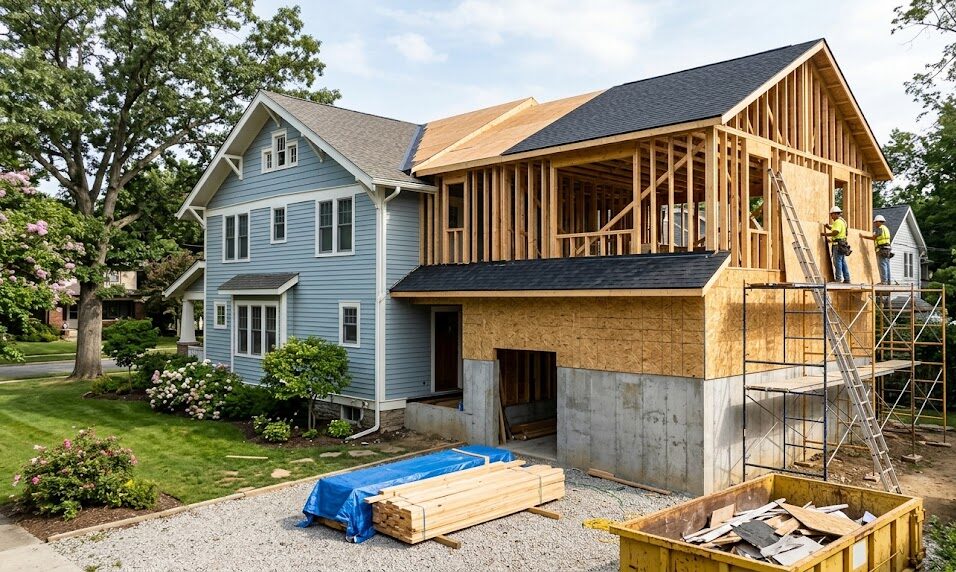
Rooflines are one of the clearest ways additions either succeed or fail visually. Homeowners may focus first on the interior square footage, but the exterior form is often what determines whether the addition feels elegant or awkward. Roof geometry, height relationships, wall planes, and how the addition meets the existing structure all affect the final impression.
Rooflines should feel resolved, not improvised
Good addition design does not leave the roofline looking like it was simply pushed outward to fit a room. The addition should feel compositionally connected to the house.
Massing matters just as much as material match
Even if siding, trim, and windows are coordinated, an addition can still feel wrong if the overall shape and scale are unbalanced.
Exterior blending is really about hierarchy
The homeowner should be able to understand the house as one architectural composition, even if the addition is newer and functions better than the original areas it supports.
- How the addition attaches to the original structure
- Whether the roofline steps, intersects, or extends naturally
- How windows and openings relate to the existing home
- Whether the addition feels proportionate from the street and yard
- How trim, fascia, siding, and exterior materials are coordinated
Utilities and infrastructure: the invisible work that shapes the addition
Many homeowners imagine additions mainly in terms of finished rooms, but the project also depends heavily on utilities and infrastructure. Heating and cooling, plumbing, electrical capacity, drainage considerations, structural tie-ins, and site access all influence what the addition can become and how smoothly it can integrate into the existing house.
Utilities do not just “extend themselves” automatically
New square footage often requires deliberate decisions about HVAC support, power distribution, plumbing routing, and how those systems will serve both the old and new parts of the home.
Infrastructure planning affects room placement
A bathroom addition, kitchen expansion, or in-law suite addition may place much heavier demands on plumbing and mechanical coordination than a simple sitting room or office.
Site and drainage still matter
Exterior grading, runoff paths, foundation strategy, and how the addition meets the lot can influence the long-term performance of the new space as much as the room layout itself.
Homeowners also benefit from looking at how broader remodeling work is phased. The Fortress Builders resource on home addition cost drivers is especially useful because it helps explain why invisible project factors often shape budget more than surface finishes alone. If permits, inspections, ventilation, electrical requirements, or drainage issues become part of the project, those details can vary by scope and jurisdiction and should always be confirmed with qualified professionals and local authorities.
| Infrastructure Area | Why It Matters in an Addition |
|---|---|
| HVAC | The new room needs comfortable heating and cooling without weakening performance in the original house. |
| Electrical | Lighting, outlets, appliances, and room function often require more than a simple extension of existing power. |
| Plumbing | Baths, laundry zones, or kitchen-type additions require more intentional routing and coordination. |
| Drainage & Site Fit | The addition must handle water, grading, and exterior integration as thoughtfully as the original home. |
Living disruption: what to expect during an addition remodel in Utah
An addition often feels easier than a whole-house remodel because part of the work happens outside the existing home envelope. But that does not mean it is disruption-free. Depending on where the addition ties into the original structure, homeowners may still experience major interruption to circulation, kitchen use, bedroom privacy, utilities, or access patterns during construction.
The tie-in phase is often where disruption spikes
The addition may begin outside, but eventually the project has to connect to the existing house. That is often when noise, dust, and day-to-day inconvenience increase noticeably.
Site access changes daily routine
Equipment, crews, material staging, and exterior work zones can affect parking, yard use, entries, and family movement even before the new room is framed in.
Some additions are easier to live through than others
An office addition off a side wing may feel very different from a kitchen expansion that changes how the main living level functions every day. Homeowners should discuss disruption honestly as part of the planning phase.
Which part of the house will feel the impact of the addition most during construction—and what does your family need in place to handle that period well?
Permits, approvals, and professional coordination matter more on additions
Additions are usually more complex than many interior remodels because they affect the footprint of the house, the structure, and the relationship between the house and the lot. That often means permitting and approvals matter earlier and more significantly.
Do not treat permits as a late admin step
On additions, permit and review pathways can shape timing, scope, and even design decisions. They are part of the project strategy, not a formality at the end.
Structural and code coordination usually carry more weight
Because the addition physically alters the building envelope and often affects egress, utilities, and exterior form, professional planning becomes especially important.
Local requirements can vary
Setbacks, lot coverage, utility requirements, drainage issues, structural review, electrical and mechanical rules, and inspection procedures can differ by municipality and project type. Those details should always be confirmed with qualified professionals and local authorities.
- Approvals can influence project timeline more than expected
- Site constraints can affect what type of addition is possible
- Good design-build coordination reduces the risk of costly late-stage redesign
- Permitting logic should support the project, not surprise it halfway through
Common mistakes homeowners make on additions and expansions
Adding square footage without improving the original layout
A new room alone may not solve the daily-life problem if nearby circulation, storage, or room relationships remain weak.
Underestimating roofline and exterior composition
An addition can match finishes and still look awkward if massing and roof relationships are unresolved.
Thinking only about the new room
The addition should also improve how the existing house connects, functions, and flows.
Leaving utilities and infrastructure too vague too long
Mechanical, electrical, plumbing, and site-fit issues shape the real project more than many homeowners realize.
Chasing a bigger addition instead of the right addition
The most successful expansions are usually the ones that are sized correctly for function, proportion, and long-term value.
How Fortress Builders approaches additions that blend seamlessly
A strong design-build process starts by identifying the real problem the home is trying to solve. Is the family missing square footage, or missing the right square footage? Is the goal a larger kitchen, better gathering space, more privacy, or more long-term flexibility? From there, the addition can be designed around how it will change both the new room and the existing house.
That approach usually includes careful attention to room relationships, transitions, rooflines, utility coordination, and the bigger picture of how the home sits on the lot and functions day to day. The result is not just a bigger house. It is a house that works better and looks more resolved than it did before the project began.
That is what seamless addition ideas really aim for. Not invisibility for its own sake, but integrity—new space that feels original because it was planned with the whole home in mind.