

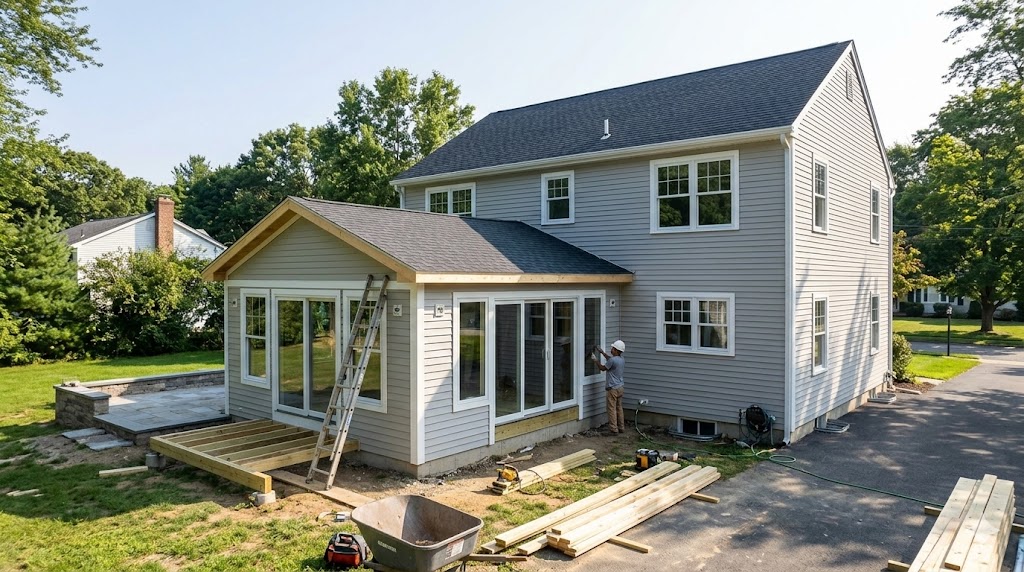
Home addition cost drivers Utah: what impacts price the most?
Additions are one of the best ways to make a home fit your life better—more room for kids, aging parents, a bigger kitchen, a new primary suite, or an office that finally feels calm. But they’re also one of the easiest projects to underestimate.
This guide breaks down the real home addition cost drivers Utah homeowners should understand early—so you can plan with clarity, set expectations with confidence, and build a budget that matches the scope. We’ll cover room addition cost factors, home addition permits utilities, and the hidden complexity behind addition structure roof tie-in costs—all in homeowner-friendly language.
In this planning guide, you’ll learn:
- why two “same-size” additions can cost wildly different amounts,
- how the type of addition (bump-out vs. second story) shapes labor and structure,
- what happens when plumbing, HVAC, or electrical has to move (or expand),
- how site access and tie-ins change the build approach,
- how finish level and selections impact cost more than most people expect,
- and how to build a realistic Utah home expansion budget with a proper contingency.
The Fortress Builders is a Utah-based design–build company built on one principle: strength through structure. That means we start with a design blueprint that aligns vision, budget, and timeline—then coordinate permitting, project management, and construction so your addition feels intentional, not chaotic.
Helpful pages while you plan:
Additions vary wildly in price for good reasons—and you can plan for them
Homeowners often ask a fair question: “What does an addition cost?” The honest answer is that additions aren’t priced by square footage alone. They’re priced by complexity—structure, tie-ins, utilities, access, permit scope, and finish level.
Think of it this way: building new space isn’t just “adding a room.” It’s connecting a new mini-building to an existing one—without compromising structural integrity, weather protection, energy performance, or day-to-day livability during construction.
Quick takeaway: The best way to control cost isn’t cutting corners—it’s reducing uncertainty. Clear scope, early feasibility checks, and coordinated design decisions are what keep additions predictable.
Cost driver #1: What type of addition are you building?
The biggest room addition cost factors start with the category of addition. Different types require different structural moves, different trade sequencing, and different levels of disruption to the existing home.
Common addition types (and why they price differently)
- Single-room bump-out: Often smaller in size but can be deceptively complex if it impacts rooflines, windows, or utilities.
- Rear/side addition: Adds meaningful space but typically requires major foundation work, exterior tie-ins, and changes to drainage and siding.
- Primary suite addition: Includes plumbing, waterproofing, ventilation, and higher-end finishes—more trades, more detail, more budget sensitivity.
- Kitchen expansion: Can involve load-bearing changes and expensive utility rework. If the kitchen is staying operational during construction, dust control and logistics matter.
- Second-story addition: Often the highest complexity because it impacts the entire structural system, roofing, stair layout, and mechanical distribution.
- Garage conversion or garage addition: May be simpler structurally, but insulation, fire separation, and HVAC/comfort upgrades can raise the scope.
Planning prompt: Before you chase layouts, define the “job” the addition must do.
- Is this a daily-use space (kitchen, primary suite, family room) or occasional-use (guest room, hobby room)?
- Do you need plumbing (bathroom, laundry, kitchenette)?
- Does it require privacy (in-law suite, teen zone, home office)?
- Will the home stay occupied during construction?
If your addition includes major interior remodeling, it’s worth reading Whole-Home Remodel Sequencing so you understand how trades are coordinated to avoid rework.
Cost driver #2: Structure and “tie-ins” (foundation + rooflines)
Structure is where additions become real construction—not just interior design. Your addition needs a foundation that matches the soil conditions and load requirements, and it needs a roof system that sheds water correctly and ties into your existing roofline without creating leaks or weak points.
Foundation complexity: more than “pouring concrete”
Foundation scope depends on conditions and design. Some additions require new footings and stem walls; others integrate with existing foundations. Variables that influence cost include:
- excavation access and soil conditions,
- foundation depth requirements (often climate-related),
- drainage and waterproofing details,
- crawl space vs. slab vs. basement extension,
- steps, retaining needs, or significant grade changes.
Roof tie-ins: where details matter
Addition structure roof tie-in costs increase when roof geometry becomes complex—valleys, dormers, intersecting pitches, or transitions that require careful flashing. The goal is simple: water must be directed safely, and the new roof must be integrated like it always belonged there.
Homeowner-friendly rule: The cleaner the roof tie-in, the lower the risk. Complex roof intersections aren’t “bad,” but they require more labor and more detail control to be durable.
Cost driver #3: Utilities—plumbing, electrical, and HVAC expansions
Utilities are a primary reason addition pricing changes quickly. Your existing home systems may be able to extend into the new space—or they may need upgrades to handle the added load and code requirements.
Plumbing and drainage (when the addition includes “wet” spaces)
Bathrooms, laundry rooms, wet bars, and kitchen expansions bring plumbing scope. Costs rise when:
- drain lines need long runs or new vent routes,
- floor framing needs reinforcement for tubs or tiled showers,
- water heater capacity needs to be increased,
- the project requires relocating existing plumbing stacks.
If your addition includes a bathroom, you may also want to review bathroom durability topics like Bathroom Waterproofing 101 and Bathroom Vent Fan Sizing—because wet spaces are high-risk areas when corners are cut.
Electrical upgrades (not just “add outlets”)
Electrical work scales with the demands of the space. Think lighting layers, appliance loads, dedicated circuits, and panel capacity. The cost drivers include:
- the number of circuits and the distance from the panel,
- panel upgrades (if capacity is limited),
- specialty lighting (accent, under-cabinet, task),
- requirements for smoke/CO alarms or other safety devices.
If the addition includes a kitchen or kitchenette, lighting and power planning are a big deal—see Under-Cabinet Lighting Done Right and Kitchen Lighting & Electrical Designed for Real Life.
HVAC capacity, distribution, and comfort
Many additions “work” on paper but fail in real life because comfort wasn’t planned. HVAC cost changes depend on whether your existing system can handle the new load and how airflow is routed.
Even if you’re not finishing a basement, the principles in Basement HVAC & Ventilation Planning are directly relevant: balanced supply/return airflow, zoning, and humidity control are comfort foundations.
Cost driver #4: Permits, design scope, and engineering
Home addition permits utilities can become a combined cost driver because permit scope often triggers plan requirements, inspections, and documentation—especially for structural work, electrical upgrades, and plumbing changes.
Most homeowners don’t mind permits; they mind surprises. The best way to avoid surprises is to understand that design decisions and permit documentation are real parts of the project—not “overhead,” but what makes the project safe, legal, and buildable.
What documentation often helps an addition move smoothly
- site plan (property boundaries, setbacks, addition location)
- floor plan and elevation drawings
- structural notes or engineering (especially for major openings or second-story work)
- electrical and lighting plan (for outlets, circuits, fixtures)
- HVAC approach (zoning, returns, supply plan)
- window and door schedule (sizes and locations)
For a Utah-specific overview of how permits and inspections fit into remodel scheduling, see Permits and Inspections for Basement Finishing: What to Expect in Utah. Many of the same timing principles apply to additions because inspections still occur at predictable phases (rough, insulation, final, etc.).
Cost driver #5: Site constraints and access (the “how do we actually build this?” factor)
Two homes can have the same addition design and different costs because one has easy access and the other doesn’t. Access affects labor efficiency, protection needs, and how materials move through the site.
Common access constraints that increase cost
- tight side yards or limited equipment access,
- significant slope or retaining needs,
- trees, fences, or landscaping that must be protected or removed,
- limited driveway staging,
- construction during occupied living (requires more protection, cleanup, and scheduling).
Why this matters: Challenging access doesn’t mean the project shouldn’t happen. It means the plan needs more logistics baked in—so timelines and budgets stay grounded.
Cost driver #6: Finish level and selections (where budgets quietly balloon)
Finish level is one of the biggest swings in any Utah home expansion budget. The same addition footprint can become “value-focused” or “premium” depending on what you choose for:
- flooring type and installation complexity,
- window package, trim style, and casing detail,
- cabinet construction level and storage features,
- countertops and backsplash materials,
- lighting fixtures (and how many layers you add),
- tile and waterproofing system choices in bathrooms.
How to set finish expectations early (without locking yourself in)
Homeowners don’t need to pick every finish on day one. But you do want to define the “finish tier” early—because it changes budget and schedule realities.
Simple tiering system (homeowner-friendly):
- Good: durable, clean, standard profiles, limited specialty features.
- Better: upgraded fixtures and materials, stronger design cohesion, more lighting layers.
- Best: premium surfaces, custom details, high-end millwork, elevated performance (quiet fans, better windows, etc.).
If your addition includes kitchen work, it helps to understand where upgrades truly matter. These guides can anchor decisions:
- Semi-Custom vs. Custom Cabinets: What You’re Really Paying For
- Quartz vs. Granite vs. Porcelain Countertops
- Waterfall Islands: Pros, Cons, and When They Make Sense
- Range Hood CFM Sizing Guide
Cost driver #7: Timeline and sequencing (how rework happens)
Additions are not only “what gets built,” but when and in what order. Poor sequencing creates rework: trades repeating steps, materials damaged or installed too early, and schedule gaps that add labor cost.
If you want a clear picture of the phases that keep projects moving, read Whole-Home Remodel Sequencing and Timeline and What to Expect. Those principles apply directly to additions.
A simple “order of operations” for most additions
- Feasibility + concept design: define scope, constraints, rough budget bands.
- Design development: lock layout, major selections tier, and structural approach.
- Permits + procurement: permit submittals, long-lead ordering as needed.
- Site prep + demo: protect living areas, remove what must move.
- Foundation + framing: build the shell, tie into existing structure.
- Rough-ins: plumbing/electrical/HVAC and inspections where required.
- Insulation + drywall: close walls only after rough-in verification.
- Finishes: floors, cabinets, trim, paint, fixtures.
- Final inspections + punch: verify performance, correct details, clean handoff.
Homeowner tip: Ask your builder for a written sequence and milestone plan. It’s one of the clearest signals that the project is being managed like a system—not improvised week to week.
Cost driver #8: Contingency planning (the “unknowns” category you should plan for)
Even well-planned additions can reveal conditions inside existing walls—older wiring, unexpected framing, prior repairs, or hidden moisture issues. A contingency isn’t pessimism; it’s smart planning.
What contingency is (and what it isn’t)
- It is: a reserved portion of budget for discovered conditions and scope clarifications.
- It is not: an excuse for vague pricing or poor planning.
Contingency checklist (practical planning):
- Have you reviewed existing electrical panel capacity?
- Do you know where main plumbing and vent lines run?
- Have you considered how the addition impacts the roof drainage path?
- Are long-lead items identified (windows, specialty fixtures, cabinets)?
- Is there a plan for dust control if the home stays occupied?
- Do you have a clear finish tier defined (good/better/best)?
How to get an accurate budget range early (without wasting time)
The fastest path to a realistic range is not “getting 10 random estimates.” It’s doing a structured feasibility pass with a clear scope statement. In a design–build process, that typically means:
- measuring and reviewing the existing home conditions,
- identifying structural and utility constraints early,
- defining the addition type and the finish tier,
- mapping permit requirements into the schedule,
- and then creating a phased plan that matches the budget you want to invest.
If you’re still in early planning mode, the homeowner resources here can help you ask the right questions:
Conclusion: plan additions like systems—not surprises
Additions get expensive when complexity shows up late. They get predictable when you define scope, confirm feasibility, and align structure, utilities, and finishes early.
If you take nothing else from this guide, remember: your budget gets stronger when your decisions are coordinated. That’s the core of a design–build approach—and it’s how you avoid expensive rework.
Thinking about a home addition in Davis or Weber County?
The Fortress Builders can help you evaluate feasibility, identify the biggest cost drivers, and build a clear plan before you commit to drawings or selections that create surprises later.
Request a Design Consult Explore Additions & Expansions
Bring your ideas, inspiration photos, and any must-haves. We’ll help you define scope and map a realistic budget range.