

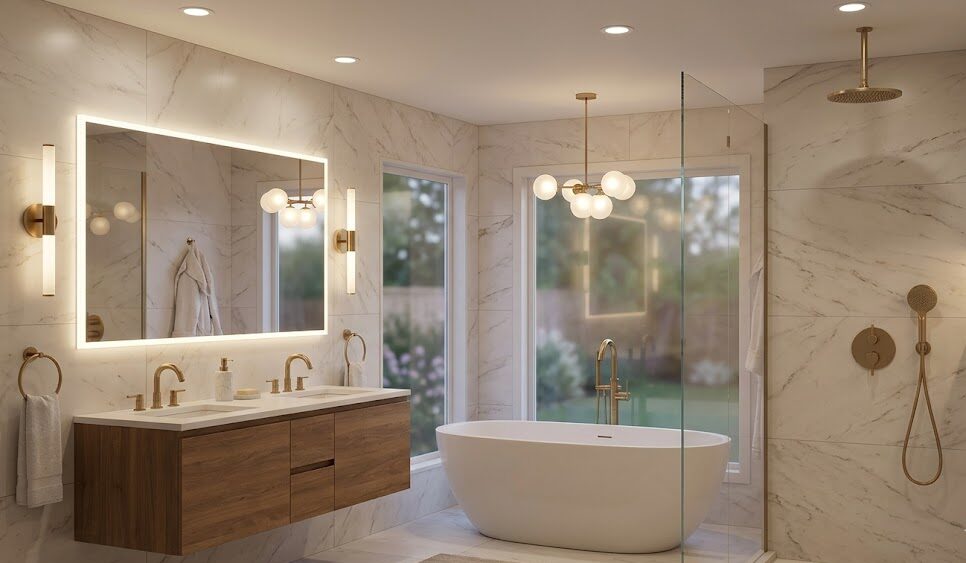
Bathroom Fixtures & Lighting That Elevate Daily Routines
The best bathrooms do more than look polished. They support the way mornings begin, the way evenings wind down, and the way everyday routines actually unfold. That is why bathroom fixtures lighting decisions deserve more attention than they often get.
A bathroom can have beautiful tile and a strong layout and still feel frustrating if the faucet splashes poorly, the toilet feels out of place, the mirror is undersized, or the vanity lighting creates harsh shadows. In the same way, a bathroom can feel dramatically better without changing its footprint if the fixtures and lighting are chosen with daily comfort in mind.
In this guide, you’ll learn:
- how to think through bathroom faucet, showerhead, and toilet selection with real-life use in mind,
- how mirrors, sconces, and overhead lighting influence comfort and usability,
- why a strong bathroom lighting plan matters as much as the fixture style itself,
- how to coordinate fixtures and lighting so the room feels intentional rather than pieced together,
- and how to create a bathroom that supports daily routines instead of fighting them.
The Fortress Builders approaches bathroom remodeling through a design-build process built around one principle: strength through structure. That means the visual choices and the functional choices are planned together. Fixtures, mirrors, sconces, lighting layers, plumbing, and layout all need to support the way the room will be used for years to come.
Helpful Fortress Builders pages while you plan:
- Bathroom Remodeling in Utah: Built to Last
- Bathroom Lighting Plan: Vanity Sconces, Mirrors, and Overhead Lighting
- Water-Efficient Bathroom Fixtures: Comfort, Performance, and Savings
- Small Bathroom Vanity Guide
- Spa Bathroom Upgrades That Feel Luxurious Without Going Overboard
- Heated Bathroom Floors: Electric vs. Hydronic
- Request a Design Consult
Why fixtures and lighting matter more than homeowners expect
Bathrooms are routine-driven rooms. You use them when you are tired, rushed, getting ready for work, helping kids, winding down at night, or trying to move through the morning with as little friction as possible. That means the details you touch and see every day matter a lot.
When bathroom fixtures and lighting are chosen well, the room tends to feel easier, calmer, and more comfortable. When they are chosen casually, even a good-looking bathroom can feel just slightly off in all the wrong ways.
- Fixtures affect touchpoints: how water flows, how handles feel, how easy the toilet is to use and clean, how the shower performs.
- Lighting affects function: whether you can groom comfortably, move safely, and use the room in both bright and low-light moments.
- Together, they affect daily experience: whether the bathroom feels intentional and supportive or simply finished.
Homeowner takeaway: In a bathroom, small decisions are rarely small. Faucets, mirrors, sconces, overhead lighting, and shower fixtures are some of the most repeated daily interactions in the room.
Start with daily routines, not with fixture catalogs
One of the easiest ways to improve bathroom renovation decisions is to stop starting with finishes and start with routines. A beautiful faucet or sconce matters less if it does not support the way the room is actually used.
Think about the busiest moments
In many homes, the bathroom experiences a few key daily scenes:
- morning grooming and getting ready,
- showers before work or school,
- late-night use with softer lighting needs,
- quick cleanups,
- shared use by multiple people.
Bathroom fixtures lighting planning should make those scenes easier, not simply make the room look upgraded.
Think about what currently annoys you
Homeowners often already know where the current bathroom underperforms:
- bad mirror lighting,
- not enough light at the vanity,
- awkward faucet reach,
- toilet placement that feels cramped,
- builder-grade fixtures that feel flimsy,
- a room that is too bright at night and not bright enough during grooming.
The 5-minute bathroom routines profile
- Who uses the room? One person, a couple, guests, or a family?
- When is it busiest? Morning rush, nighttime routines, shared schedules?
- What is most frustrating now? Lighting, splash, mirror use, shower performance, or cleaning?
- What matters most? Better grooming light, softer evening mood, more reliable fixtures, easier cleaning?
- What should feel better after the remodel? Faster mornings, calmer evenings, better comfort, better function?
Why this matters: These answers usually point to smarter fixture and lighting choices than trend boards alone ever will.
Bathroom faucet showerhead toilet selection should be about performance first
Style matters, but bathroom fixtures live or die on daily use. A faucet can look elegant and still feel awkward. A showerhead can seem luxurious and still disappoint. A toilet can disappear visually and still be one of the most important comfort choices in the room.
Faucets: where comfort and practicality meet
Bathroom faucet selection is about more than finish color. It affects splash behavior, handle comfort, coordination with the vanity and sink, and how easy the sink area is to keep clean. The faucet should feel proportional to the vanity, mirror, and counter rather than oversized or under-scaled.
Showerheads: think beyond the showroom
Shower fixtures need to support the kind of shower experience you actually want. That may mean a simple, reliable setup or a more layered system with a handheld and multiple functions. Either way, the most important question is whether it improves real daily use.
Toilets: one of the most underrated bathroom decisions
Toilets rarely get much design attention, but they affect comfort, clearance, cleaning, and how the bathroom feels in practical terms. The right choice should support the room’s layout and feel easy to maintain.
Simple rule: The best bathroom fixture selection is the one that disappears into a smooth daily experience. You should notice good performance more than you notice the product label.
How to choose fixtures that feel coordinated instead of overdesigned
One of the easiest ways to make a bathroom feel expensive is not by adding more features. It is by creating visual consistency across the fixtures. Faucet style, shower trim, hardware, mirror shape, sconces, and even the toilet’s relationship to the rest of the room should feel like part of the same design language.
Repeat the design logic, not every exact shape
Everything does not need to match perfectly. In fact, overly matched bathrooms can feel flat. The better goal is consistency in tone, scale, and visual direction.
Let the room decide how strong the fixtures should look
Some bathrooms benefit from bolder, sculptural fixtures. Others feel better with simpler, quieter pieces that let the tile, vanity, or mirror do more of the talking.
Balance statement fixtures with practical use
A beautiful faucet that splashes, a dramatic mirror that reflects poorly, or a trendy sconce that underlights the face is not a win. Function always has to stay in the conversation.
| If your bathroom priorities are… | Your fixture approach may lean toward… |
|---|---|
| Timeless and calm | Refined fixtures with simple lines, balanced scale, and restraint |
| Modern and design-forward | Cleaner silhouettes, stronger geometry, fewer competing decorative details |
| Warm and classic | Fixtures with softer shapes and more traditional familiarity |
| Daily practicality | Fixtures chosen primarily for ease of use, easy cleaning, and proportional fit |
Why a strong bathroom lighting plan matters so much
Bathrooms are one of the worst rooms in the house for bad lighting because poor light shows up in exactly the moments you need it most. Shaving, makeup, grooming, skincare, cleaning, late-night use, and mirror visibility all depend on light quality and placement.
A strong bathroom lighting plan typically needs more than one type of light. The room should be usable in bright task mode and also comfortable in lower-light moments.
- Task lighting: especially around the vanity and mirror
- Ambient lighting: broader room illumination
- Accent or softer lighting: for mood and nighttime comfort
For the deeper Fortress Builders guide, see Bathroom Lighting Plan: Vanity Sconces, Mirrors, and Overhead Lighting.
Homeowner takeaway: Bathroom lighting should not just make the room bright. It should make the room usable, flattering, comfortable, and flexible at different times of day.
Vanity lighting guide: the most important bathroom lighting zone
If the bathroom has one lighting area that deserves extra attention, it is the vanity. This is where most grooming tasks happen, where people judge whether the room “works,” and where bad lighting becomes irritating fast.
Mirror lighting should reduce shadows
Bathrooms often rely too heavily on a single overhead fixture, which can cast shadows in all the wrong places. Vanity lighting works best when the face is lit more evenly and comfortably.
Sconces can improve the grooming experience
Sconces placed thoughtfully can improve mirror usability, visual balance, and the overall sense of polish in the room. They also help create more layered light than overhead fixtures alone.
Mirror size and placement matter too
A mirror that is too small, too large, or poorly aligned with the vanity and light fixtures can weaken the entire composition. The lighting and mirror should be planned together, not separately.
Vanity lighting checklist
- Does the vanity light support real grooming tasks?
- Are shadows minimized at the mirror?
- Do the mirror, sconces, and vanity feel proportionate together?
- Does the light feel flattering rather than harsh?
- Can the vanity lighting work in both morning-bright and evening-softer settings?
Overhead lighting, mirrors, and layered light: getting the mix right
A bathroom usually needs overhead lighting, but overhead lighting should rarely do all the work. The strongest results come when ceiling lights support the room while mirror lighting and fixture lighting handle the more task-driven moments.
Overhead lighting supports the whole room
Ceiling-mounted light helps with movement, general visibility, cleaning, and background illumination. In larger bathrooms, it may also help define the room outside the vanity area.
Mirrors affect light perception
Mirrors multiply and redirect light, which means their placement and scale change how bright and balanced the bathroom feels. They should be selected with the lighting plan in mind.
Layered light creates flexibility
A bathroom that can move between bright task lighting and softer ambient light usually feels much more comfortable over time than one locked into a single lighting mode.
Best practice: Let overhead lighting support the room, and let vanity and decorative lighting do the work of making the bathroom feel human and usable.
Bathroom faucet, showerhead, toilet selection: what to compare before buying
When homeowners compare bathroom fixtures, it helps to evaluate them through three lenses: performance, cleaning, and proportional fit.
Performance
Does the faucet reach the sink properly? Does the shower setup match how the shower will actually be used? Does the toilet support comfort and room scale?
Cleaning
Some fixture shapes are easier to wipe down and live with than others. That is not the only factor, but it matters in a bathroom that will be cleaned often.
Proportional fit
A large, dramatic faucet on a small vanity can feel out of balance. A tiny mirror or weak light over a larger vanity can make the room feel under-scaled. The right choices often feel “obvious” only because the proportions were considered early.
| Fixture Category | What to Evaluate |
|---|---|
| Faucet | Splash behavior, handle comfort, proportion to sink and vanity, ease of cleaning |
| Showerhead / shower trim | Daily use pattern, adjustability, comfort, visual coordination with the room |
| Toilet | Comfort, clearance, cleaning ease, and overall fit within the layout |
| Mirror | Scale, relation to vanity and lighting, brightness impact, usability |
| Sconces / lighting fixtures | Light quality, placement, proportion, and mood flexibility |
Layout still drives how good fixtures and lighting feel
Even the best fixture and lighting package cannot fully overcome a weak layout. Vanity width, mirror placement, toilet clearance, shower entry, and traffic flow all affect how bathroom fixtures lighting decisions perform in real life.
Small bathrooms need tighter coordination
In a compact bathroom, every fixture choice is amplified. Vanity size, mirror shape, and light fixture projection all need to work together carefully. Related guide: Small Bathroom Vanity Guide.
Primary bathrooms often need more flexibility
Shared primary bathrooms may need stronger mirror lighting, better fixture performance, and more thought around simultaneous use. In these rooms, “looks good” is rarely enough on its own.
Guest bathrooms still deserve intentional decisions
Guest baths often benefit from simpler, durable fixtures and a clean, welcoming light strategy. The room does not have to be oversized to feel polished.
Practical truth: A bathroom feels elevated when the fixtures and lights seem to naturally belong exactly where they are. That usually comes from layout coordination, not luck.
Comfort upgrades that pair well with better fixtures and lighting
Sometimes the most effective bathroom upgrades are not dramatic on their own. They become powerful because they work together. Better fixtures and lighting often feel even more valuable when paired with a few comfort-focused improvements.
Heated floors
Strong lighting and better fixtures improve how the room works. Heated floors improve how the room feels. Related guide: Heated Bathroom Floors: Electric vs. Hydronic.
Water-efficient fixtures that still perform well
Fixture upgrades often feel more worthwhile when they save water without feeling weak. Related guide: Water-Efficient Bathroom Fixtures: Comfort, Performance, and Savings.
Spa-focused lighting and finish restraint
If the goal is a calmer, more restorative room, lighting usually matters more than adding more decorative objects. Related guide: Spa Bathroom Upgrades That Feel Luxurious Without Going Overboard.
If you want the bathroom to feel better daily, focus on:
- better mirror and vanity lighting,
- fixtures that feel good to use,
- stronger shower performance,
- lighting layers for both task and evening comfort,
- and a few comfort upgrades that support the room without overcrowding it.
Common fixture and lighting mistakes homeowners regret
Mistake 1: Choosing by finish alone
Finish color matters, but it is only one part of the decision. Performance, scale, and use matter more over time.
Mistake 2: Relying on overhead light only
This is one of the most common reasons a bathroom looks fine on paper but feels disappointing in daily use.
Mistake 3: Treating the mirror as an afterthought
Mirror size and position affect lighting performance, visual balance, and routine comfort more than many homeowners expect.
Mistake 4: Overdecorating the vanity wall
Too many competing elements can make the room feel busy and reduce functional clarity.
Mistake 5: Waiting too long to coordinate plumbing and lighting decisions
Fixture and lighting choices should be coordinated early enough to support rough-in, switch planning, mirror placement, and the overall bathroom composition.
How Fortress Builders would approach fixtures and lighting for daily routines
A good bathroom is not assembled one product at a time. It is planned around how the room should feel and function first, then supported with the right layers of fixtures, lighting, and layout decisions.
That means asking:
- How will the vanity be used daily?
- What kind of mirror lighting creates the best comfort?
- Which fixture selections improve the room without overcomplicating it?
- How should task, ambient, and softer lighting layers work together?
- What choices support both practical routines and long-term satisfaction?
When those questions are answered early, the finished bathroom tends to feel far more intentional. The fixtures feel like they belong. The light supports real routines. And the room does not just look elevated. It actually behaves better every day.
FAQ: Bathroom fixtures and lighting
What is the most important bathroom lighting zone?
For most bathrooms, the vanity zone is the most important because that is where grooming, mirror use, and daily routines happen. Good vanity lighting has an outsized effect on how the whole bathroom feels.
Should bathroom fixtures all match exactly?
Not necessarily. They should feel coordinated, but they do not all need to be identical. The better goal is a consistent design language and balanced proportions.
How do I choose the right bathroom faucet?
Look at how it functions with the sink and vanity, how easy it is to use and clean, how it fits the scale of the room, and whether it supports the broader bathroom style without overpowering it.
Are sconces better than overhead bathroom lighting?
They do different jobs. Overhead lighting helps illuminate the room overall, while sconces often support better mirror lighting and more flattering task light. The strongest bathrooms usually use both in a layered plan.
When should lighting and fixture decisions be finalized?
As early as possible during the design phase, especially before rough-in and mirror placement are finalized. Late decisions often create compromises in layout, wiring, or overall visual balance.
Conclusion: choose bathroom fixtures and lighting that make real life easier
The best bathroom fixtures lighting plan is not simply the one that looks the most current. It is the one that makes the room more comfortable, more usable, and more aligned with the routines that happen there every day.
When the faucet works well, the mirror feels right, the shower performs the way it should, the vanity lighting reduces shadows, and the room can move from bright morning function to softer evening comfort, the bathroom starts to feel truly elevated. Not just finished, but thoughtfully built around daily life.
That is what makes good fixtures and lighting worth planning carefully. They shape the room in small ways that add up every single day.
Want help choosing bathroom fixtures and lighting that actually improve daily routines?
If you’re planning a bathroom remodel in Davis or Weber County, Fortress Builders can help you think through faucet and shower selections, mirrors, sconces, vanity lighting, overhead lighting, and the layout decisions that make the finished room feel easy to live in.
Request a Design Consult Explore Bathroom Remodeling Read the Bathroom Lighting Guide
Bring your inspiration images, your current frustrations, and the routines you want the new bathroom to support. Fortress Builders can help turn that into a bathroom plan that is beautiful, practical, and built to last.