

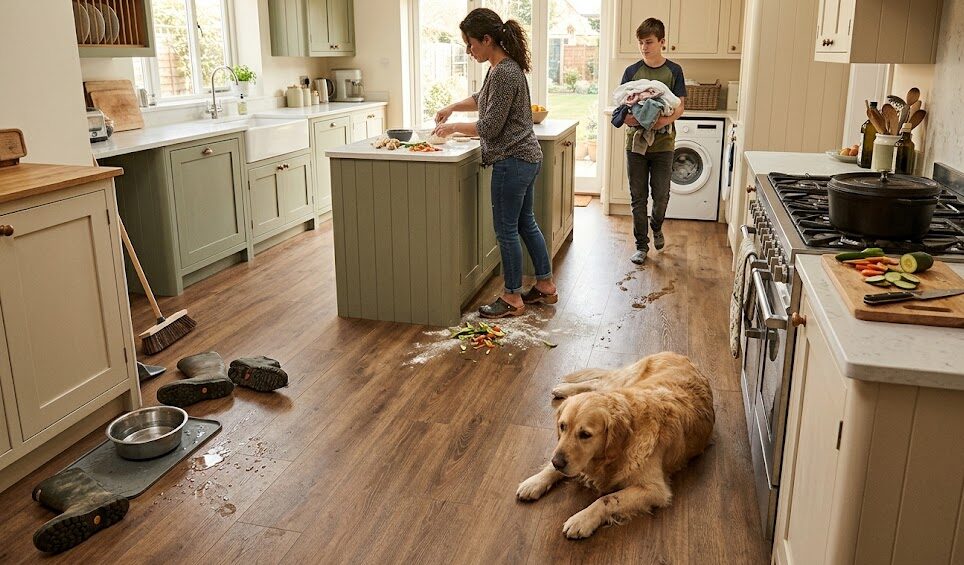
Durable Kitchen Flooring & Surfaces Built to Last
Kitchen floors do more than complete the look of a remodel. They take the daily impact of shoes, spills, dropped utensils, chair movement, pet traffic, moisture, crumbs, grease, and constant cleaning. In other words, your kitchen flooring and surfaces have to perform long after the “before and after” photos are taken.
That is why durable kitchen flooring should never be an afterthought. Homeowners often spend weeks comparing cabinet finishes and countertop samples, but rush the floor decision because the options feel technical or overwhelming. The problem is that the floor influences comfort, noise, maintenance, visual warmth, transitions into nearby rooms, and how the whole kitchen ages over time.
In this guide, you’ll learn:
- how to compare popular kitchen floor materials in plain English,
- what “durable” really means in a real household,
- how wear patterns, cleaning habits, and transitions should shape your choice,
- how flooring and surface decisions connect to layout, cabinets, and the rest of the remodel,
- and how to avoid common mistakes that make a new kitchen feel high-maintenance too quickly.
The Fortress Builders plans kitchen remodels through a design-build process that aligns layout, cabinetry, lighting, appliances, and finishes from the start. That matters here because kitchen surface selection is never just about a single material sample. It is about how the kitchen will look, feel, and perform in real life.
Helpful Fortress Builders pages while you plan:
Why kitchen flooring deserves more attention than it usually gets
Kitchen flooring is one of the hardest-working surfaces in the house. Unlike a wall color or decorative light fixture, the floor affects almost every moment of daily use. You feel it underfoot. You clean it constantly. You notice whether it hides crumbs gracefully or seems to show every mark five minutes after mopping.
Good kitchen flooring and surfaces planning should balance five things:
- Durability: How well does the material handle wear, water, dents, dropped items, and traffic?
- Maintenance: How easy is it to clean, and how forgiving is it between cleanings?
- Comfort: Does it feel hard, cold, noisy, or supportive for longer periods of standing?
- Appearance: Does it work with the cabinet style, countertop, lighting, and overall kitchen direction?
- Transitions: How well does it relate to the nearby rooms and the broader home?
Homeowner takeaway: The “best” kitchen floor material is not the one with the strongest marketing claims. It is the one that matches the way your household lives, cleans, cooks, and moves through the home.
What “durable kitchen flooring” really means in real life
Durability sounds straightforward, but it means different things depending on how your kitchen is used. A floor can resist scratching well but feel cold and hard. Another floor can be comfortable underfoot but less forgiving around standing water. One material may handle dropped spoons beautifully but chip if a heavy pan lands badly.
That is why kitchen remodel flooring choices should be judged against actual household behavior:
- Do kids run in and out of the kitchen from outside?
- Do you cook every night or mostly reheat and snack?
- Do you have dogs with nails and water bowls in the kitchen zone?
- Do you care more about low maintenance, visual warmth, or sheer toughness?
- Are you remodeling for long-term personal use or partly with resale in mind?
The 5-minute flooring reality check
- Traffic: Light, medium, or heavy daily use?
- Moisture: Are spills wiped immediately, or does life get messy?
- Comfort: Do you stand and cook for long stretches?
- Maintenance: Do you want forgiving surfaces or are you comfortable with more upkeep?
- Style goal: Warm and natural, crisp and modern, classic and timeless?
Why this matters: Your answers often narrow the best kitchen floor materials faster than any showroom display can.
The most common kitchen floor materials, compared simply
There is no single perfect answer for every household. But there are patterns. Some materials tend to perform better in busy kitchens. Others offer a certain look but ask more from homeowners in maintenance or comfort.
| Material | Strengths | Watch-outs |
|---|---|---|
| Porcelain or ceramic tile | Durable, water-resistant, easy to clean, works in many styles | Hard underfoot, grout maintenance matters, can feel cold |
| Luxury vinyl plank (LVP) / luxury vinyl tile (LVT) | Water-friendly, softer than tile, often budget-flexible, easy to live with | Quality varies, long-term appearance depends on product level and installation |
| Hardwood | Warm, timeless, visually cohesive with nearby rooms | Can show wear and moisture issues more easily in busy kitchens |
| Engineered wood | Wood look with somewhat more dimensional stability than solid hardwood | Still needs realistic moisture expectations and product-specific evaluation |
| Natural stone | High-end character, strong visual impact, classic appeal | Can require more maintenance and can feel hard/cold like tile |
Porcelain and ceramic tile: a classic durability-first option
Tile remains one of the most trusted kitchen floor materials for a reason. It handles water well, cleans easily, and can hold up beautifully over time when the installation is solid. For homeowners who want durable kitchen flooring and do not mind a firmer feel underfoot, tile is often high on the list.
Why tile works well in kitchens
- It stands up well to spills and routine cleaning.
- It works in traditional, transitional, modern, rustic, and luxury kitchens.
- It offers a broad range of looks, from warm stone visuals to sleek modern finishes.
- It pairs well with radiant heat in some projects, which can improve comfort.
What homeowners should think about carefully
- Grout: Grout selection and maintenance matter almost as much as the tile itself.
- Comfort: Tile is firm, and some homeowners feel that more quickly during long cooking sessions.
- Slip resistance: Surface texture matters, especially in a working kitchen.
- Transitions: Tile thickness and height transitions need to be planned relative to nearby flooring.
Tile is often strongest when the design team thinks through not just the tile color, but also grout color, tile size, slip feel, edge conditions, and where the material transitions into adjacent rooms.
Luxury vinyl plank and luxury vinyl tile: practical and forgiving for many households
LVP and LVT have become popular kitchen surface selection options because they offer a useful mix of resilience, water tolerance, comfort, and visual flexibility. For many families, they hit a sweet spot between everyday practicality and style.
Why homeowners often like vinyl flooring in kitchens
- It is generally softer and warmer underfoot than tile.
- It can be more forgiving with everyday splashes and family messes.
- It often provides strong style value without requiring the same budget level as some premium materials.
- It can work especially well in homes where comfort and ease of cleaning rank high.
Where homeowners need to be careful
- Not all vinyl products perform equally. Product quality matters.
- Installation quality still matters, especially in how the floor feels and ages.
- Some homeowners prefer the authenticity of tile or wood over a printed-look product.
- Very design-driven kitchens may call for a more premium-feeling finish, depending on the rest of the materials.
Practical truth: For many busy families, durable kitchen flooring is not just about surviving spills. It is about staying visually calm, feeling comfortable, and not making every dropped crumb feel like a crisis.
Hardwood and engineered wood: warmth, continuity, and tradeoffs
Wood flooring continues to appeal to homeowners because it creates warmth and helps kitchens feel connected to the rest of the home. In open-concept layouts especially, wood can make transitions feel softer and more cohesive.
Why wood remains appealing
- It brings warmth that many homeowners find hard to replicate.
- It often helps the kitchen connect naturally to dining, living, and hallway spaces.
- It suits a wide range of styles, from classic to modern organic.
What to weigh honestly
- Wood is still wood. Kitchens are high-traffic, spill-prone rooms.
- Some wear can add character, but some homeowners find kitchen wear stressful.
- Moisture exposure habits matter more with wood-based floors than with tile or many resilient surfaces.
- Product choice, finish, and household expectations matter a lot.
For some households, wood is absolutely the right answer. For others, the idea of wood is more appealing than the reality of maintaining it in a high-use cooking zone.
Natural stone and premium surface options: beautiful, but not always the most forgiving
Natural stone can create a high-end look with real depth and character. In the right home, it can feel timeless. But like tile, it is usually firm underfoot, and some stone surfaces ask more from homeowners in maintenance or sealing depending on the material.
When stone can be a strong choice
- You want a more elevated, natural-material look.
- You are comfortable with a harder walking surface.
- You are committed to the right maintenance expectations for the selected stone.
When another option may be easier to live with
- If you want low-stress cleaning and less ongoing care.
- If comfort underfoot is a top priority.
- If the broader kitchen budget is better spent on other upgrades.
Kitchen flooring and surfaces should be judged by cleaning reality, not ideal conditions
One of the smartest ways to compare kitchen floor materials is to stop imagining a spotless designer kitchen and instead imagine a Wednesday evening after dinner. There are crumbs under the stools. Someone spilled water near the sink. The dog came in with wet paws. The dishwasher is open. The kitchen is not terrible, but it is real.
Ask yourself:
- What does this floor look like between cleanings?
- Does it show every streak or footprint?
- Will I resent maintaining it, or barely think about it?
- How does it feel when I stand on it for 45 minutes?
Cleaning-reality checklist
- Does the material show dust, crumbs, and streaks quickly?
- Will grout or joints require extra attention?
- Does the finish hide everyday traffic or amplify it?
- Will this floor still feel livable on a busy week, not just after a deep clean?
- Does your household prefer low-fuss or is some upkeep acceptable for the look?
Wear patterns matter more than showroom samples
Samples are helpful, but they rarely tell the whole story. Kitchens develop wear in predictable places: in front of the sink, near the refrigerator, around the island corners, at the range, and along the most-used walking paths. Those wear zones should influence kitchen remodel flooring decisions early.
Watch the “standing zones”
If one person in the home cooks frequently, the floor will be felt most intensely where that person stands. A material that looks amazing but feels punishing may become more frustrating than expected.
Watch the “pivot points”
Some zones receive repetitive turning, chair movement, and traffic concentration. A material’s long-term success often shows up in how it handles those spots.
Watch the “water moments”
Not every kitchen experiences huge spills, but nearly every kitchen sees repeated splashes at the sink, dishwasher, and refrigerator area. A floor that matches your real spill habits usually ages more gracefully.
Best practice: Choose kitchen flooring as though the high-use zones matter most—because they do. The performance in those areas usually shapes your opinion of the whole floor.
Transitions can make a great floor choice feel wrong if they are ignored
Kitchen flooring rarely lives in isolation. It meets hallways, mudrooms, dining spaces, family rooms, or adjacent pantries. Even a strong flooring choice can feel awkward if the transition to nearby rooms is abrupt or poorly planned.
Open-concept homes
In open layouts, flooring continuity matters more because the kitchen is visually connected to nearby spaces. The kitchen floor may need to feel like part of a larger design story rather than a separate “zone.” Related reading: Open-Concept Kitchen Remodel: Pros and Cons.
Whole-home or partial remodel sequences
If the kitchen is one phase of a bigger remodel, future flooring decisions may affect what makes the most sense now. In that case, sequencing matters. Related reading: Whole-Home Remodel Sequencing.
Height differences
Material thickness and subfloor conditions can affect transition height. That is one reason flooring decisions should be coordinated early alongside cabinetry, appliances, and adjacent finishes.
Flooring has to work with cabinets, counters, lighting, and layout
Kitchen surface selection should never happen in a vacuum. The floor influences how cabinets read, how countertop tones feel, how light reflects through the room, and whether the kitchen feels grounded or visually busy.
Flooring and cabinet color
Strong cabinet color and strong flooring pattern can be a powerful combination—or an overwhelming one. The key is balance. If the cabinets are bold, the floor may need to calm the room. If the kitchen is mostly quiet and neutral, the floor may be able to contribute more character.
Flooring and countertops
Countertops bring visual weight higher in the room, while floors anchor it below. They should feel coordinated, not matched. If you are still comparing countertop options, see Quartz vs. Granite vs. Porcelain Countertops and Countertop Edge Profiles Guide.
Flooring and lighting
Some floors reflect more light. Some absorb it. Some show texture dramatically under pendant or under-cabinet lighting. That is why flooring decisions connect directly to the broader lighting plan. See Kitchen Lighting & Electrical and Under-Cabinet Lighting Done Right.
| If your kitchen priorities are… | You may lean toward… |
|---|---|
| Maximum water resistance and easy cleanup | Tile or a strong resilient flooring option |
| Warmth and whole-home continuity | Wood or wood-look flooring that suits your household tolerance for upkeep |
| Comfort underfoot for frequent cooking | A less rigid surface than stone or tile, depending on your priorities |
| A timeless, premium-feeling material palette | Tile, natural stone, or another finish that suits the home’s style and maintenance expectations |
| Low-drama daily living with kids or pets | A forgiving, easy-care flooring choice that aligns with your layout and budget |
How to compare kitchen floors without getting lost in details
Homeowners sometimes get overwhelmed because flooring decisions can spiral into dozens of sub-questions about finish, thickness, tone, texture, and installation details. A simpler method is to compare options in tiers.
Tier 1: Performance fit
Which materials match your moisture tolerance, traffic level, comfort preferences, and maintenance expectations?
Tier 2: Design fit
Which of those materials works with the cabinets, counters, lighting, and overall style direction?
Tier 3: Budget fit
Which option makes sense once the full remodel budget is considered—not just the flooring line item?
Simple comparison process
- Eliminate materials that do not match your real-life performance needs.
- Narrow the remaining options based on kitchen style and nearby-room transitions.
- Compare the finalists with your broader remodel budget in mind.
- Review how the winning option interacts with cabinets, counters, and lighting.
- Confirm installation, transitions, and substrate conditions before final ordering.
Common kitchen flooring mistakes homeowners regret later
Mistake 1: Choosing only by sample-board beauty
A small sample often does not show how a floor behaves across a whole room, especially once traffic, light, and adjacent materials are factored in.
Mistake 2: Underestimating cleaning reality
Some floors are technically easy to clean but show mess faster. Others stay visually calmer longer. That difference matters in busy households.
Mistake 3: Forgetting transitions
A good kitchen floor choice can still feel awkward if it does not relate well to the surrounding home.
Mistake 4: Ignoring comfort
If you spend a lot of time cooking, a floor that feels punishing underfoot may become a daily annoyance regardless of how durable it is.
Mistake 5: Finalizing flooring too late
Flooring decisions should be coordinated early enough to support cabinets, appliances, heights, and transitions—not made in a rush once everything else is already set.
Best practice: The right kitchen floor should feel like it belongs to the whole remodel, not like a separate decision made at the end.
How Fortress Builders would approach kitchen flooring and surfaces planning
A strong kitchen remodel does not start by asking, “Which flooring is trending?” It starts with how the homeowners use the space, what the house architecture supports, and what level of maintenance and comfort makes sense for the people living there.
From there, flooring is evaluated alongside:
- layout and traffic flow,
- cabinet style and finish,
- countertop and backsplash direction,
- lighting plan,
- appliance placement,
- and how the kitchen transitions into nearby rooms.
This is one of the advantages of a design-build process. Instead of selecting kitchen surfaces in isolation, the whole system can be considered together before the work begins.
If you are still in the earlier stages of planning, these resources can help complete the bigger picture: Kitchen Measurement Guide for Remodel, Kitchen Remodel in Stages: What to Prioritize, and Your Guide to a Seamless Remodel.
FAQ: Durable kitchen flooring and surfaces
What is the most durable kitchen flooring?
There is no one universal answer because “durable” depends on what kind of wear matters most in your home. Tile is often chosen for water resistance and toughness. Some resilient flooring options are chosen for comfort and easy everyday living. The best answer usually depends on your traffic, cleaning habits, and style goals.
What kitchen floor material is easiest to maintain?
That depends on the product and the household, but many homeowners find that floors with forgiving visual texture and simple cleaning needs are easier to live with than floors that show every streak or crumb. Grout, finish, and color all influence maintenance experience.
Is hardwood a bad idea in a kitchen?
Not necessarily. Many beautiful kitchens use wood successfully. The key is matching the material to the household’s moisture habits, wear expectations, and comfort with maintenance over time.
Should kitchen flooring match the rest of the house?
Not always exactly, but it should relate well. In open-concept layouts, continuity often matters more. In more segmented homes, a thoughtful transition may be enough. The goal is visual harmony, not forced matching.
When should flooring be selected in a remodel timeline?
Early enough that the flooring decision can support cabinet planning, appliance coordination, transitions, and overall design direction. Waiting too long often creates avoidable compromises.
Conclusion: choose flooring that works hard and ages gracefully
Durable kitchen flooring is not just about surviving heavy use. It is about choosing a surface that still feels right after months and years of cooking, cleaning, walking, hosting, and everyday life. The right floor should support the way your household lives now and help the whole kitchen feel stronger as a finished space.
For some homeowners, that means prioritizing water resistance and easy cleanup. For others, it means warmth, continuity, and a softer feel underfoot. For many, the best answer sits somewhere in the middle. The point is not to chase a trend. It is to choose kitchen flooring and surfaces that hold up visually, functionally, and practically over time.
That decision gets much easier when it is made as part of the full kitchen plan—not as a rushed finish choice near the end of the project.
Want help choosing kitchen flooring and surfaces that will still feel right years from now?
If you’re remodeling a kitchen in Davis or Weber County, Fortress Builders can help you compare kitchen floor materials, think through wear patterns and transitions, and align your flooring choice with the rest of the remodel before materials are ordered.
Request a Design Consult Explore Kitchen Remodeling Countertop Comparison Guide
Bring your inspiration images, cabinet ideas, and surface samples. Fortress Builders can help you make a flooring decision that looks good now and performs well long after the remodel is complete.