

Outdoor Living Spaces Designed for Utah Living
A great outdoor living space is not just a patio with furniture on it. It is an extension of the home—planned for weather, comfort, function, and the way Utah families actually live.
That is what makes outdoor living design different from simply adding hardscape or building a deck. A successful outdoor remodel has to respond to sun exposure, wind, changing temperatures, snow load, maintenance expectations, entertaining habits, and how the exterior space connects to the house. When all of that is handled well, the backyard starts to feel less like leftover square footage and more like a true living environment.
This guide walks through what homeowners should think about when planning outdoor living spaces in Utah. You will learn how patio design in Utah differs from milder climates, why covered patio planning is often worth the effort, how to evaluate deck, patio, and pergola ideas, what material choices matter most, and how to create an outdoor remodel that still feels useful after the reveal photos are over.
The Fortress Builders approaches outdoor remodeling through one core principle: strength through structure. Every strong exterior project starts with a design blueprint that aligns homeowner goals, budget direction, and build logic before the work begins. That process helps create outdoor spaces that are not only beautiful, but durable, comfortable, and truly fitted to Northern Utah living.
- How to plan outdoor living spaces in Utah around climate, comfort, and long-term use
- What makes patio design in Utah different from generic inspiration online
- How to compare deck, patio, and pergola ideas more realistically
- Why covered patio planning matters for sun, weather, and usability
- How to choose materials and layouts that hold up under real entertaining and real seasons
Why homeowners invest in outdoor living spaces instead of settling for a simple backyard
Most backyards already have space. What they often do not have is structure. A homeowner may technically own plenty of outdoor square footage, but without shade, layout logic, lighting, gathering zones, or weather-conscious design, that space often stays underused. Outdoor living projects change that by giving the yard function, comfort, and purpose.
Homeowners usually invest in outdoor living spaces because they want more than appearance. They want the backyard to support the way they actually spend time.
Better Gathering Space
A strong outdoor layout gives family and guests somewhere to actually spend time rather than just pass through.
Indoor-Outdoor Connection
Outdoor living works best when it feels like a continuation of the home rather than a separate zone with no clear relationship to it.
More Seasonal Use
Thoughtful design can make the space useful across much more of the year instead of only on the easiest summer days.
Entertaining Support
Dining, lounging, grilling, and conversation all work better when the outdoor area is planned around them intentionally.
Property Enjoyment
Outdoor remodels often increase how much homeowners actually enjoy being at home, not just how the yard photographs.
Long-Term Value
Well-built exterior living spaces can improve daily use now while also making the property feel more complete later.
Outdoor living spaces in Utah need to be planned for Utah—not for a generic Pinterest climate
Utah outdoor living brings its own opportunities and its own demands. Bright sun, temperature swings, seasonal snow, dry conditions, occasional wind exposure, and strong sun angles all influence how an outdoor space should be built. That means homeowners should be careful about copying inspiration from regions with very different climates, vegetation, and construction expectations.
Sun exposure is a major comfort issue
In Utah, a beautiful patio can become nearly unusable during peak summer hours if shade and orientation are not handled well. Covered patio planning, pergolas, and strategic zone placement matter because direct sun changes how long the space feels comfortable.
Seasonality should shape design decisions
Homeowners may not expect to use the yard every day in every season, but they often want the space to feel durable, attractive, and low-hassle year-round. Materials, drainage, snow handling, and furniture zones should all reflect that reality.
Dry climate does not remove weather risk
Utah may not present the same moisture conditions as coastal climates, but exterior construction still has to handle freeze-thaw cycles, temperature variation, UV exposure, and site-specific drainage.
If an outdoor feature looks good online but does not account for direct summer sun, seasonal exposure, wind, snow, or maintenance in a high-UV climate, it may not perform the way you expect in Northern Utah.
| Utah Outdoor Condition | Why It Matters in Planning |
|---|---|
| Strong Sun | Shade planning, orientation, and covered areas often determine whether the space is truly usable. |
| Seasonal Temperature Swings | Materials and comfort strategies should hold up across hot summers and cold winters. |
| Snow / Freeze-Thaw | Structure, drainage, surface materials, and overhead features need to be chosen with long-term durability in mind. |
| UV Exposure | Color fade, surface wear, and material aging can happen faster when outdoor spaces are heavily sun-exposed. |
Patio design in Utah starts with orientation, flow, and real behavior
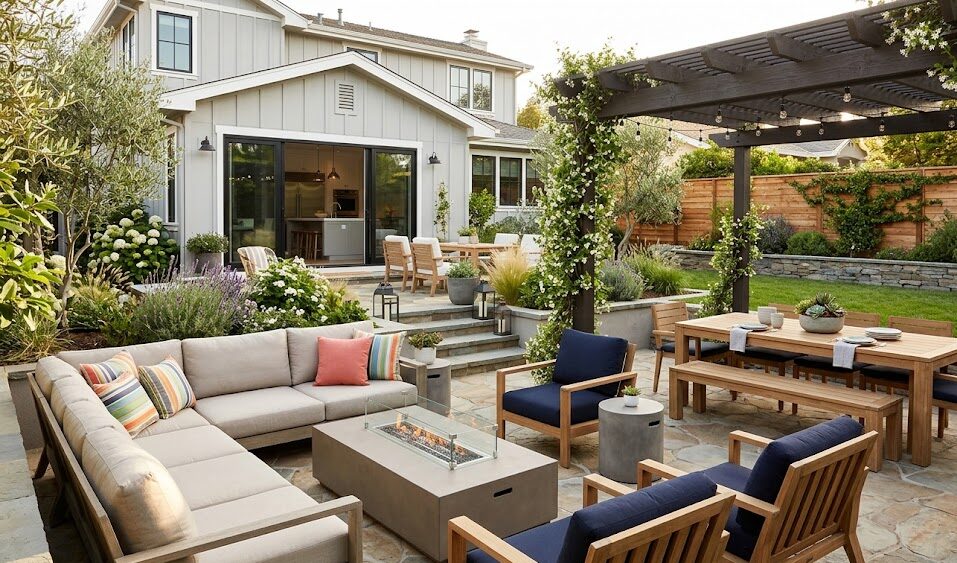
Patio design in Utah is often treated too narrowly, as if the patio is just a surface choice. In reality, the patio is usually the foundation of the whole outdoor living environment. It determines where furniture can go, how traffic moves, how grilling and dining relate to each other, and how easily the space connects to the house.
Patio location matters as much as patio size
A patio that is technically large enough may still feel weak if it is exposed at the wrong time of day, too disconnected from the kitchen, or placed where wind and glare work against it.
Think in zones, not just square footage
Dining, lounging, grilling, circulation, and fire-feature gathering all need slightly different spatial logic. The strongest outdoor spaces feel easy because those functions were planned in relationship to each other instead of layered into one flat slab at the end.
The patio should support the house
Outdoor living works best when the patio extends interior function instead of competing with it. That often means thinking carefully about door locations, sightlines, and how the family naturally exits and re-enters the home.
- Where will people actually sit longest?
- Where will dining feel most convenient and comfortable?
- How will traffic move between house, grill, and gathering zones?
- Which parts of the patio need shade first?
- Will the layout still work when the space is fully occupied?
Deck, patio, and pergola ideas: how to choose the right outdoor structure
Homeowners often begin by asking whether they need a deck, a patio, a pergola, or some combination of the three. The right answer depends on grade conditions, access to the house, the kind of use the space needs to support, and how much weather protection is important.
Patios
Patios often work well where the outdoor living zone is close to grade and where homeowners want a stable surface for dining, lounging, or larger entertaining zones. They often feel grounded and easy to integrate into broader backyard design.
Decks
Decks can be the better solution when the main level of the home sits above grade or when the house needs a more direct elevated transition to the outdoors. They often create stronger immediate connection to upper-level living spaces.
Pergolas
Pergolas can add visual structure, partial shade, and stronger definition to an outdoor living space. They are especially helpful when homeowners want the area to feel more architectural without fully enclosing it.
| Outdoor Feature | Best Use Case |
|---|---|
| Patio | Ground-level gathering, flexible furniture zones, dining areas, and broad entertaining surfaces |
| Deck | Elevated connection to the house, views, and strong transition from main-floor living zones |
| Pergola | Architectural definition, partial shade, and visual structure over key outdoor zones |
Homeowners comparing deck, patio, and pergola ideas often benefit from understanding how outdoor living decisions affect the larger remodel strategy too. The Fortress Builders page on outdoor living in Utah: deck vs patio is especially useful for thinking through which base structure supports the space best before you move too far into finishes or furnishings.
Covered patio planning: why overhead protection is often the real difference-maker
For many outdoor living spaces in Utah, the biggest upgrade is not the surface underfoot. It is the protection overhead. Covered patio planning often determines whether the space becomes truly usable during hot afternoons, light weather changes, or shoulder-season evenings.
Shade extends daily use
Without some form of overhead relief, homeowners may find that the outdoor area is only pleasant during limited hours. A cover can dramatically increase comfort during the times of day when people most want to be outside.
Coverage changes furniture and finish durability too
Outdoor furniture, upholstery, and even the day-to-day maintenance of the space are all affected by how exposed the zone is.
Covered does not have to mean enclosed
Homeowners sometimes assume the choice is between a totally open patio and a fully enclosed room. In reality, there is a lot of middle ground—roofed structures, pergola layers, partial covers, and integrated shade strategies can all create stronger usability without losing the outdoor feel.
If the outdoor space already seems attractive but somehow still goes unused, coverage and shade may be the missing factor—not more furniture, more décor, or a larger hardscape footprint.
Materials and maintenance: what should hold up in Utah conditions
Outdoor remodel materials have to do more than look good on installation day. They need to withstand UV exposure, seasonal movement, moisture events, freeze-thaw cycles, spilled drinks, furniture drag, and the general wear of everyday use. That is why outdoor material selection should always be tied to both climate and behavior.
Low maintenance does not mean no maintenance
Every outdoor material will age. The real question is whether it ages gracefully and whether the maintenance it requires matches the homeowner’s tolerance and routine.
Surface temperature matters too
Some surfaces may look great but become less pleasant under direct summer sun. This is one of the reasons Utah-specific planning matters.
The most durable choice is not always the best design choice
Material selection is usually about balancing durability, comfort, visual warmth, and long-term care expectations instead of optimizing one factor only.
- How will this surface handle direct sun and seasonal exposure?
- Will it feel comfortable to walk on in summer?
- How much maintenance will it realistically require?
- Will it still look good after several seasons of actual use?
- Does it support the design style of the home as well as the outdoor lifestyle of the family?
Homeowners also benefit from looking at broader exterior design logic, especially when the outdoor remodel includes significant structure. If you are deciding how to connect an outdoor project back to the rest of the property, the Fortress Builders page on outdoor living spaces is a good next step for seeing how different components fit into one full design-build strategy.
Entertaining-focused outdoor remodels should be designed around real gatherings
Some outdoor spaces are mostly about quiet family use. Others are clearly meant to host. If entertaining is one of the main goals, the layout should reflect how gatherings actually unfold rather than assuming people will magically adapt to whatever shape is built.
Dining and lounge zones should not compete with each other
One of the most common entertaining mistakes is crowding too many functions into one zone without enough room for each of them to work well.
Grilling and serving should feel convenient
If cooking outside is part of the plan, the route between grill, prep space, dining area, and house matters more than homeowners often expect.
Traffic paths need to stay open when the space is full
An outdoor area that feels generous when empty can feel surprisingly tight during actual gatherings if circulation was not planned intentionally.
Dining Zone
Works best where meals can happen comfortably without blocking movement across the rest of the patio.
Lounge Zone
Should feel like somewhere guests can settle in, not a leftover arrangement squeezed beside traffic paths.
Cooking Support
Grill and prep zones should feel close enough to the house and dining area to stay practical during real hosting.
Conversation Flow
The best outdoor layouts make it easy for people to move, sit, and gather naturally without constant rearranging.
Lighting, power, and comfort details are what make the space usable after sunset
Outdoor living often gets planned as if it only matters during perfect daylight hours. But many of the best moments happen later in the day, especially in warmer months. That means exterior lighting and comfort details play a major role in whether the space becomes a real extension of the home.
Outdoor lighting should support safety and mood
People need to move comfortably through the space, but the yard should also feel inviting rather than overlit or flat.
Power planning matters more than homeowners expect
Fans, heaters, music, charging, lighting features, cooking support, and other outdoor conveniences all benefit from a plan that anticipates actual use rather than relying on temporary plug-in workarounds later.
Wind, heat, and evening use all shape comfort
An outdoor space can be visually beautiful and still feel slightly off if basic comfort conditions were never part of the original design conversation.
Permits, drainage, electrical, and structural requirements should be treated seriously
Outdoor remodel projects can look visually simple and still involve important technical decisions. Structural loads, footings, electrical needs, exterior drainage, lighting, overhead structures, and site conditions can all affect what is possible and what is required for a safe, durable result.
Do not assume the backyard is “low-risk” just because it is outside
Exterior work still has to hold up structurally, manage water responsibly, and function safely over time.
Requirements vary by project and jurisdiction
Covered patio structures, electrical installations, drainage changes, deck framing, and other outdoor features may involve permitting, inspections, or local code requirements.
Professional coordination protects the result
Outdoor spaces often fail not because the idea was bad, but because important structural or environmental decisions were treated too casually early in the process.
- Permits, inspections, structural requirements, snow-load considerations, electrical work, and drainage rules can vary by project and jurisdiction.
- Utah climate and site conditions can significantly influence outdoor design and build decisions.
- Final planning details should always be confirmed with qualified professionals and local authorities where applicable.
Common mistakes homeowners make on outdoor remodel projects
Designing for looks before designing for comfort
A beautiful patio that overheats, lacks shade, or ignores circulation often goes underused quickly.
Ignoring Utah weather and sun exposure
Outdoor spaces in Utah need climate-aware planning to remain comfortable and durable over time.
Choosing features before defining the real use case
Decks, patios, pergolas, and covers work best when they are selected to support behavior, not just because they look appealing in inspiration photos.
Underplanning shade and evening comfort
Many outdoor spaces fail not because they are too small, but because they do not feel good to use during the times people most want to be outside.
Treating the project like surface work instead of real construction
Drainage, structural support, electrical planning, and build quality all shape whether the space lasts.
How Fortress Builders approaches outdoor living spaces for Utah homes
A strong outdoor remodel starts by understanding how the space should work, not just how it should look. Is the goal dining, lounging, hosting, grilling, quiet retreat, or a mix of all of those? How much shade is needed? How much weather protection is worth building in? What should connect directly to the house, and what should feel more like a destination within the yard?
From there, the design-build process can coordinate patio design, deck or pergola choices, covered patio planning, structural decisions, electrical support, and finish selection in a way that responds to Utah conditions instead of ignoring them. That is what helps the finished space feel integrated, comfortable, and built to last.
The goal is not to make the yard look busy or high-budget. The goal is to make it feel usable, durable, and naturally tied to the life of the home.