

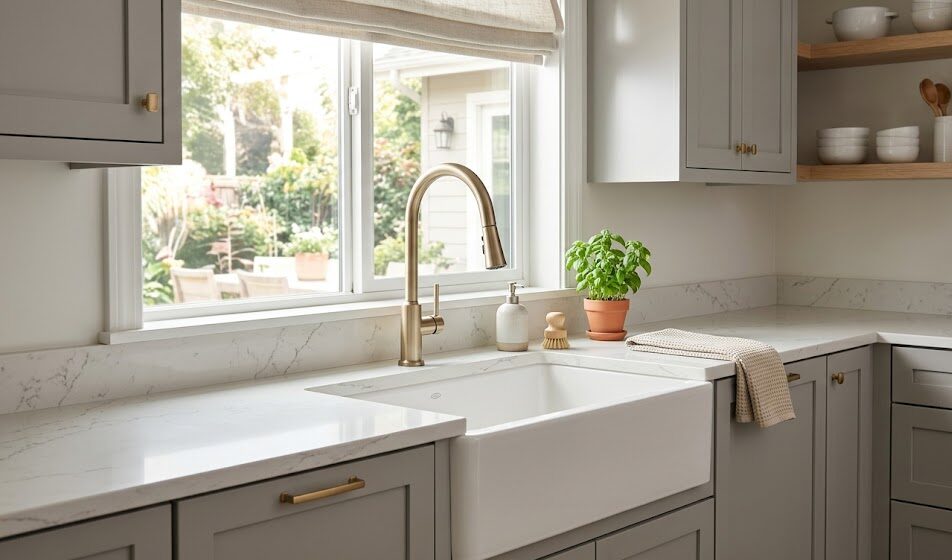
Undermount vs. Drop-In vs. Farmhouse Sinks: Pros, Cons, and Cabinet Impacts
Your kitchen sink is not “just a fixture.” It’s a structural and layout decision.
Sink style affects how your countertop is cut, how your base cabinet is built, what kind of faucet and accessories fit, and even how easy your daily cleanup feels. It also changes what’s possible later (like swapping sinks without touching the counters).
In this homeowner-friendly guide, you’ll learn:
- the real differences between undermount, drop-in (top-mount), and farmhouse (apron-front) sinks,
- how each option impacts cabinets, countertops, and installation,
- what matters most for cleaning, durability, and long-term maintenance,
- how to choose based on your routine (cooking, dishes, kids, entertaining),
- and a short checklist to finalize the right sink before cabinets are ordered.
The Fortress Builders is a Utah design–build company built on “strength through structure.” That means we help homeowners lock key decisions early—like sink type, base cabinet sizing, plumbing placement, and countertop details—so you avoid costly mid-project changes.
Helpful internal pages while you plan:
Why sink style matters more than most homeowners expect
When people say “we’ll pick the sink later,” they usually mean the finish (stainless vs. white), brand, or accessories. But the sink mounting style often needs to be decided earlier because it changes cabinet construction and countertop fabrication.
Simple rule: if your sink choice changes how the cabinet is built or how the stone is cut, it’s not a “later” decision.
Here are the big reasons sink style matters:
- Countertop cut + edge detail: undermount sinks expose a cut edge of stone. Drop-in sinks hide it. Farmhouse sinks often require a custom front cut and specific support strategy.
- Base cabinet sizing: many sinks need a larger cabinet than homeowners realize (especially farmhouse and some workstation sinks).
- Plumbing + disposal space: deeper bowls and larger basins can shift drain height and reduce usable storage below.
- Future replacement: swapping a drop-in sink is usually simpler than swapping an undermount or farmhouse sink without countertop changes.
Quick definitions: what “undermount,” “drop-in,” and “farmhouse” actually mean
| Sink type | What it is | What it changes |
|---|---|---|
| Undermount | Mounted underneath the countertop. The counter opening is visible from above. | Countertop cut quality matters; sealing and cleaning at the rim matter; cabinet support and clips are critical. |
| Drop-in (Top-mount) | Has a rim that sits on top of the countertop. The rim covers the cutout. | Generally easier replacement; rim affects cleaning and the “look”; works with more countertop types. |
| Farmhouse (Apron-front) | Sink front (apron) is visible and extends past cabinet face. Typically large and deep. | Cabinet must be designed for it (front cut + support); faucet reach/clearance matters; weight and installation planning are key. |
Video: Undermount vs. drop-in — what homeowners should actually compare
If you’re early in the planning phase, start with the “why” behind each sink type—cleaning, installation, and how it feels day-to-day. This video gives a clear comparison between undermount and drop-in so you can spot the tradeoffs quickly.
The “decision drivers” that should pick your sink (not trends)
Most sink regret comes from choosing based on photos instead of routine. Before we compare styles, decide what matters most in your kitchen.
Pick your top 3 decision drivers:
- Cleaning speed: Do you want to sweep crumbs straight into the sink? Do you hate wiping around rims and seams?
- Durability: Are you hard on sinks (cast iron pans, kids, heavy use)?
- Maintenance tolerance: Are you okay re-sealing, babying finishes, or avoiding harsh cleaners?
- Cabinet storage: Do you need every inch under the sink for trash, recycling, and cleaning tools?
- Style fit: Are you going modern, transitional, or classic? (Sink style should match cabinet door style and hardware.)
- Budget + timeline: Some sinks add cabinet modifications, support, fabrication complexity, and lead time.
One more framing tip: sink choice is usually best made alongside your cabinet and counter planning, not separately. If you haven’t locked those yet, start with Cabinets and Countertops and circle back.
Undermount sinks: pros, cons, and cabinet impacts
Why homeowners choose undermount sinks
Undermount sinks are popular because they create a clean countertop line and make wipe-down easier. With an undermount, you can push water and crumbs straight into the sink without catching on a rim.
Undermount pros
- Easier counter cleanup: no rim in the way.
- Modern, seamless look: especially with stone or solid-surface counters.
- Works well with accessories: many workstation sink systems are undermount-friendly.
Undermount cons (the real ones)
- Counter edge is exposed: the cut edge of stone is visible and must be fabricated cleanly.
- Seam hygiene matters: the joint between sink and countertop can collect grime if not sealed/maintained well.
- Replacement can be harder: you need a sink that matches the cutout closely (and sometimes the countertop must be removed for access).
Cabinet impacts for undermount sinks
Undermount sinks typically require:
- Correct sink base cabinet width: many common sinks need 30″, 33″, or 36″ sink base cabinets. Workstation sinks often push larger.
- Solid support strategy: undermount sinks are held by clips/brackets plus adhesive/sealant. Heavy sinks may need additional support rails or frames.
- Thoughtful faucet + accessory clearance: especially if you’re using thick counters or adding a ledge system.
Planning note: If you want undermount, confirm that your countertop material and fabricator support the edge detail you want (standard reveal, zero reveal, or positive reveal). Each choice affects maintenance and appearance.
Drop-in (top-mount) sinks: pros, cons, and cabinet impacts
Why homeowners still choose drop-in sinks
Drop-in sinks are often overlooked in high-end remodel conversations, but they still have legitimate advantages—especially if you want easier replacement, are using certain countertop materials, or want a straightforward installation path.
Drop-in pros
- Typically easiest to install and replace: the rim hides imperfections in the cutout and makes swapping simpler.
- Works with more countertop types: including some laminate applications where undermount isn’t ideal.
- Often budget-friendly: both the sink itself and fabrication requirements can be simpler.
Drop-in cons
- Rim collects grime: you’ll wipe around the edge more often.
- Visual bulk: some homeowners dislike the “lip” look, especially in modern kitchens.
- Counter cleanup is slower: you can’t sweep crumbs straight in without catching on the rim.
Cabinet impacts for drop-in sinks
Drop-in sinks generally reduce cabinet complications, but you still want to verify:
- Sink base cabinet size: bowl size and depth still matter for plumbing and storage below.
- Rim footprint: some large-rim sinks can conflict with thick backsplash returns or tight counter corners.
- Faucet hole configuration: many drop-ins come with pre-drilled holes (which can be limiting if you want a clean deck or filtered water tap).
Farmhouse (apron-front) sinks: pros, cons, and cabinet impacts
Why farmhouse sinks are loved
Farmhouse sinks can be beautiful and functional. They’re often large, deep, and comfortable for big dish loads. The exposed apron can also create a strong design focal point.
Farmhouse pros
- Large capacity: great for big pots, baking sheets, and family dish volume.
- Ergonomics for some users: depending on how the cabinet is built, you may stand closer to the sink basin.
- Design statement: works especially well in transitional, classic, and farmhouse-adjacent kitchens.
Farmhouse cons (the ones that show up after move-in)
- Cabinet modification is required: you need an apron-front sink base or a custom cut to the cabinet front.
- Weight and support matter: some materials (fireclay, cast iron) are heavy and need a proper support frame.
- Splash potential: deep bowls + high water flow can splash more if faucet reach and bowl geometry aren’t matched well.
- Replacement can be complex: apron sizing and cabinet cutouts can limit future options.
Cabinet impacts for farmhouse sinks
Farmhouse sinks are where cabinet planning becomes non-negotiable. You’ll typically need:
- An apron-front sink base cabinet: sized and designed for that sink model.
- Support framing: especially for heavy sinks—built as part of the cabinet construction, not improvised later.
- Precise countertop templating: the sink reveal, apron height, and counter thickness all interact.
Farmhouse sink planning checks (do these early):
- Confirm the exact sink model (or at least the exact dimensions + mounting type) before cabinet orders.
- Confirm your desired counter thickness and edge profile because it affects the reveal and faucet height.
- Confirm how the cabinet will handle trash/recycling nearby, since sink base storage gets tighter.
Video: Drop-in vs undermount — installation and replacement reality
Many homeowners only realize replacement complexity when something fails or when they want an upgrade later. This video walks through the practical differences so you can plan for long-term flexibility.
The cabinet + countertop interactions most people miss
1) Sink base width is not “whatever fits”
Sink base width affects everything under the sink: disposal placement, plumbing routing, and your ability to use pull-outs for trash and cleaning supplies. Oversizing the sink without planning the base cabinet can create daily frustration.
Best practice: choose your sink base cabinet to match your kitchen workflow. If you want trash/recycling pull-outs near the sink, plan that zone intentionally.
2) Countertop material influences sink choice
Undermount sinks are commonly paired with stone and solid surface counters. Drop-in can work with many counter types. Farmhouse can work with stone and other materials, but the details must be designed carefully (especially at the front edge).
If you’re still choosing counters, review Quartz vs. Granite vs. Porcelain Countertops and pair it with your sink decision.
3) Edge profile affects comfort and maintenance
Your counter edge profile changes how the sink area feels against forearms, how easy it is to wipe down, and how well edges resist chips. If you’re deep in counter planning, also see Countertop Edge Profiles: Eased, Bevel, Bullnose, and Waterfall Alternatives.
Farmhouse vs undermount — the “cabinet impacts” comparison
If you’re deciding between undermount and farmhouse, focus less on the “look” and more on build constraints.
| Decision factor | Undermount | Farmhouse |
|---|---|---|
| Cabinet complexity | Moderate (support + clips) | High (apron-front cabinet + framing) |
| Countertop complexity | Moderate (quality cut + reveal) | High (front reveal + apron alignment) |
| Storage below | Usually better | Often reduced (depending on sink depth + support) |
| Replacement flexibility | Medium (must match cutout closely) | Lower (apron/cabinet cutout limits options) |
| Look | Clean, modern, seamless | Statement focal point |
Video: Undermount vs farmhouse — the decision factors that matter
This comparison is especially helpful if you’re torn between “sleek and minimal” and “classic and bold.” Use it to clarify what you’re optimizing for: capacity, cleaning, installation, or design impact.
How to choose the right sink for your routine
If you cook daily and do lots of dishes
- Prioritize basin depth and accessories (grids, cutting boards, colanders).
- Make sure faucet reach matches the bowl so water lands where you expect.
- Consider how your trash/recycling is placed near the sink (workflow matters).
If you want fastest cleanup
- Undermount typically wins for counter wipe-down speed.
- Choose a finish that hides water spots if you hate constant polishing (many stainless options do better than glossy finishes).
If you want easiest future replacement
- Drop-in often wins because the rim covers the cutout and replacement is simpler.
- If you choose undermount, pick a size with “standard” replacement options and avoid overly custom cutouts unless you’re comfortable with more complexity later.
If you love the farmhouse look
- Commit to it early so the cabinet can be designed correctly.
- Make sure your overall kitchen style supports it (cabinet door style + hardware + lighting).
- Plan the sink zone so it doesn’t steal all the storage you need.
Related planning note: Sink choice is tightly connected to appliance placement and cabinet clearances. If you’re still refining the “kitchen zone,” review Built-In Appliances: Layout Tips for Fridges, Wall Ovens, and Microwaves.
Instagram examples: how sink choices show up in real kitchens
Short-form videos can help you visualize how sink types feel in the real world. Use these as prompts to ask better questions: “Do I want easier wipe-down?” “Do I want maximum bowl size?” “How will this affect replacement later?”
Common sink-planning mistakes (and how to avoid them)
Mistake 1: Choosing the sink after cabinets are ordered
This is how homeowners end up with a sink that “sort of fits,” a cabinet that needs modifications, or a faucet configuration they don’t love.
Fix: lock sink style and approximate size early, then confirm the exact model during design development.
Mistake 2: Oversizing the sink and losing the trash/recycling zone
A huge sink is great—until you have nowhere for trash pull-outs, cleaning supplies, or a water filter system.
Fix: plan the sink cabinet and adjacent base cabinets as a system (sink + trash + storage).
Mistake 3: Not matching faucet reach to bowl geometry
When faucet reach is too short or too long, splashing increases and the sink feels awkward to use.
Fix: confirm faucet spout reach and height against sink depth and bowl shape.
Mistake 4: Ignoring countertop edge and reveal details
Undermount sinks require a clean, sealed edge detail. Different reveals look different and maintain differently.
Fix: choose a reveal style with your fabricator and understand the maintenance tradeoff.
Pre-order checklist: lock these sink decisions before you commit
Use this checklist before cabinets or countertops are finalized:
- Sink type: undermount, drop-in, or farmhouse?
- Cabinet size: what sink base cabinet width is required for your preferred sink?
- Countertop compatibility: does your countertop material support your sink mounting style and edge detail?
- Faucet plan: faucet reach/height + any accessories (filtered water tap, soap dispenser).
- Workflow: where are trash/recycling and dishwasher relative to sink placement?
- Maintenance tolerance: are you okay with wiping seams/rims, polishing finishes, or re-sealing as needed?
- Future replacement: do you want easier swap potential later?
If you’re still dialing in the full kitchen system, start with Kitchen Remodel Planning Checklist for Utah Homeowners and then refine layout at Design and Layouts for Kitchens.
Want a second set of eyes on your sink + cabinet plan before you order?
The easiest time to prevent sink regrets is before cabinets and countertops are fabricated. Fortress Builders can review your sink choice in context—cabinet sizing, countertop edge detail, faucet compatibility, and storage workflow—so the kitchen works for real life.
Request a Design Consult Explore Kitchen Remodeling Cabinets & Countertops
Bring your rough layout (even hand-drawn), your preferred sink style, and any inspiration links. We’ll help you confirm fit, function, and feasibility before you commit.