

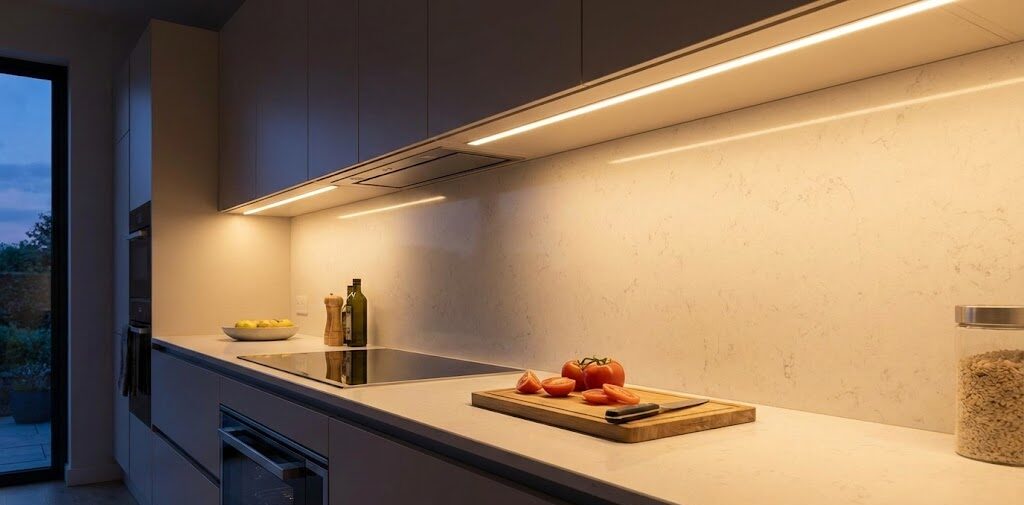
Under-Cabinet Lighting Done Right: Bright Counters Without Glare
In a well-designed kitchen, lighting isn’t an afterthought—it’s part of how the room functions. Under-cabinet lighting is one of the most practical upgrades you can make because it puts light exactly where you work: on the countertop.
Done well, under-cabinet lighting creates bright, even kitchen task lighting that makes prepping, cooking, and cleaning easier. It also helps your cabinets, countertops, and backsplash look more intentional—especially at night—without relying on harsh overhead lights.
Done poorly, it can create glare, hotspots, dark shadows, visible cords, or light that feels too “blue” and clinical. The good news: most of those problems are preventable with the right fixture choice, smart placement, and clear wiring and control planning.
This guide explains under cabinet lighting design in plain English—what to choose, where to place it, how to control it, and how to plan wiring early (ideally before cabinets and drywall). For a full-kitchen planning sequence, start with the Kitchen Remodel Planning Checklist for Utah Homeowners or explore Kitchen Lighting & Electrical Designed for Real Life.
The “small detail” that makes counters feel premium: glare-free task lighting
Under-cabinet lights do two jobs at once:
- They improve function: You can see what you’re doing without casting a shadow over your work.
- They improve comfort: You can use the kitchen at night without turning the room into a spotlight.
When you hear people say a kitchen feels “warm” or “easy to use,” lighting is often the hidden reason.
Kitchen lighting works best in layers (and under-cabinet is the task layer)
Before choosing LED under cabinet lights, it helps to understand how they fit into the larger kitchen lighting plan. Great kitchens typically use a layered approach so one light type isn’t forced to do every job.
|
The three kitchen lighting layers
Ambient lighting: The room’s overall light level (often recessed lights or a ceiling fixture). It helps you move safely through the kitchen but doesn’t always light your work surface well. Task lighting: Focused light where you work (under-cabinet lighting, pendant lights over islands, sometimes a well-placed recessed light). This is what makes counters usable. Accent lighting: Light that adds depth and atmosphere (toe-kick lighting, interior cabinet lighting, shelf lighting). It’s optional but can make the room feel finished. |
Here’s why under-cabinet lighting matters: even if your ambient lighting is “bright,” the upper cabinets can block that light from reaching the countertop. And when you stand at the counter, your body can create a shadow right where you need light most.
If your remodel includes layout changes, it’s worth coordinating lighting with your workflow zones—prep, cook, clean, and storage. That bigger-picture planning is covered in Design and Layouts for Kitchens.
Fixture choices: the best LED under cabinet lights for even counters
Under-cabinet lighting is one of those categories where “LED” doesn’t automatically mean “good.” The fixture type and the way it’s installed determine whether you get smooth, comfortable light—or an uneven row of bright dots.
Option 1: LED strip (tape) lighting
LED strip lighting (sometimes called LED tape) is a flexible strip that can be mounted under cabinets. When paired with a diffuser (a frosted cover), it can produce very even light across long countertop runs.
Why homeowners like LED strips
- They’re low-profile and easy to conceal.
- They can create smooth light without “hotspots” when installed correctly.
- They work well for long runs, corners, and custom layouts.
What to plan for: You’ll need a power supply/driver (especially for low-voltage systems), and you’ll want a plan for hiding wiring and creating clean transitions between cabinet sections.
Option 2: LED bar fixtures (rigid linear lights)
LED bars are rigid fixtures that mount under cabinets. Many are linkable, meaning one fixture can connect to the next. They can work well and may be simpler for certain retrofits, but the light quality depends on the lens design and spacing.
- Some LED bars have an integrated diffuser and create smooth light.
- Others have a more defined “source” and can create scalloping or bright bands on the backsplash.
Option 3: Puck lights
Puck lights are small round fixtures that create focused pools of light. They were common before LED strips became mainstream, and they can still be useful in specific situations—like highlighting a display area or inside glass-front cabinets.
For everyday kitchen task lighting, pucks often create uneven lighting unless carefully spaced and aimed. Many homeowners prefer a continuous linear look for countertop work areas.
|
Quick comparison: strips vs bars vs pucks
LED strips: Best for even light and “built-in” look (especially with a diffuser). Great for long counters and modern kitchens. LED bars: A solid option when you want a simpler installation and consistent segments. Light quality varies by product design. Puck lights: Best for accent or display lighting; can be uneven for full countertop task lighting. |
Plug-in vs hardwired: what changes the result?
Both approaches can work, but they affect how “finished” the final result looks.
- Plug-in systems are common for quick upgrades. They often plug into a standard outlet and may use cords to link fixtures. They can look clean if cords are hidden well, but visible wires are a frequent complaint.
- Hardwired systems are common in remodels. Wiring can be hidden in walls and inside cabinets, and lights can be controlled from a wall switch and dimmer like the rest of the kitchen.
If your remodel includes cabinetry changes, your cabinet design and finish details matter for lighting—light rails, panels, and undersides affect how well fixtures can be concealed. Explore cabinet planning in Cabinets and Countertops.
Placement rules: how to avoid glare in kitchen lighting
Under-cabinet lighting placement is where most glare problems begin. The goal is simple: light the counter surface evenly, without shining into your eyes or creating harsh reflection off a glossy backsplash.
Rule #1: place the light toward the front of the cabinet
In most kitchens, the best placement is near the front edge of the upper cabinet (often an inch or two back from the face frame or door edge, depending on the fixture). This helps the light land on the counter where you work and reduces shadows caused by your body.
If lights are mounted too far back (closer to the wall), you may get:
- More shadows on the front part of the counter
- More glare reflecting off the backsplash
- Less useful light where your hands are working
Rule #2: use a diffuser or lens (especially with LED strips)
A diffuser softens light and blends individual LEDs into a smoother line. Without diffusion, many LED strips can look dotted and create multiple small shadows on the countertop.
Rule #3: prioritize continuous runs over “spotlight” spacing
For kitchen task lighting, most homeowners prefer even illumination across the whole counter rather than bright spots separated by darker gaps. Continuous strip lighting (or well-designed linear fixtures) makes it easier to prep food without moving into and out of shadow.
Rule #4: treat corners and sink runs as special cases
Corners and sink areas often need extra attention. If you have an L-shaped counter, a strip or fixture may need a clean transition around the corner. For sinks, you want enough light directly over the basin without creating glare on reflective surfaces like stainless-steel sinks or polished faucets.
Under-cabinet placement checklist (glare-free version)
- Mount fixtures near the front edge of the upper cabinets.
- Use diffused fixtures or a channel with a lens for LED strips.
- Light the entire work surface, not just one section.
- Plan transitions at corners and breaks between cabinet runs.
- Test glare risk if you have glossy tile, glass, or highly polished stone.
Brightness and color: what “good” light actually looks like
Two kitchens can use “LED under cabinet lights” and feel completely different. Often, the difference is brightness, color temperature, and color quality (how accurately the light shows your finishes and food).
Color temperature: warm vs cool in a kitchen
Color temperature is commonly described as warm (soft, yellow-toned) vs cool (bright, blue-toned). The “best” temperature depends on your overall lighting plan and your design style, but most kitchens look more comfortable when under-cabinet lighting matches or complements the rest of the room.
- Warm to warm-neutral light often feels inviting and works well in kitchens that open into living spaces.
- Very cool light can make surfaces feel stark and can exaggerate glare, especially on reflective backsplash materials.
If you’re unsure, aim for consistency: under-cabinet lighting should not look dramatically different from your ambient lighting when both are on.
Color rendering (how “true” things look)
Color rendering describes how accurately light shows the colors of your countertops, cabinets, paint, and food. For many homeowners, higher color quality is worth it because the kitchen looks more natural and less washed out. Product specifications often list this as “CRI.”
If you’re comparing lighting systems, look for fixtures designed for residential interiors and task lighting (not just utility lighting). The goal is a kitchen that looks good and feels comfortable, not a workspace that feels industrial.
Diffusion and dot-free light
If you want the cleanest look—especially with strip lighting—diffusion matters. A diffuser can:
- Reduce visible “LED dots” when you’re standing in the kitchen
- Blend light more evenly on the counter
- Help prevent harsh shadow lines
Countertop color affects perceived brightness
Dark countertops absorb more light than light countertops. That doesn’t mean you need “blinding” fixtures—it means you should plan for dimming so you can adjust brightness as needed. A dimmer lets you go brighter for prep and softer for evenings, which is usually more satisfying than installing a single fixed light level.
Dimmers and zones: the best way to make under-cabinet lighting feel natural
If you only take one recommendation from this guide, make it this: plan dimmer under cabinet lighting. Bright task lighting is great for chopping and reading recipes, but the same brightness can feel harsh at night.
Why dimming matters (even if you “like bright kitchens”)
- Daytime prep: Higher brightness helps you see clearly on the counter.
- Evening use: Lower brightness creates a warm, comfortable glow without lighting up the whole house.
- Entertaining: Dimming gives you flexibility so the kitchen doesn’t overpower the dining or living area.
What “zoning” means in a kitchen
Zoning is simply splitting lighting into separate groups you can control independently. Many homeowners prefer under-cabinet lights on a separate switch/dimmer from overhead lights. Some also separate different counter runs (for example, the sink run vs the coffee station run).
|
A practical zoning plan (simple and effective)
Zone A: Under-cabinet lighting (dimmer) — The primary kitchen task lighting for counters. Zone B: Overhead ambient lighting (dimmer or multi-level) — General lighting for the room. Optional Zone C: Accent lighting (separate switch) — Toe-kick lights, cabinet interior lights, or shelf lights for evening ambience. This setup keeps controls intuitive: task lighting for work, ambient lighting for the room, and accent lighting for mood. |
Dimmer compatibility is important
Not every LED system works with every dimmer. LED drivers, transformers, and fixtures often have specific dimming requirements. If you’re planning a remodel, confirm dimming compatibility before installation so you don’t end up with flicker, inconsistent dimming, or a dimmer that doesn’t control the lights the way you expected.
If you’re already working with an electrician, this is a great conversation to have early—especially before finalizing switch locations and wiring.
Wiring planning: the cleanest results are decided before drywall and cabinets
If you’re remodeling, the best time to plan under-cabinet lighting is before cabinet ordering is finalized and before walls are closed up. That’s when you can hide wiring, choose the best switch locations, and coordinate drivers and power supplies without compromises.
Think in two parts: power + light
Under-cabinet systems generally involve:
- A power source (hardwired connection or plug-in outlet)
- The lighting fixtures (strip, bar, puck) installed under the cabinets
Many systems also include a driver or transformer, depending on whether the fixtures are line-voltage or low-voltage. The driver needs a location that is accessible for service but hidden from view.
Where should drivers, transformers, and connections go?
Common “hidden but accessible” locations include inside a cabinet (like an upper cabinet near the range hood area), inside a sink base if manufacturer instructions allow it, or in another discreet area coordinated with the electrician and cabinet installer. The right solution depends on your specific product and layout.
Best practice: keep critical electrical components accessible (for service or replacement), and follow manufacturer instructions for clearances and ventilation.
Switch placement: make it intuitive
One of the easiest ways to make a kitchen feel thoughtfully designed is to make lighting controls predictable. Most homeowners prefer under-cabinet lights controlled by a wall switch with a dimmer—often near the main kitchen entry point or near the primary work area.
For larger kitchens, it may make sense to have 3-way switching (control from more than one location). This is a planning decision that needs to happen before wiring is completed.
What to decide before the electrician starts
- Which counters need task lighting (all runs vs select zones).
- Fixture type (strip, bar, puck) and whether diffusion is included.
- Where the driver/power supply will be located (hidden and accessible).
- Which wall switch controls under-cabinet lights (and whether dimming is required).
- Whether under-cabinet lights are a separate zone from overhead lighting.
- How wiring will pass between cabinet sections (especially around windows and range hoods).
Permits, inspections, and electrical requirements
When under-cabinet lighting involves new wiring, added circuits, or changes to existing electrical, permitting and inspection requirements can apply. The details vary by location and project scope. Confirm requirements with qualified professionals and local authorities, and follow manufacturer instructions for installation and dimming compatibility.
If you want professional coordination between layout, cabinets, and electrical, Fortress Builders covers this as part of a structured design–build process. Learn more at Kitchen Lighting & Electrical Designed for Real Life.
Design details that make under-cabinet lighting look built-in
Homeowners often say they want under-cabinet lighting that “doesn’t look like an add-on.” That built-in look usually comes down to a few cabinet and installation details that hide the light source and wiring.
Light rails (or recessed mounting) hide fixtures
Many custom and semi-custom cabinet lines can include a small trim piece under the cabinet called a light rail. The goal is to conceal the fixture from normal standing views while still allowing light to wash the counter surface. Another approach is recessing an LED channel into the cabinet bottom.
Not every cabinet style uses light rails, and not every kitchen needs them. But if you’re sensitive to seeing the fixture from across the room, it’s worth discussing early in the cabinet design phase.
Keep wiring invisible (especially at cabinet breaks)
Most kitchens have breaks between cabinet sections: windows, range hoods, tall cabinet banks, or open shelving. Those breaks are where visible wires tend to show up if the wiring plan isn’t coordinated.
Common best practices include planning wire pathways inside cabinets, using concealed transitions, and choosing fixtures designed for linkable, clean connections.
Match lighting to the cabinet and countertop style
Under-cabinet lighting should complement your finishes. For example:
- Highly reflective backsplashes (gloss tile, glass, polished stone) benefit from careful placement and diffusion to reduce glare.
- Textured or matte backsplashes are generally more forgiving.
- Dark counters often need a slightly higher usable brightness range (and benefit from dimming so you can tune it).
Finish coordination is part of the bigger cabinet and countertop planning process. If you’re still selecting those materials, see Cabinets and Countertops and related kitchen planning tools in Your Guide to a Seamless Remodel.
Special situations: open shelves, windows, and tricky cabinet layouts
Not every kitchen has a “perfect” run of upper cabinets. Many modern kitchens include open shelves, windows over the sink, tall cabinet walls, or range hoods that interrupt lighting runs. You can still get excellent task lighting—you just need to plan each area intentionally.
Open shelves instead of upper cabinets
If you have open shelves instead of traditional upper cabinets, you may still want task lighting on the counter. Options can include:
- LED strips or linear fixtures mounted under the lowest shelf (if shelf depth and structure allow)
- Thoughtful recessed lighting placement aligned with prep zones
- Decorative fixtures that also provide task lighting (depending on layout)
The key is to avoid relying only on ceiling lights if they’re blocked by your body when you work.
Windows over the sink
Sink runs often have a window instead of cabinets. Consider how you’ll light that counter area, especially in the evening. In some kitchens, a well-placed recessed light can help. In others, adjacent under-cabinet lighting and thoughtful ambient lighting can cover the area.
Tall cabinet banks and appliance walls
In many remodels, homeowners add tall cabinet walls for storage or built-in appliances. Under-cabinet lighting may not apply directly, but you may still want task lighting near coffee stations, beverage zones, or secondary prep areas.
If your kitchen includes appliance planning and cabinetry changes, coordinate lighting with appliance locations so outlets, clearances, and lighting zones all work together. Related planning: Built-In Appliances: Layout Tips for Fridges, Wall Ovens, and Microwaves.
Retrofit guide: adding under-cabinet lighting without a full remodel
Many homeowners want better kitchen task lighting but aren’t ready for a full remodel. Under-cabinet lighting can often be added as a targeted upgrade, and there are several approaches depending on how much you want to change.
Approach A: plug-in LED systems
Plug-in systems are popular because they can be installed quickly. Many are designed to be linked together, so one outlet can power multiple fixtures. The biggest downside is managing cords so the kitchen still looks clean.
Tip: Plan where cords will run before buying. Look for systems that include cord management accessories and consider whether you have an outlet location that won’t create visible wires.
Approach B: hardwired retrofit (cleaner, but more planning)
A hardwired retrofit can look much more built-in. It typically involves running wiring to a switch (often with a dimmer) and connecting fixtures in a way that hides cords and drivers. This approach usually requires an electrician and may involve local permitting requirements, depending on scope.
Approach C: battery-powered lights (best for limited use)
Battery-powered puck lights and strips exist, and they can be useful in a pinch—especially for cabinets or closets. For daily kitchen task lighting, many homeowners find battery options less satisfying because they require regular charging/replacement and may have lower consistent output.
If you want “set it and forget it” kitchen lighting, wired options usually deliver a better long-term experience.
Hardwired vs plug-in: how to decide what’s right for your kitchen
If you’re comparing options, the right choice often comes down to your goals and your project scope.
|
Choose plug-in if…
|
|
Choose hardwired if…
|
If you’re already opening walls or updating your electrical plan, hardwired under-cabinet lighting is usually the easiest time to do it cleanly. That’s why many homeowners add it as part of a larger kitchen plan, not as a last-minute add-on.
Common mistakes that cause glare, frustration, or “why does it look like that?”
Most under-cabinet lighting problems fall into a few predictable categories. Catching them early is much easier than trying to fix them after cabinets and backsplash are installed.
|
Mistake #1: mounting lights too far back
This increases glare on the backsplash and creates shadows on the front of the counter—right where you work. |
|
Mistake #2: no diffuser (visible dots and harsh light)
Un-diffused LEDs can create dotted light patterns, especially on textured counters, and can be visually distracting. |
|
Mistake #3: skipping dimmers
Without a dimmer, your “task lighting” may feel uncomfortably bright at night. Dimming gives you flexibility without sacrificing function. |
|
Mistake #4: mismatched color temperatures
If under-cabinet lights look dramatically cooler or warmer than the rest of the kitchen, the lighting feels inconsistent and can make finishes look “off.” |
|
Mistake #5: visible cords and drivers
Even a great fixture looks unfinished if cords are dangling or drivers are sitting in plain sight. Plan hidden pathways and accessible locations early. |
|
Mistake #6: not coordinating with outlets, backsplash, and cabinets
Lighting should be planned alongside electrical and cabinetry, not after everything is “final.” That’s how you avoid last-minute compromises. |
A homeowner-friendly planning worksheet (use this before you buy anything)
If you want under-cabinet lighting that looks intentional, treat it like a mini-project with a clear plan. Here’s a practical worksheet you can use whether you’re remodeling or retrofitting.
Step 1: Map your counter runs
- List each section of countertop you want to light (sink run, range run, coffee station, etc.).
- Note any breaks: windows, range hoods, tall cabinets, open shelving.
- Decide whether you want lighting on every run or only prep zones.
Step 2: Choose fixture type
- Even, continuous light: consider LED strip lighting with a diffuser.
- Simpler segments: consider linkable LED bar fixtures.
- Accent-only areas: consider puck lights or smaller fixtures.
Step 3: Decide on controls
- Will under-cabinet lighting be on a dedicated switch/dimmer?
- Do you want it separate from overhead lighting (recommended for flexibility)?
- Do you want multiple zones (for example, main counters vs coffee station)?
Step 4: Plan wiring and concealment
- Where will power come from (hardwired vs plug-in)?
- Where will the driver/transformer be placed (hidden but accessible)?
- How will wires pass between cabinet sections without being visible?
Step 5: Confirm compatibility
- Confirm LED/dimmer compatibility before installation.
- Follow manufacturer instructions for mounting, ventilation, and safety.
- If electrical work is involved, confirm permit/inspection needs locally.
How under-cabinet lighting fits into Fortress Builders’ design–build process
The Fortress Builders works with homeowners who want strong, lasting results without the uncertainty that often comes with remodeling. That means decisions like lighting aren’t made in isolation—they’re coordinated with cabinetry, layout, finishes, and electrical planning so the kitchen works as a complete system.
In a design–build workflow, under-cabinet lighting is typically planned during the design phase—before cabinet orders and before walls are closed—so the finished kitchen feels clean, functional, and intentional from day one.
If you’re planning a kitchen remodel, under-cabinet lighting is easiest (and cleanest) when:
- Cabinet design includes a plan to conceal fixtures (light rail or recessed channel, if desired).
- Electrical rough-in is coordinated with fixture locations, zones, and dimmers.
- Backsplash and countertop choices are considered for glare and reflection.
This is the “strength through structure” mindset in action: a clear plan up front prevents rework and surprise compromises later.
Related kitchen resources (so lighting matches the rest of your plan)
Under-cabinet lighting works best when it’s aligned with your layout, cabinetry, and electrical plan. These pages help you plan the full system:
Kitchen Lighting & Electrical Kitchen Layouts Cabinets & Countertops Planning Checklist Kitchen Portfolio
FAQs: Under cabinet lighting design, dimmers, and glare
Where should under-cabinet lights be placed to avoid glare?
In most kitchens, placing the fixture closer to the front edge of the upper cabinet helps light the counter more effectively and reduces backsplash glare. Using a diffuser also helps soften light and reduce harsh reflection—especially on glossy tile or glass backsplashes.
Are LED strips better than puck lights for kitchen task lighting?
For countertop task lighting, many homeowners prefer linear lighting (like LED strips in a diffused channel or well-designed bars) because it creates more even illumination across the work surface. Puck lights can work well as accent lighting, but they often create bright spots and darker gaps for everyday counter use.
Do under-cabinet lights need a dimmer?
While not strictly required, dimmer under cabinet lighting is a widely used best practice because it makes the kitchen comfortable from daytime prep to evening use. The important detail is compatibility: LED fixtures and drivers often require a compatible dimmer to avoid flicker or inconsistent performance.
Should under-cabinet lights match the ceiling lights?
They don’t have to be identical, but they should be coordinated. If under-cabinet lights are much cooler or warmer than your ambient lighting, the kitchen can feel visually inconsistent. Many homeowners aim for a cohesive look so all layers feel like part of one plan.
Can I add under-cabinet lighting without remodeling?
Yes. Plug-in and linkable LED systems are common retrofit options. For a more built-in look, a hardwired retrofit can be done, but it typically requires more planning and may involve electrical work that should be performed by qualified professionals. Local code, permitting, and inspection requirements can vary—confirm details with local authorities and your electrician.
Conclusion: plan lighting early so your kitchen feels bright, calm, and easy to use
Under-cabinet lighting is one of the highest-impact upgrades in a kitchen because it improves real daily function. The difference between “just okay” lighting and truly great lighting usually comes down to a few decisions:
- Choose the right fixture type for smooth task lighting (often diffused linear LED options).
- Place fixtures toward the front edge to light counters effectively and reduce glare.
- Use dimmers and zones so the kitchen works day and night.
- Plan wiring and driver locations early—before cabinets and drywall—so everything stays clean and concealed.
If you’re remodeling, the best time to make these decisions is before cabinet orders are finalized and before the electrical plan is locked. That’s how you get bright counters without glare—and a kitchen that feels intentionally designed.
Want a lighting plan that works before drywall and cabinets?
The Fortress Builders helps homeowners plan kitchens with a clear, structured design–build process—so lighting, cabinetry, and electrical all work together from the start.
Request a Design Consult Explore Kitchen Remodeling
If you already have a draft layout or cabinet plan, we can help you pressure-test fixture placement, glare risk, dimming zones, and wiring coordination—before anything becomes permanent.