

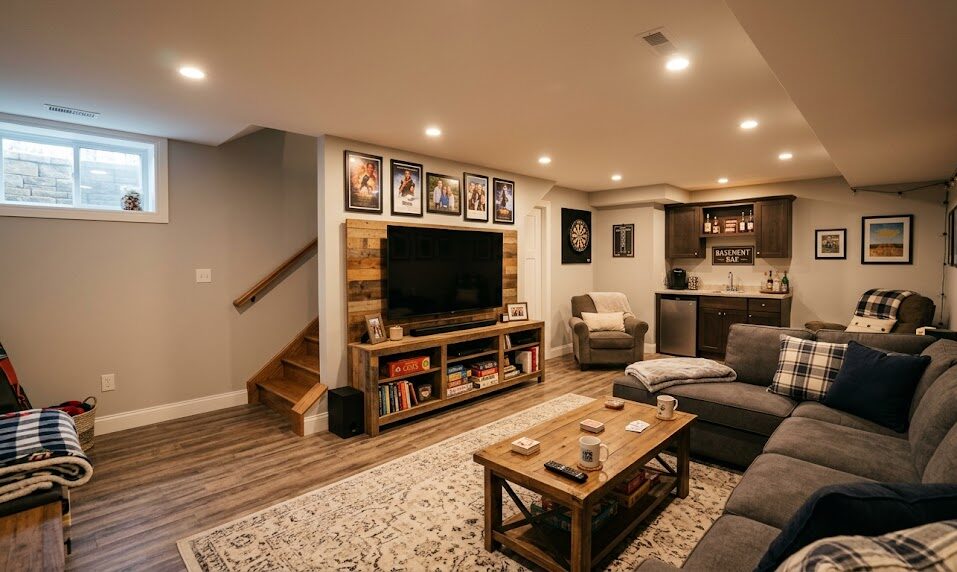
Space Planning for Basement Finishing: Transforming Your Unused Square Footage
A basement does not become valuable just because it gets drywall and flooring. It becomes valuable when the layout makes the space easier to live in, easier to grow into, and flexible enough to keep working as your family’s needs change.
That is why basement space planning should come before furniture ideas, feature walls, or even finish selections. A well-finished basement can add real comfort, function, and long-term value to the home. A poorly planned one can end up feeling dark, chopped up, awkward to furnish, and underused no matter how new it looks.
In this guide, you’ll learn:
- how to think through basement layout design before construction begins,
- how zoning, circulation, storage, and ceiling conditions shape the final result,
- why egress and utility planning matter early,
- how to build flexible layouts that age well with your household,
- and how to approach a finished basement layout with both comfort and future value in mind.
The Fortress Builders approaches basement remodeling through a design-build process built around one principle: strength through structure. That means the layout is treated as the foundation of the project. Once the zones, constraints, and priorities are clear, the basement can be finished in a way that feels intentional instead of improvised.
Helpful Fortress Builders pages while you plan:
Why basement space planning matters more than most homeowners expect
Basements are rarely blank rectangles with no constraints. Most have columns, utility rooms, lower ceiling areas, stairs, mechanical systems, window limitations, and odd corners that affect what the space can become. That is why basement layout design is not really about forcing your wish list into the square footage. It is about understanding the space honestly and then using it well.
A strong basement layout solves more than one problem at once. It should:
- support daily life,
- make circulation feel natural,
- respect moisture and structural realities,
- allow enough storage,
- and keep the basement flexible enough to evolve over time.
Homeowner takeaway: The most successful finished basement layout is not usually the one with the most rooms. It is the one that makes the square footage feel useful, comfortable, and easy to adapt.
Start with how the basement should function
Before deciding where walls go, step back and define what the basement is supposed to do for the house. Basement zones planning works best when it starts with the household’s real needs rather than a generic list of possible rooms.
What problem is the basement solving?
For some households, the basement needs to become a family hangout space. For others, it needs a guest bedroom and bath, a theater room, a home office, a teen zone, a playroom, or a flexible combination of all of those.
What should happen down there every week?
If the basement will be used mostly for movie nights and hosting, the layout should support gathering. If it needs to function for guests or multi-generational living, privacy matters more. If it needs to absorb work-from-home life, quieter zones matter more.
What should the main floor be relieved from doing?
One of the smartest ways to plan a basement is to ask what pressure it should take off the rest of the house. That helps avoid designing the basement in isolation.
The 5-minute basement planning profile
- What is the top priority? Gathering, guests, bedrooms, entertainment, work space, kids’ space, or flexibility?
- How many people will use it most often?
- Will it need a bathroom now or later?
- Does the basement need quiet zones and active zones?
- What part of upstairs life would be improved if the basement worked better?
Why this matters: These answers reveal what deserves the best part of the layout and what can stay secondary.
Think in zones before thinking in rooms
One of the most effective ways to improve basement space planning is to stop thinking only in labeled rooms and start thinking in zones. Many basements function better when they are organized by how people move and gather rather than by how many walls can be built.
Public zones
These are the more social areas: lounge space, TV or theater zones, game tables, wet bars, and open family-use areas. These spaces usually work best closer to the main arrival path into the basement.
Private zones
Guest bedrooms, offices, in-law spaces, and more secluded rooms usually benefit from being pulled away from louder or more active parts of the basement.
Support zones
Storage, mechanical areas, closets, under-stair use, and bathrooms help the basement function properly but do not usually need the most visible square footage.
Best practice: Good basement zones planning gives the most open, flexible, and comfortable part of the basement to the spaces that will be used most often.
Circulation is what makes a basement feel bigger
Many basements feel smaller than they actually are because the circulation is awkward. Hallways are too tight, doors interrupt furniture placement, and the route from stairs to major zones feels like an obstacle course. Basement remodel layout planning should always consider how people will move through the space first.
Respect the arrival point from the stairs
The stairs create the first impression of the basement and often dictate how the rest of the plan unfolds. A strong design uses that arrival zone intentionally instead of letting it create dead space.
Avoid over-fragmenting the floor plan
Too many small rooms can make the basement feel boxed in and darker than necessary. Strategic openness often makes the square footage feel more generous and flexible.
Protect furniture walls where possible
TV walls, bed walls, desk walls, and sofa zones need usable placement opportunities. Doorways and hallways should not consume more functional wall space than necessary.
| Layout Goal | What Often Helps |
|---|---|
| Make the basement feel larger | Open circulation paths, fewer unnecessary walls, strong sightlines |
| Support both active and quiet use | Separate public and private zones thoughtfully |
| Create easier furniture planning | Protect usable wall space and reduce awkward door conflicts |
| Keep the plan flexible long term | Use multi-purpose rooms and avoid overspecializing every area |
Ceiling height and soffits should shape the layout early
Ceiling conditions often play a bigger role in a basement than homeowners expect. Lower beams, soffits, duct runs, and mechanical crossings can make certain parts of the basement feel better suited for circulation, storage, or seating rather than for full-height visual focal points.
Do not pretend the ceiling is higher than it is
One of the smartest design moves is to use the basement’s real ceiling conditions honestly. Put the highest-value gathering spaces where the ceiling feels most open, and let more constrained zones support the plan quietly.
Lighting and ceiling planning go together
Ceiling height influences fixture selection, light spread, and how open the basement feels. Related guide: Basement Lighting for Low Ceilings.
Structure can become part of the logic
Columns, beams, and bulkheads do not always need to be “hidden.” Sometimes the better move is to plan around them in a way that gives the layout more clarity and less awkwardness.
Simple rule: The best finished basement layout gives the basement’s best ceiling conditions to the spaces that benefit most from openness and visual breathing room.
Bedrooms and egress should be planned from the beginning
If the basement may include a bedroom, guest room, or future sleeping space, that should influence the plan early. Bedroom placement is not only about where a bed fits. It affects privacy, window strategy, circulation, and often egress-related decisions.
Not every room should become a bedroom
Sometimes homeowners try to maximize “room count” at the expense of layout quality. A stronger basement may include fewer enclosed rooms but better overall function.
Bedrooms need to feel private enough
A bedroom directly off the loudest media or game zone rarely feels ideal. Privacy zones matter, especially in guest or in-law scenarios.
Egress planning belongs early
If a bedroom is part of the plan, egress conversations should happen during layout planning, not after the design is mostly set. Related guide: Basement Egress Basics.
Before adding a basement bedroom, ask:
- Does the room have the right privacy from active zones?
- Is the best basement window location being used wisely?
- Would the basement benefit more from one good bedroom than several compromised rooms?
- Does the plan support future sleeping use even if the room starts as an office or flex room?
- Are egress and code-related requirements being addressed early enough?
Storage should be designed in, not squeezed in
One of the biggest mistakes in finished basement layout planning is treating storage like whatever space is left over at the end. Basements tend to attract overflow storage naturally, whether that is seasonal items, media equipment, games, supplies, luggage, or household extras. If the plan ignores that reality, clutter often takes over the finished zones quickly.
Use support spaces intentionally
Under-stair areas, dead-end corners, utility-adjacent spaces, and wall pockets can often become efficient storage if they are planned rather than improvised.
Separate living storage from house storage
The basement usually works better when the storage that supports everyday basement use is distinct from deeper household storage.
Built-ins are not always required
Sometimes simple, well-placed closets or concealed storage walls are enough. The point is to keep the main basement zones from being forced to carry clutter they were never meant to handle.
| Storage Type | Best Role in the Basement |
|---|---|
| Utility-adjacent storage | Seasonal bins, long-term household overflow, less decorative needs |
| Room-based storage | Games, throws, office supplies, guest items, theater accessories |
| Under-stair storage | Compact concealed storage for practical overflow |
| Closets near bedrooms or baths | Guest use, linens, adaptable storage for future room changes |
Flexible layouts age better than highly specialized ones
One of the smartest basement space planning moves is to leave room for change. The basement that works for toddlers is not the same basement that works for teenagers, overnight guests, parents working from home, or grown children visiting later. That is why rigid planning can age poorly even when it looks exciting at first.
Multi-use rooms often outperform niche rooms
A flex room that can become an office, guest room, hobby room, or quiet retreat may be more valuable over time than a room designed so specifically that it only works for one short phase of life.
Open spaces can still have purpose
Flexibility does not mean vagueness. It means creating zones that can hold more than one use without losing their identity.
Future plumbing or room conversion is worth considering
Even if the basement does not need every feature today, a layout that respects future possibilities is often the wiser long-term move.
Best practice: A basement that ages well is usually one that can shift with the household rather than locking every square foot into one fixed story forever.
Bathrooms, mechanical zones, and service spaces should not be accidental
Even when the basement’s main purpose is entertaining or family use, support spaces still shape the layout significantly. Bathrooms, laundry zones, utility rooms, and mechanical access areas should be planned early enough that they support the finished basement instead of interrupting it.
Bathrooms improve usability fast
A well-placed basement bathroom can transform how long and how comfortably people use the space. That is especially true in basements with guest zones, theaters, bedrooms, or entertainment use.
Mechanical access still matters
Basement plans should respect the reality that some equipment and service zones need access. The goal is not to pretend they do not exist, but to integrate them intelligently.
Support spaces can strengthen the plan when placed well
Sometimes these areas help anchor quieter corners, privacy zones, or storage edges of the layout rather than acting like purely negative space.
Support-space questions worth asking early
- Should the basement include a bathroom now or plan for one later?
- Where do mechanical access needs place natural limits on room design?
- Can support spaces help buffer private rooms from noisy living zones?
- Is the layout giving service spaces enough access without giving them too much of the best square footage?
Common basement layout mistakes homeowners regret later
Mistake 1: Designing too many rooms too quickly
This often creates a basement that feels smaller, darker, and less flexible than it needs to be.
Mistake 2: Ignoring circulation
A basement can have plenty of square footage and still feel awkward if the movement paths are poorly planned.
Mistake 3: Giving premium space to low-priority functions
The best ceiling heights, sightlines, and window relationships should be reserved for the most important living zones.
Mistake 4: Underplanning storage
A beautifully finished basement can get cluttered quickly when practical storage has not been built into the layout from the start.
Mistake 5: Planning only for today’s use
Basements often last through multiple seasons of family life. Layouts that allow some flexibility usually perform better long term.
Practical truth: The basement layout you regret is rarely the one that had “too little design.” It is usually the one that had too little foresight.
How Fortress Builders would approach basement space planning
A strong basement design build process starts by understanding constraints and opportunities clearly. That means identifying moisture conditions, window locations, ceiling realities, stairs, utilities, and household goals before trying to divide the floor plan.
From there, the most useful basements are usually organized around a few core principles:
- give the best space to the most important uses,
- separate louder and quieter zones thoughtfully,
- keep circulation clean,
- respect storage and service-space realities,
- and leave enough flexibility for the layout to age well.
That approach tends to create basements that feel more open, more usable, and more naturally connected to the rest of the home.
FAQ: Basement space planning
What is the best layout for a finished basement?
The best layout depends on how the basement will actually be used, but in general, the strongest plans prioritize circulation, flexible zoning, comfort, and smart placement of private versus public spaces.
Should I add more rooms or keep the basement more open?
Usually a balance is best. Too many enclosed rooms can make the basement feel chopped up, while too little definition can make it feel vague. The right answer depends on whether you need privacy, bedrooms, offices, or mostly shared living space.
How do I make a basement feel bigger?
Good circulation, better sightlines, thoughtful zoning, strong lighting, and avoiding unnecessary walls often make the biggest difference.
When should I plan egress and bedroom placement?
As early as possible. Bedroom ideas should influence the layout from the start, because window location, privacy, and room placement all matter.
What makes a basement layout age well?
Flexibility. Basements that allow rooms or zones to shift use over time usually stay more valuable and more useful than basements designed around one narrow phase of life.
Conclusion: a great basement starts with a great plan
Transforming unused square footage is not really about finishing a basement. It is about making that square footage useful, comfortable, and adaptable. The strongest finished basement layout is the one that understands the basement’s real constraints, honors the home’s real needs, and gives the most valuable space to the things that matter most.
That is what good basement space planning does. It turns empty lower-level square footage into something that feels purposeful and easy to live with—not just now, but years from now as the home and family continue to evolve.
Need help planning a basement layout that actually works?
If you’re considering basement finishing in Davis or Weber County, Fortress Builders can help you think through zoning, egress, storage, bathrooms, ceiling constraints, and flexible-use planning before walls and finishes lock the space in.
Request a Design Consult Explore Basement Finishing Read the Moisture Checklist
Bring your rough ideas, your must-haves, and the way you want the basement to support your home. Fortress Builders can help turn that into a finished basement plan that feels smart, spacious, and built to last.