

Home Offices & Flex Spaces Built to Adapt
A good home office is not just a desk in a spare room. A good flex space is not just an empty room waiting for a purpose.
The most successful home office remodels and flex room designs are built around how the space actually needs to perform. That means thinking about focus, acoustics, lighting, built-ins, tech needs, storage, privacy, and how the room may need to change over time. When that planning happens early, the room works harder, feels calmer, and stays useful longer.
This guide walks through how to plan a home office remodel or multi-use flex room with more clarity. You will learn how to evaluate spare room office planning, how to think through office acoustics and lighting, where home office built-ins add real value, and how to design a room that supports work today without locking you into one narrow use forever.
The Fortress Builders approaches home office and flex room remodeling through one core principle: strength through structure. Every project starts with a clear design blueprint that aligns your goals, your budget, and your build path before construction begins. That is what helps a room move from “kind of useful” to genuinely purposeful.
- How to approach a home office remodel with function first
- What makes flex space design actually adaptable instead of vague
- How office acoustics and lighting change the quality of daily use
- Where home office built-ins improve workflow, storage, and calm
- How to plan a spare room office that still works when life changes later
Why homeowners are remodeling home offices and flex rooms more intentionally
There was a time when a home office could be improvised. A corner of a guest bedroom, a small desk off the kitchen, or a surface tucked beside a hallway might have been enough. But for many households, that is no longer realistic. Work-from-home routines, hybrid schedules, online learning, business ownership, creative work, therapy sessions, video calls, and home administration all demand more from a room than temporary furniture can usually support.
Flex rooms face a different version of the same problem. Homeowners often know they need a room that can evolve, but they are unsure how to design for flexibility without ending up with a room that feels generic and underpowered for everything.
Work Has Changed
Many households need real concentration space now, not just a place to set down a laptop for an hour.
Rooms Need to Multitask
A space may need to support office work, guest use, studying, hobbies, or admin work at different times.
Storage Matters More
Paperwork, equipment, chargers, books, printers, files, and household items need better organization than temporary furniture usually provides.
Comfort Drives Use
Lighting, sound control, temperature, and layout all influence whether the room gets used consistently or avoided.
Technology Is Now Core
Power, internet, monitors, charging, and device placement have become basic room-planning issues, not afterthoughts.
Homes Need to Adapt
Families want rooms that serve current routines well but can still shift later without becoming obsolete.
Start by defining the real job of the room
One of the biggest mistakes in home office remodel planning is starting with furniture or finishes before defining what the room must actually do. A room cannot be designed well if its role is still vague. “Office and maybe some other stuff” is not enough to guide layout, power, storage, acoustic, or lighting decisions.
Ask what happens here most often
Is this room for daily eight-hour work? A few focused calls a week? Homework and family administration? Creative work? A business with storage needs? Guest overflow? The dominant use should shape the room first, even if it also needs secondary flexibility.
Identify what the room has to support physically
Monitors, printers, files, books, video calls, craft supplies, fold-out sleeping arrangements, exercise gear, or household storage all create different design priorities.
Decide whether the room is office-first or flex-first
Some rooms are primarily home offices that need to flex occasionally. Others are primarily flex rooms that need a work zone built into them. That difference changes almost every planning choice.
If you cannot explain what the room is for on a normal Tuesday afternoon, it is too early to start choosing finishes.
| Room Type | Primary Planning Question |
|---|---|
| Office-First Room | What does focused daily work require for comfort, privacy, light, storage, and technology? |
| Flex-First Room | How can the room support multiple uses without becoming mediocre at all of them? |
| Guest + Office Room | How can the office function feel complete while still allowing sleeping-space conversion when needed? |
| Family Utility Room | How should work, homework, admin, and household storage be zoned so the room stays organized? |
Layout and zoning: why flex space design needs more structure, not less
Flex space design often sounds loose by definition. But the rooms that adapt best are usually the ones with the strongest internal structure. They may be flexible in use, but they are rarely random in layout.
Separate the room into functional zones
A room might need a desk zone, a storage wall, a reading or guest zone, and a clear circulation path. Those areas do not always need walls between them, but they do need enough definition that the room does not feel like every function is competing for the same footprint.
Protect the primary working wall or focal area
In a home office remodel, the main desk wall or built-in wall should be treated as a priority, not as the leftover wall after the room layout is mostly decided.
Do not sacrifice circulation for ambition
It is easy to overfill a spare room office with too many functions. The room still needs to feel calm and easy to move through when it is in active use.
- Gives the main function the strongest part of the room
- Builds secondary use around that instead of against it
- Preserves enough open area that the room still feels comfortable
- Lets furniture and built-ins reinforce the room’s structure
- Supports future changes without making today’s use feel temporary
Spare room office planning: how to avoid making the room feel temporary
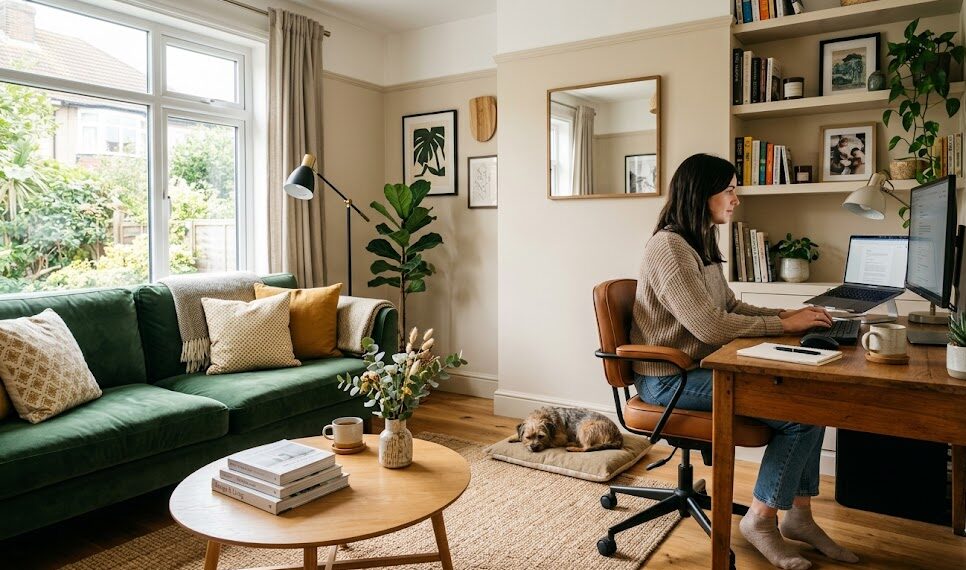
Many home office remodels begin in a spare bedroom, loft, bonus room, or underused den. That is common and often smart. But one of the biggest design traps is leaving the room feeling like it is only pretending to be an office. Homeowners can usually sense the difference between a room that is truly designed for work and one that is only “using office furniture for now.”
Treat the office use as real
If the room is being used as an office most days, the design should support that with lighting, power, storage, and layout decisions that feel deliberate.
Keep conversion logic in mind without letting it dominate
If the room may need to host guests later, that matters. But it should not force the room to feel half-committed all the time if office use is the primary daily need.
Use the architecture of the room fully
Windows, alcoves, wall length, closets, ceiling shape, and built-in opportunities all affect how convincingly the room can function as an office.
Homeowners who want to compare this kind of planning with broader specialty remodeling often benefit from the Fortress Builders page on custom carpentry, especially because built-in work frequently makes the difference between a room that feels improvised and one that feels purpose-built.
If someone walked into the room without context, would it feel like the house intentionally has an office here—or like a bedroom that happens to contain work equipment?
Office acoustics and lighting are what turn a room from usable to enjoyable
Homeowners often underestimate how much lighting and sound quality influence daily work. A room can be attractive, furnished, and well organized and still feel draining if the lighting is harsh or weak, the ceiling echoes, or outside noise bleeds into every call.
Lighting should support the type of work happening there
General room light is not enough by itself. Many offices need a combination of daylight support, ambient light, and task lighting that helps reduce fatigue and keeps the room comfortable from morning into evening.
Video-call quality matters now
Home office lighting is no longer only about reading and computer work. It often affects how a homeowner appears on camera and whether the room feels professional during meetings.
Acoustics shape concentration
A quiet-looking room can still sound bad. Hard surfaces, door placement, adjacent traffic, and household activity all influence how distracting the room feels during real work.
| Performance Priority | What to Think About |
|---|---|
| Ambient Lighting | Is the room bright enough overall without feeling flat or harsh? |
| Task Lighting | Does the work surface have enough focused light for reading, writing, and detail work? |
| Video Call Presence | Will the user look clearly lit and composed on camera during meetings? |
| Acoustic Control | How much sound enters, echoes, or leaves the room during normal work? |
- If the room supports concentration well, work feels easier.
- If the room fights concentration every day, no amount of nice furniture fully fixes that.
Home office built-ins and tech planning: where the room becomes genuinely custom
Built-ins are often one of the highest-value upgrades in a home office remodel because they solve both function and visual order at the same time. They can create cleaner storage, integrate equipment, improve proportion, and make a room feel anchored.
Built-ins help the room hold more without feeling cluttered
Shelving, lower cabinetry, printer storage, file storage, display areas, concealed tech space, and integrated desk systems can all reduce the feeling that office life is spilling into the rest of the room.
They also improve flexibility
A built-in wall can help a flex room feel office-ready today while still being useful for future storage, study, media, or guest support later.
Tech should be planned early, not patched in later
Power, charging, monitor placement, lighting controls, data needs, and outlet positions should all be resolved early enough that the room does not end up depending on visible cords or workarounds.
Desk Wall Built-Ins
Create a strong work anchor, cleaner storage, and a more tailored office feel.
Concealed Storage
Helps files, printers, office supplies, and equipment stay present but not visually loud.
Open Shelving
Adds display and quick-access storage when used carefully and not overloaded.
Integrated Power Planning
Makes the room easier to use daily and more professional-looking over time.
For homeowners thinking about broader house-wide organization alongside office remodeling, the Fortress Builders page on home office and flex space is a useful next step because it frames these rooms as part of a bigger design-build strategy rather than a furniture problem alone.
How to design a room that adapts later without becoming weak now
Future flexibility is one of the most valuable goals in this category, but it is also one of the easiest to misunderstand. Designing for change does not mean refusing to commit to any one function. It means creating a room that handles today’s primary use well while leaving enough room for evolution.
Build around the most likely future shifts
Common changes include a guest room function, children’s study use, hobby or creative work, library/lounge use, therapy or consultation calls, or general household overflow. You do not need to design for every possibility equally. You need to design for the most plausible ones.
Use furniture and built-ins strategically
Permanent built-ins can make a room stronger, but they should not block every future adaptation. The best rooms usually mix stable architectural elements with flexible furniture choices.
Protect the room’s calm
A room that can “do anything” but feels chaotic doing it is not truly flexible. Real flexibility feels composed.
If this room stopped being a full-time office three years from now, what would you want it to become—and what could you do now to make that transition easier without hurting today’s work use?
When to remodel, when to reconfigure, and when to add built-ins only
Not every office or flex room project needs a full remodel. Some rooms need layout changes, lighting upgrades, sound improvements, and built-ins. Others mainly need better built-in storage and stronger power planning. Still others reveal bigger house-wide issues, such as the absence of a truly quiet room anywhere in the current floor plan.
A lighter-scope office project may be enough when the room already functions fairly well
If the basic room placement is good and the pain points are mostly storage, power, lighting, or work-surface issues, targeted improvements may go a long way.
A fuller remodel makes sense when the room fights its job structurally
Bad layout, weak lighting, poor acoustic conditions, or severe underuse often justify a broader intervention.
Sometimes the bigger issue is house-wide
If no room in the house is truly fit for focused work, it may be worth looking at larger specialty remodeling options rather than forcing the least bad room to keep trying.
- If the room already has the right location and proportions, built-ins and lighting may be enough.
- If the room is functionally wrong, layout change may matter more than finishes.
- If the whole house lacks a suitable quiet zone, a broader remodel conversation may be more honest.
Electrical, data, ventilation, and code-related details still matter
Home office and flex space remodels may look simpler than kitchens or bathrooms, but they still depend on the right infrastructure. Lighting circuits, outlet placement, internet or data needs, heating and cooling comfort, and possibly added electrical capacity can all influence how well the finished room performs.
Power should support actual work patterns
Devices, monitors, lamps, chargers, printers, and built-ins all affect outlet logic more than many homeowners expect.
Comfort is still part of performance
If the room is too warm, too cool, stale, or under-ventilated, focus suffers even if the room looks beautiful.
Requirements can vary
Electrical work, lighting changes, HVAC adjustments, built-in wiring, and other project details can vary by home and scope. If permits, inspections, ventilation, electrical, or similar requirements are involved, final decisions should always be confirmed with qualified professionals and local authorities where applicable.
Common mistakes homeowners make on home office and flex room projects
Starting with furniture before defining the room’s job
A room cannot perform well if the main use is still unclear while selections are already being made.
Trying to make the room do everything equally
True flexibility still requires hierarchy. One use usually needs to lead.
Underestimating lighting and acoustic quality
These are two of the biggest drivers of whether the room feels good to work in every day.
Ignoring built-ins until the room already feels cluttered
Storage and integrated work surfaces often need to be part of the room plan, not rescue work later.
Designing only for today’s routine
The strongest flex rooms support current use while still allowing plausible future shifts with minimal friction.
How Fortress Builders approaches home office and flex space remodeling
A strong design-build process starts by understanding the role the room needs to play now and what level of adaptability matters later. From there, layout, built-ins, lighting, acoustics, and infrastructure can be coordinated into a room that feels more composed and more useful from the first day it is finished.
That usually means prioritizing the dominant function, building real storage into the plan, solving work comfort issues early, and avoiding the temptation to leave the room conceptually vague just because it needs to adapt. The result is a room that feels intentional now and resilient later.
That is what makes these spaces so valuable. A strong office or flex room does not just add square footage value. It adds daily performance, calm, and long-term versatility to the home.