

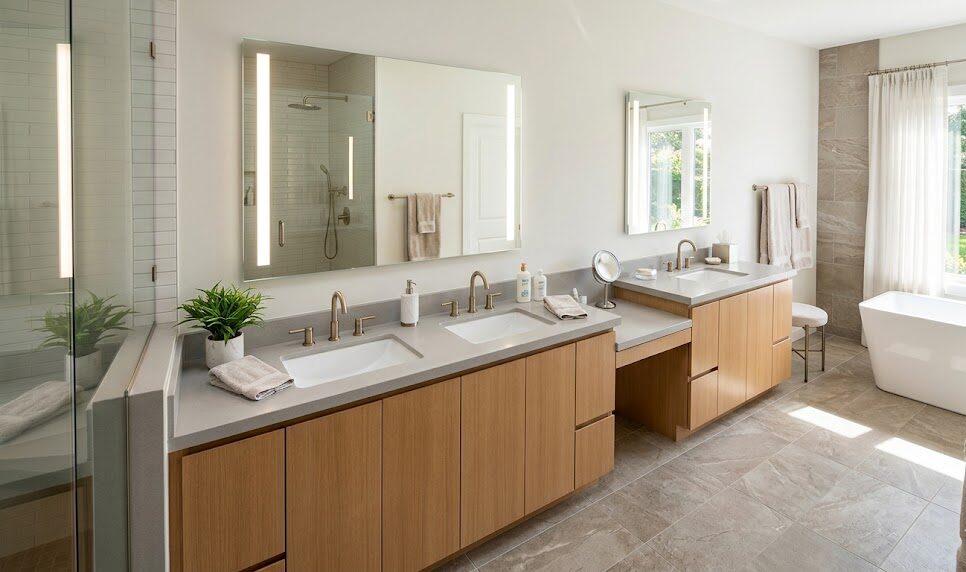

Double Vanity vs. Single: When Two Sinks Are Worth It
Bathrooms fail fast when layout, moisture control, and storage details are planned late, and the single-versus-double-vanity decision is one of the clearest examples.
This guide explains double vanity vs. single in plain English and focuses on the decisions worth making before you commit. The short answer is that two sinks are worth it when two people truly use the bathroom at the same time, when the room has the width and clearance to support them without making the space feel crowded, and when the added plumbing and counter split do not sacrifice more useful storage than they add convenience. A single vanity is often the better choice when storage, counter continuity, and clean circulation matter more than simultaneous sink use.
That is why this is not really a style question. It is a layout and routine question. A double vanity can feel like a major quality-of-life upgrade in the right primary bath. It can also be an expensive space-eater in the wrong room. Likewise, a single vanity can feel elegant, generous, and highly functional when the room is planned well, but it can feel frustrating if two people are constantly competing for sink access during the busiest part of the day.
The Fortress Builders approaches remodeling through one core principle: strength through structure. Every project begins with a design blueprint that aligns real household routines, layout limits, storage needs, and build sequencing before materials are ordered. That structure matters in bathroom remodeling because the right vanity choice only works when it is coordinated with doors, plumbing, lighting, mirrors, ventilation, tile planning, and how the room is actually used every day.
- How to decide between a double vanity and a single vanity based on real daily routines
- Why doors, clearances, plumbing, and room width often matter more than style alone
- How storage, drawer layout, counter space, and mirrors affect long-term satisfaction
- Which decisions need to be made early because they affect rough-ins, lighting, and scheduling
- What to confirm before ordering a vanity or starting demo
Why the vanity choice matters more than many homeowners expect
The vanity is one of the hardest-working elements in a bathroom. It affects storage, counter space, sink access, mirror layout, sconce placement, outlet locations, circulation, and the overall visual balance of the room. That is why choosing between a single vanity and a double vanity is not just about whether two basins look more upscale. It is about whether the room will work better once real daily routines start happening again.
In many bathrooms, the sink count becomes a proxy for a bigger planning issue: what is the room actually supposed to do? If the vanity decision is made too late, the room can end up with awkward tradeoffs. Two sinks might reduce useful drawer storage. One sink might create crowding during busy mornings. A wide vanity might look impressive but choke the circulation path. A smaller vanity might preserve openness but leave homeowners frustrated by the lack of counter landing space.
Daily Routine Support
The right vanity choice should reduce morning friction instead of creating a prettier version of the same problem.
Layout Impact
Vanity width and sink count influence doors, mirror sizing, lighting placement, clearances, and how the room feels in motion.
Storage Consequences
Adding a second sink often changes drawer count, under-sink storage, and how well small daily items stay organized.
Countertop Use
Two sinks can be helpful, but they can also split the counter in ways that reduce the most useful open working area.
Electrical and Lighting Coordination
The vanity choice influences mirrors, sconces, outlets, and how the room is lit during real grooming routines.
Budget and Schedule
Two sinks often change plumbing scope, vanity selection, and installation complexity, which can affect both cost and timing.
Start with routines: who actually uses the bathroom and how?
The first question is not how many sinks look best in a photo. It is how the bathroom is actually used. Do two adults truly get ready at the same time most mornings, or do they mainly use the space one after the other? Is the room a primary bath with overlapping routines, or is it a smaller space that serves one person at a time most of the day? Do the users want separate sink zones, or do they really just need better storage and more countertop landing space?
Those questions matter because a double vanity is most valuable when it solves a real behavior pattern. If two people use the room heavily at the same time, separate sinks can reduce crowding and create a sense of personal space. But if simultaneous use is rare, a larger single vanity with strong drawers and uninterrupted counter space can often perform better.
Busy overlapping routines make two sinks more compelling
If mornings involve two adults brushing teeth, shaving, styling hair, washing up, and moving quickly through the room at the same time, a second sink can provide real day-to-day relief.
Sequential use often weakens the case for a second sink
If one person usually finishes before the other begins, the room may benefit more from better storage, stronger lighting, and calmer counter space than from another basin.
Think about habits, not assumptions
Some homeowners assume that a larger primary bath automatically needs a double vanity. But that only makes sense if the room’s real routine supports it.
If the second sink is not solving a real shared-use problem, it may be taking away storage and counter space that the bathroom needs more.
| Use Pattern | What It Often Suggests |
|---|---|
| Two People at Once | A double vanity may genuinely improve flow, reduce sink competition, and create clearer personal zones |
| Mostly One at a Time | A larger single vanity may deliver better storage and uninterrupted counter space with fewer tradeoffs |
| Small Primary Bath | The best answer often depends on whether a second sink would crowd the room or compromise circulation |
| Guest or Hall Bath | A single vanity is usually sufficient unless the room is serving an unusual shared daily routine |
This is why vanity planning usually works best when it is treated as part of the full bathroom remodeling plan rather than as a late product decision.
Layout constraints and clearances often decide the answer before style does
Even if two sinks sound appealing, the bathroom still has to carry them comfortably. This is where layout reality starts to matter more than wishful thinking. A double vanity that technically fits is not automatically the right choice if it crowds the door swing, pinches the walkway, compresses the toilet zone, or leaves too little room in front of drawers and cabinet doors.
Room width matters
Bathrooms only have so much usable wall space. Once doors, windows, shower entries, toilets, and circulation paths are accounted for, the remaining vanity zone may be more limited than it first appears.
Depth matters too
A vanity that projects too far into the room can make a bathroom feel cramped even if the wall length technically allows it. This is especially important in smaller primary baths and tighter hall bathrooms.
Two sinks need more than just two bowls
A true double vanity also needs enough elbow room, usable counter, and mirror/light coordination to feel balanced. Otherwise the second sink can make the whole room feel squeezed.
- Does the bathroom have enough width for two sinks without shrinking circulation too far?
- Will the vanity depth crowd the room once doors and people are moving through it?
- Can drawers and cabinet doors open comfortably without conflict?
- Does the toilet zone still feel comfortable if the vanity gets wider?
- Will mirrors, sconces, and outlets still align cleanly with the chosen vanity size?
These questions usually connect naturally to related planning resources like small bathroom vanity planning, bathroom lighting planning, and what to expect during a remodel.
Storage, counter space, and clutter control are often more important than sink count
One of the most common mistakes in vanity planning is assuming that more sinks automatically means more function. Often the opposite can happen. Adding a second sink may reduce drawer stacks, eat into under-counter storage, and split the most useful uninterrupted counter zone into smaller, less practical pieces. That can matter more than homeowners expect once toothbrushes, skincare, grooming tools, backup toiletries, and daily-use items start claiming space.
A single vanity often preserves stronger drawer storage
When the plumbing only has to serve one sink, the vanity can often give more space to full-width drawers and better internal organization.
Counter continuity is a real quality-of-life feature
A broad stretch of uninterrupted counter can be more useful than two smaller sink zones if the room is mainly used one person at a time or if daily grooming products need a flexible place to land.
Clutter control often decides whether the room feels calm
A bathroom that looks good on day one but has nowhere for the ordinary daily mess to go will lose its finished feeling quickly.
Double Vanity Tradeoff
Two sinks can improve parallel use, but they often reduce the cleanest stretches of open counter and the simplest storage layout.
Single Vanity Strength
One sink often supports larger drawers, more flexible counter space, and a calmer daily-use zone when overlap is limited.
Drawer Quality
Well-planned drawers usually outperform large empty cabinet voids for organizing smaller daily-use items efficiently.
Tower and Side Storage
Sometimes the best compromise is a single sink with stronger vertical storage rather than a second basin that steals organization space.
If the second sink causes the bathroom to lose the storage and landing space that keep the room calm every day, the upgrade may not actually be an upgrade.
This is why the double-versus-single question often belongs next to vanity size and storage planning and the broader fixture conversation in bathroom fixtures and lighting.
When a double vanity is worth it
A double vanity is usually worth the added space, cost, and plumbing complexity when the bathroom is a true shared daily-use room and the layout can support two sinks comfortably. In the right primary bath, two sinks can reduce wait time, create clearer personal zones, and make the room feel more accommodating for two adults moving through overlapping schedules.
It is strongest in a real shared primary-bath routine
If both users are in the room together often, especially during morning prep or evening wind-down, a second sink can create a noticeable reduction in friction.
It is worth more when the room is generous enough to hold it well
A double vanity should not feel squeezed in. It should still leave comfortable clearances, useful storage, and balanced lighting and mirrors.
It works best when the rest of the room supports dual use
If the shower, storage, outlets, and lighting all still force one person to wait on the other, the value of a second sink may be smaller than expected.
| Strong Case for Double Vanity | Why It Makes Sense |
|---|---|
| Two Adults Get Ready Together | Separate sink zones can reduce crowding and improve morning flow in a meaningful way |
| Room Has the Width | The bathroom can support two sinks without creating awkward clearances or sacrificing too much storage |
| Shared Primary Bath | A double vanity often aligns best with the expectations of a true two-user primary suite |
| Lighting and Mirrors Can Be Balanced | The room can support dual mirror or balanced lighting placement cleanly instead of forcing awkward symmetry |
- two people genuinely use the bathroom at the same time most days
- the room has enough wall length and depth to support two sinks comfortably
- storage and counter space still remain practical after the second sink is added
- lighting, mirrors, and outlets can still be planned cleanly
- the added plumbing scope fits the project budget and schedule expectations
When a single vanity is the better choice
A single vanity is often the stronger answer when the bathroom needs more storage, better counter continuity, cleaner circulation, or more visual calm than it needs a second sink. This is especially true in smaller primary baths, guest baths, and many hall baths where two sinks sound attractive in theory but are rarely used simultaneously enough to justify the tradeoffs.
It often wins in compact rooms
In smaller bathrooms, a well-planned single vanity can make the room feel more open and functional rather than forcing a cramped double-sink layout.
It often creates better storage performance
One sink frequently allows better drawer banks, more usable counter surface, and simpler organization for daily-use items.
It can still feel high-end
A single vanity does not have to feel like a downgrade. In the right room, it can feel cleaner, more generous, and more intentional than a crowded double vanity ever would.
Small Primary Baths
One sink often preserves the comfort and openness the room needs more than a second basin would.
Guest Bathrooms
A single vanity is usually sufficient and often gives better balance to a room that is not serving two simultaneous daily users.
Storage-First Households
When countertop clutter and drawer organization matter most, a stronger single-sink layout often performs better.
Budget-Conscious Remodels
One sink can reduce plumbing complexity and selection pressure while still producing a beautiful, highly functional bathroom.
When the second sink is not solving a real routine problem, a larger or better-designed single vanity often becomes the smarter and more satisfying long-term choice.
Doors, mirrors, sconces, and outlet locations should be planned with the vanity, not after it
One of the reasons vanity decisions matter so much is that they influence a whole chain of other design and rough-in choices. Mirror size, sconce spacing, outlet placement, faucet centering, drawer layout, and even how the room feels when the door opens are all connected to whether the vanity is single or double.
Mirror strategy changes immediately
A double vanity may call for two mirrors, one wider mirror, or a more symmetrical lighting strategy. A single vanity often gives more freedom for one large mirror and a calmer focal composition.
Lighting becomes more complex with two sink zones
Two sinks usually mean more decisions about how sconces, overhead lighting, and task light align so the room feels balanced rather than overly busy.
Outlets and counter use follow the vanity logic
Hair tools, toothbrushes, shavers, and charging devices all need practical locations. The vanity plan should support those routines, not just the sink bowls themselves.
- mirror size and whether the room should use one mirror or two
- sconce placement and how lighting supports real grooming routines
- outlet locations for daily-use tools and charging
- drawer access and door swing clearance
- countertop landing space that still feels useful after fixtures are in place
This is why vanity selection usually belongs closely with bathroom lighting planning and bathroom fixtures and lighting instead of being handled in isolation.
Rough-ins, lead times, and selection timing can change the whole vanity decision
Some bathroom decisions can wait a little longer. Vanity direction is usually not one of them. That is because single-versus-double affects plumbing locations, electrical planning, lighting layout, and often the schedule itself if the vanity is custom, oversized, or paired with special mirrors, stone tops, or plumbing trim.
Double vanities usually increase rough-in coordination
Two sinks mean more plumbing considerations, more fixture spacing, and more coordination with drawers, trap locations, and countertop templating.
Custom or specialty vanities can affect the schedule
Whether single or double, vanities often have longer lead times than homeowners expect, especially when they are custom-built or require a coordinated top and sink package.
It helps to know which decisions are rough-in-sensitive
Sink count, faucet style, mirror strategy, lighting, and outlet positions should be clear early enough that the walls can be prepared correctly.
| Selection | Why Timing Matters |
|---|---|
| Single vs. Double Sink | It directly affects plumbing rough-ins, vanity configuration, mirror strategy, and lighting layout |
| Vanity Width and Depth | These dimensions influence room clearances, door swings, and how much storage the room will actually gain |
| Faucet and Countertop Choices | They can affect top fabrication, hole spacing, and the final balance of usable landing space |
| Mirror and Lighting Plan | They need to align with the sink count and vanity size before electrical planning moves too far |
This also connects naturally with broader homeowner planning resources like timeline expectations and budget planning, because vanity scope affects both.
Small-bath mistakes that make double vanities feel worse than they looked on paper
Small bathrooms are where the double-versus-single decision gets most distorted by wishful thinking. A double vanity can look like an obvious upgrade until the room is actually being used. Then the homeowners realize the walkway is tight, the drawers are smaller than expected, the toilet zone feels cramped, and the counter surface that could have handled daily clutter more gracefully is now split into two smaller islands around the basins.
Cramped circulation is a major red flag
If people have to squeeze past each other or if the vanity crowds the door, the second sink is likely costing more than it gives back.
Reduced drawer quality is often overlooked
Two bowls and two trap zones can leave less room for the kind of drawer storage that actually makes a bathroom work better every day.
Visual crowding matters too
Two mirrors, extra lighting, and more fixtures can make a small room feel busy if the space does not have enough visual breathing room.
Choosing two sinks because it feels more luxurious
A second sink is only truly luxurious if the room still functions well around it.
Ignoring what the second sink takes away
Counter space, drawer storage, and clear circulation often matter just as much as the added sink bowl.
Forgetting the lighting and mirror implications
The vanity choice changes the whole focal wall, and small rooms are less forgiving when those elements feel crowded.
Assuming simultaneous use happens more often than it really does
Many couples like the idea of two sinks more than they actually need the function every day.
Waiting too long to settle vanity direction
Late decisions on sink count can create avoidable rough-in changes, lighting adjustments, and selection pressure.
What to confirm before ordering a vanity or starting demo
By the time demo starts, the vanity direction should be more than a mood-board preference. The homeowners and project team should understand who uses the room, whether simultaneous sink use is truly valuable, how much storage the room needs, what clearances must be protected, and how the vanity will affect lighting, outlets, and mirrors.
Confirm routines honestly
The best vanity answer usually becomes much clearer once the household is honest about whether two sinks solve a real daily problem or just seem like a good idea on paper.
Confirm the room dimensions with the finished vanity in mind
Width, depth, door swings, toilet clearances, and walkway comfort should all be checked against the actual vanity plan, not just rough assumptions.
Confirm the supporting selections
Mirrors, sconces, outlets, faucet style, and drawer configuration should be understood early enough that the full wall can be planned coherently.
- whether the bathroom is truly a simultaneous-use room
- that the room can support the chosen vanity width and depth comfortably
- how much storage and uninterrupted counter space the household really needs
- that mirrors, lighting, and outlets align with the sink count cleanly
- that plumbing, electrical, inspections, or other requirements are reviewed with qualified professionals and local authorities where applicable
How Fortress Builders would approach the double-vanity versus single-vanity decision in a real remodel
A strong design-build process would not start with “Do you want one sink or two?” It would start with how the bathroom is actually used, what the room can comfortably hold, how much storage the household needs, and whether the second sink solves enough real daily friction to justify the tradeoffs. That is how vanity planning becomes part of a durable, clear remodeling process instead of just a trend decision.
In one primary bath, that may mean a true double vanity because two adults overlap in the room daily and the layout can support it without strain. In another, it may mean a larger single vanity with stronger drawer storage, one generous mirror, and better open counter space because that setup performs better for the real routine. In another, it may mean a hybrid strategy where a single sink and strong side storage outperform a squeezed-in second basin. The right answer depends on the room and the people using it.
The most important thing is deciding early enough that the rough-ins, lighting, storage plan, and layout can all support the final choice cleanly.