

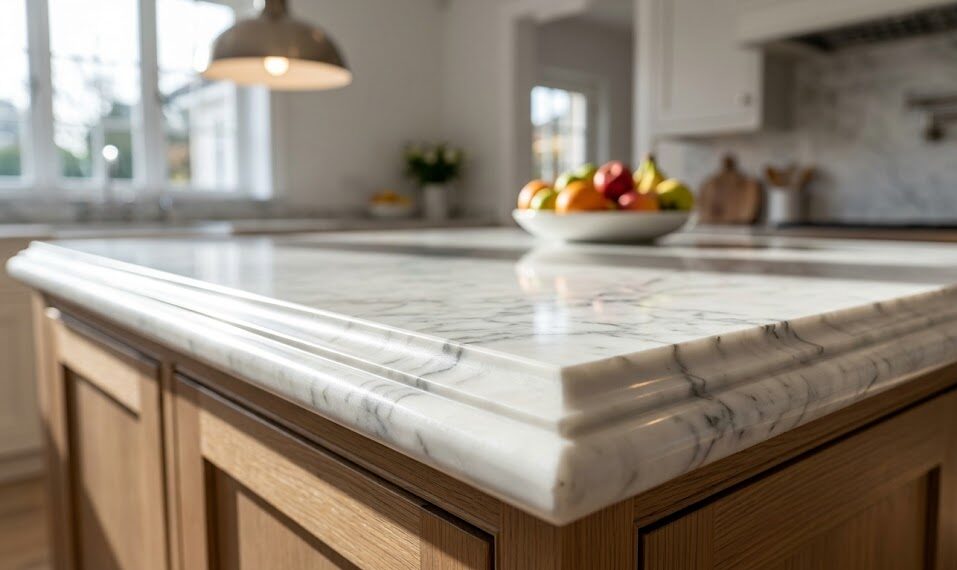
Countertop Edge Profiles: Eased, Bevel, Bullnose, and Waterfall Alternatives
Countertop edge profiles are one of the smallest kitchen decisions with the biggest daily impact.
You’ll see them every time you walk into the room. You’ll feel them every time you wipe the counter, lean in to help a kid with homework, or set down a hot pan near the sink. And because they’re fabricated into the slab, they’re not an “easy swap” later.
In this homeowner-friendly guide, you’ll learn:
- what countertop edge profiles actually are (and what they change),
- how eased, bevel, bullnose, and other profiles compare for cleaning and durability,
- how edge choices interact with quartz, granite, porcelain, and other materials,
- how to get the “waterfall look” without the full waterfall price tag,
- and a pre-order checklist to lock the right details before templating.
The Fortress Builders is a Utah design–build company built on “strength through structure.” In kitchens, that means we plan the parts that affect daily function first—layout, clearances, storage, and surfaces—then refine the details like edges so everything looks intentional and holds up over time.
Helpful internal pages while you plan:
What is a countertop edge profile (and why it matters)
An edge profile is the shape fabricated into the exposed front edge of your countertop—typically along cabinet runs, islands, and any overhangs. It can be subtle (a slightly softened square edge) or more decorative (a rounded bullnose or a traditional ogee).
In real life, edge profiles affect four things homeowners care about:
- Safety and comfort: how sharp the edge feels when you bump it or lean against it.
- Cleaning: whether crumbs and drips catch on the edge and whether it wipes clean easily.
- Durability: chip resistance and how the edge performs in a high-traffic kitchen.
- Style: whether the kitchen reads modern, transitional, or traditional.
Homeowner takeaway: Most countertops “fail” at the edges first—chips, dings, and wear show up on corners and overhangs. A good edge choice is one you don’t have to think about after move-in.
How to choose the right edge (a practical decision framework)
If you want an edge you’ll still like in five years, pick it using real-life criteria—not showroom lighting.
Edge profile decision checklist (quick, but effective)
- Who uses the kitchen? Kids, pets, and high-traffic households usually benefit from softened edges.
- How do you clean? If you wipe counters constantly, choose profiles with fewer crevices.
- What material are you using? Some materials chip differently; edge thickness and radius matter.
- Do you have seating overhangs? Bar seating changes what “comfortable” feels like along the edge.
- What style are you building? Modern typically prefers straight/eased; traditional often supports more detail.
- Where are the high-risk corners? Island corners, traffic pinch points, and sink zones deserve extra attention.
The core edge profiles: eased, bevel, bullnose (and what they’re best at)
Eased edge (often called “softened square”)
An eased edge looks like a clean, straight line—but the sharpness is softened slightly so it’s more comfortable and less prone to small chips than a true sharp square.
- Best for: modern and transitional kitchens; minimal visual noise; easy wipe-down.
- Cleaning: excellent—few crevices.
- Durability: strong, but corners can still be chip-prone if they stay crisp and square.
- Reality check: ask for a small radius at corners if your island sits in a heavy traffic lane.
Bevel edge (a chamfered angle)
A bevel introduces an angled facet at the top edge. It can be subtle (small bevel) or bold (larger bevel). In many kitchens, it reads as “clean but intentional.”
- Best for: transitional kitchens; adding definition without ornate detailing.
- Cleaning: good—though dust and crumbs can collect slightly at the angle if it’s pronounced.
- Durability: generally good; the facet can help visually mask minor chips.
- Watch-out: larger bevels can create a “line” that’s more noticeable in certain lighting.
Bullnose (rounded edge)
Bullnose is a rounded profile (often half-round or full-round) that softens the entire edge. It’s comfortable and reduces sharp corners.
- Best for: families who prioritize comfort and softer lines; some traditional and transitional kitchens.
- Cleaning: good overall, but drips can wrap under the curve and show more easily on the underside.
- Durability: often forgiving; rounded corners can reduce chipping on impact points.
- Style note: depending on the cabinet style, it can read more traditional than modern.
Other common edge profiles you’ll see in showrooms (and when they make sense)
Pencil round
This is a small, subtle rounding—less round than bullnose. It’s a common compromise for households that want modern lines but don’t want sharp edges.
- Best for: family kitchens that still want clean lines.
- Cleaning: excellent.
- Durability: good, especially at corners and seating edges.
Ogee (more decorative, “S-curve”)
Ogee edges include a curved detail that reads more traditional. They can look beautiful in the right home, but they require commitment: they become a defining design element.
- Best for: traditional kitchens, detailed millwork, classic cabinet door profiles.
- Cleaning: more effort—crevices collect grime and crumbs more easily.
- Durability: can be fine, but the profile has more “features” that show wear.
Dupont / ogee variant / multi-step profiles
These are variations with stronger shadow lines. They can feel high-end, but they also magnify any inconsistency and add cost.
Practical advice: choose these only when they match the rest of your home’s trim language and you’re comfortable with the cleaning effort.
Mitered edge (the “thick slab look”)
A mitered edge creates the appearance of a thicker countertop by joining pieces at an angle. This is often used to create bold, modern edges without stacking obvious laminations.
- Best for: modern designs; islands that need visual “weight.”
- Cleaning: good if the seam is tight and aligned.
- Watch-out: seam visibility depends on fabrication quality and pattern matching.
Edge profiles by lifestyle: what works best for real kitchens
Family kitchens (kids, backpacks, constant snacks)
When the kitchen is the home’s command center, edges should be forgiving and comfortable.
- Best bets: eased with softened corners, pencil round, or bullnose (especially on islands with seating).
- Why: less sharp impact risk, easier cleaning, fewer chips at traffic corners.
- Pro tip: specify corner radius intentionally—don’t leave it to “whatever the shop usually does.”
Entertaining kitchens (big island, serving, frequent gatherings)
Entertaining islands are where people lean, set drinks, and cluster. Comfort matters as much as style.
- Best bets: eased edge (slightly softened) or small bevel for definition; consider a softer edge at seating overhangs.
- Why: clean modern look, still comfortable for elbows and wrists.
- Planning note: island edges tie directly to seating clearance—see Kitchen Island Size Guide: Clearances, Seating, and Storage.
Low-maintenance kitchens (you want it to look good with minimal effort)
Low-maintenance is often less about the material and more about the geometry: fewer grooves, fewer ledges, fewer “dirt shelves.”
- Best bets: eased, pencil round, subtle bevel.
- Avoid (often): deep decorative profiles with curves and steps unless you love detailed cleaning.
Material matters: how quartz, granite, porcelain, and laminate behave at the edge
Edge selection should consider how a material chips, how seams show, and how thickness is handled.
| Material | Edge behavior (practical) | Edge tips |
|---|---|---|
| Quartz | Consistent look, but corners can chip if left too sharp. Most issues show up at high-impact points. | Eased + softened corners is a safe default. If you want a “thick edge,” consider a clean miter with good fabrication. |
| Granite / natural stone | Natural variation is beautiful; edges can be durable, but profiles can reveal or hide natural pattern movement. | Choose edges that match the stone’s personality. Subtle profiles keep the slab as the hero. |
| Porcelain slabs | Very thin material profile compared to stone; edges often require careful detailing and fabrication. | Confirm how the fabricator handles edge buildup, seams, and durability at corners. |
| Laminate | Edges are often the defining look (postform or square). Great for budget, but edge options differ from stone. | Prioritize durability and water management at the sink; keep seams away from high-splash areas when possible. |
| Solid surface | Can create seamless looks and softer edges; repairable in some cases. | Use profiles that support the intended look (often clean/eased or gentle rounds). |
If you’re still choosing materials, start here: Quartz vs. Granite vs. Porcelain Countertops: Which Holds Up Best?.
Waterfall edges: what you’re paying for (and smart alternatives)
A waterfall edge wraps the countertop material down the side of an island to the floor. It can look striking, but it also increases material, fabrication, and labor costs. It can also change how an island “reads” visually—sometimes in a great way, sometimes in a way that makes the space feel heavier.
When a waterfall edge makes sense
- You want a bold, modern statement and the kitchen can support it visually.
- Your island sits as a focal point and you want to protect end panels from chair scuffs and dings.
- You’re using a dramatic slab pattern and want it to be the design feature.
Waterfall alternatives that often deliver the “look” for less
- Mitered thick edge: create a substantial-looking top without wrapping to the floor.
- End panels that match cabinetry: a clean finished panel with a durable toe kick can look just as intentional.
- Partial waterfall / “apron” drop: drop the material down a short section (where chairs hit) instead of full height.
- Contrasting end treatment: use a wood panel or furniture leg detail to make the island feel designed, not boxed.
For a deeper waterfall decision framework, use: Waterfall Islands: Pros, Cons, and When They Make Sense.
Homeowner takeaway: A waterfall edge is not a requirement for a “high-end” kitchen. The high-end move is choosing a detail that fits your kitchen’s scale, budget, and daily use—and then executing it cleanly.
Corner decisions: the part most people forget to specify
Edge profiles get discussed along straight runs, but corners are where injuries and chips happen most often—especially on islands in open-concept spaces.
Corner radius (soft corners) vs. sharp corners
- Sharp corners: look crisp and modern, but chip and bump risk is higher in traffic zones.
- Small radius corners: still look clean, but are more forgiving and safer for kids.
- Larger radius corners: can feel more traditional or “softer,” depending on the cabinet style.
Where to prioritize softer corners
- islands near entry paths (garage-to-kitchen routes),
- tight clearances around stools or walkways,
- any corner that sits at kid head height.
If clearances are part of your layout planning, use: Kitchen Door and Walkway Clearances: Avoiding Pinch Points.
Edges, sinks, and backsplashes: how details stack up
Edge profiles don’t live alone. They interact with sinks, faucets, and backsplash decisions—especially around cleaning.
Undermount sinks and edge comfort
With undermount sinks, you wipe crumbs and water directly toward the sink. A clean, simple edge profile makes that easier because you aren’t navigating extra ridges.
If you’re still choosing sink type, these pages can help you avoid cabinet surprises:
- Undermount vs. Drop-In vs. Farmhouse Sinks: Pros, Cons, and Cabinet Impacts
- Best Kitchen Sink Materials: Stainless, Fireclay, Composite, and Cast Iron
Backsplash height and how edges “read” visually
A busy backsplash plus a decorative edge can start to feel visually crowded. In many kitchens, a simple edge allows you to choose bolder tile or slab backsplash without making the space feel over-designed.
Related: Backsplash Height Guide: 4-Inch, Full Height, or Up to the Cabinets?
Cost drivers: why some edges cost more (and how to stay in control)
Edge costs vary by material, thickness, fabrication complexity, and how much hand-finishing is required. A simple profile is usually faster to fabricate and easier to keep consistent across long runs.
Common reasons edge costs rise
- Complex profiles: more tool passes, more polishing, more labor.
- Thick edges (mitered build-ups): extra material and seam work.
- Waterfall applications: more slab usage + more seams + more handling.
- High-contrast veining: pattern matching on edges and seams becomes more demanding.
- Tight timelines: expedited fabrication can affect cost and scheduling.
Budget strategy that works: Spend on durability and function first (material choice, sink details, layout), then choose an edge profile that supports your style without adding “maintenance complexity.”
Installation and scheduling: where edge decisions show up in the build process
In a design–build kitchen remodel, countertops usually happen after cabinets are installed and leveled. The template is taken from the actual cabinets, then the slab is fabricated based on your chosen edge and sink details.
Decisions that should be locked before templating
- countertop material and thickness,
- edge profile selection,
- sink type and exact model (undermount/drop-in/farmhouse),
- faucet hole count and accessory holes (soap dispenser, filtered water, air gap if used),
- backsplash plan (tile vs slab; full-height decisions),
- overhang lengths and support approach.
Countertops connect to cabinet planning and appliance planning. Related pages:
Safety and code-adjacent notes (what to confirm, not assume)
Edge profiles themselves typically aren’t a “code” issue, but countertop decisions can intersect with safety and inspection realities—especially when appliances, outlets, and ventilation are being upgraded.
- If you’re adding or relocating outlets (especially islands), confirm requirements with qualified professionals and local authorities.
- If your remodel includes new appliances or changes to range location, confirm electrical and ventilation requirements early.
- If you’re increasing island overhangs for seating, confirm support methods and safe load expectations with your contractor.
For related planning topics:
- Outlet Placement in a Kitchen Remodel: Islands, Counters, and Hidden Solutions
- Range Hood CFM Sizing: How to Choose Ventilation That Works
Pre-order checklist: choose an edge you won’t regret
Use this before you finalize countertop orders:
- Profile choice: eased, bevel, pencil round, bullnose, or decorative—selected intentionally.
- Corner plan: specify corner radius at island corners and traffic corners (don’t leave it vague).
- Seating comfort: confirm the edge feels comfortable at bar seating overhangs.
- Cleaning reality: choose a profile you can wipe easily based on your daily habits.
- Material fit: confirm your chosen edge works well for your material (and thickness).
- Waterfall decision: if you want the look, confirm whether a mitered edge or partial drop could achieve the same goal.
- Sink + faucet: confirm sink model, hole count, and accessory needs before templating.
- Backsplash strategy: tile vs slab, height choice, and how “busy” the wall finishes will be.
FAQ: countertop edge profiles
| Question | Short answer | What to verify |
|---|---|---|
| What’s the most popular edge profile right now? | Eased and small bevels are common because they look clean, wipe easily, and fit modern/transitional kitchens. | How it feels at corners and seating overhangs in your specific layout. |
| Is bullnose outdated? | Not automatically. Bullnose can be great for comfort and safety, especially in family kitchens. It just reads softer. | Whether it matches your cabinet style and overall trim language. |
| Do decorative edges increase maintenance? | Often, yes—because curves and steps can collect grime more easily than simple profiles. | Your tolerance for detailed cleaning and how the kitchen is used daily. |
| Are sharp square edges a bad idea? | They can look very modern, but they’re less forgiving for impacts and can be uncomfortable in high-traffic homes. | Corner radius options and whether your island sits in a major traffic lane. |
| Is a waterfall edge worth it? | Sometimes. It’s a design statement and can protect island ends, but it adds cost and visual weight. | Whether a mitered thick edge or finished end panels deliver the look you want with better value. |
Conclusion: the best edge profile is the one that fits your life, not just your Pinterest board
For most homeowners, the “best” edge is simple: an eased edge, a subtle bevel, or a gentle round that feels comfortable and wipes clean. Decorative profiles can be beautiful in the right kitchen—but they should match the home’s style and the homeowner’s cleaning reality.
If you’re unsure, choose durability and ease of use first, then let your slab and cabinetry carry the design. That’s how kitchens stay beautiful and livable.
Want a second set of eyes before you finalize countertops?
Fortress Builders can review your countertop plan (material, thickness, edge profile, sink details, and island overhangs) so you avoid expensive changes after templating.
Request a Design Consult Cabinets & Countertops View Kitchen Portfolio
Bring your cabinet layout, the countertop material you’re considering, and any island seating/overhang questions. We’ll help you lock details that look right and hold up.