

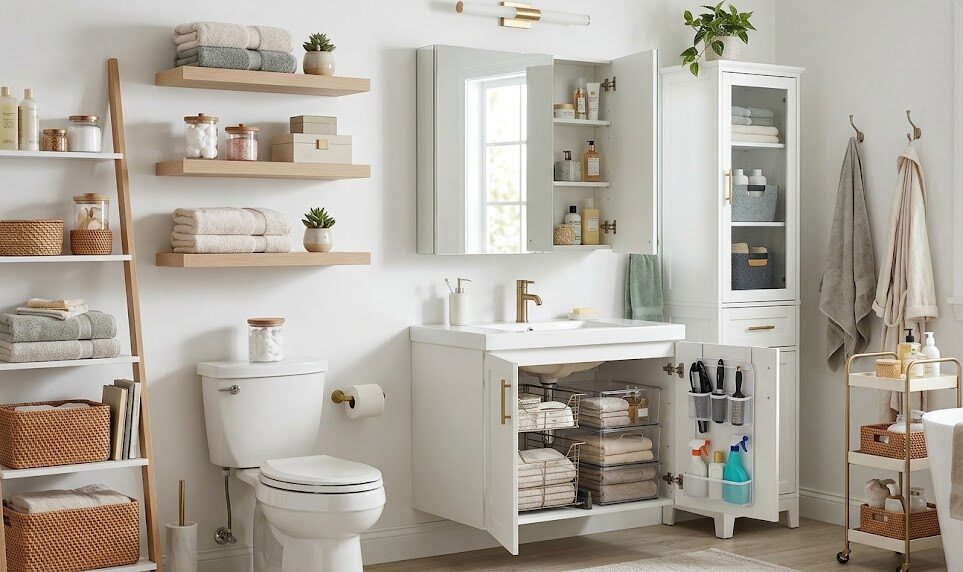

Bathroom Storage Upgrades: Linen Towers, Recessed Cabinets, and Built-Ins
Bathrooms fail fast when layout, moisture control, and details are not planned early enough, and storage is one of the clearest places that happens.
This guide explains bathroom storage upgrades in plain English and focuses on what homeowners should decide before they commit. Linen towers, recessed medicine cabinets, shower niches, vanity drawer systems, and custom built-ins can all make a bathroom feel calmer and more luxurious, but only when they are placed around real routines, room clearances, and the hidden systems behind the walls. The best storage is not the storage that simply adds more shelves. It is the storage that reduces clutter, supports daily habits, and still works cleanly with lighting, waterproofing, ventilation, and circulation.
Bathroom storage problems usually show up quickly after a remodel is done. Counters get crowded, spare towels migrate into the wrong cabinet, hair tools have nowhere practical to land, and shower bottles start collecting along ledges that were never meant to be storage zones. Those problems are rarely caused by a lack of taste. They are usually caused by storage being treated as an accessory instead of a planning decision.
The Fortress Builders approaches remodeling through one core principle: strength through structure. Every project begins with a design blueprint that aligns client goals, room constraints, budget, and build sequence before construction moves too far. That matters in bathrooms because the strongest storage upgrades are the ones planned early enough to coordinate with plumbing, framing, blocking, lighting, tile layout, and moisture control, not added late as a patch for clutter.
- How to plan bathroom storage around real daily routines instead of around empty wall space
- Why linen towers, recessed cabinets, and built-ins should be coordinated with layout and clearances early
- How to reduce clutter with better drawer systems, niches, and enclosed storage
- Which storage ideas affect rough-ins, waterproofing, framing, and schedule
- What to confirm before ordering materials or starting demo
Why bathroom storage matters more than many homeowners expect
Bathrooms may be small, but they carry a surprising number of daily-use items. Towels, backup toiletries, skincare, cleaning supplies, grooming tools, extra tissue, medications, hair accessories, and shower products all need somewhere to go. When the bathroom has no real plan for those items, the room starts losing function almost immediately. Countertops crowd, open shelves become visual noise, and the bathroom begins to feel busy no matter how beautiful the tile or fixtures are.
This is why storage is not a finishing touch. It is part of how the bathroom works. The right storage choices affect whether the room feels calm in the morning, whether guests know where essentials are, whether shower clutter stays contained, and whether the vanity can actually support everyday routines without becoming a mess magnet.
Clutter Control
Storage choices largely determine whether the room stays calm and clean-looking after real daily life starts happening.
Routine Support
The best storage is positioned around where people actually get ready, clean up, and reach for items repeatedly.
Layout Impact
Towers, cabinets, and built-ins affect clearances, mirror planning, lighting, and how open or crowded the room feels.
Moisture Awareness
Bathrooms need storage that works within a humid, splash-prone environment rather than pretending it is a dry hallway closet.
Long-Term Satisfaction
Storage upgrades often influence everyday happiness in a bathroom more than one more decorative finish ever will.
Build Coordination
Some storage ideas touch framing, waterproofing, electrical, or plumbing, which means they need to be planned earlier than expected.
Start with routines: who uses the bathroom, and what needs to stay close?
The first real storage decision is not whether the bathroom should have a linen tower or a recessed cabinet. It is understanding what the room must hold and how people actually use it. A primary bath used by two adults morning and night will likely need different storage than a guest bath or a kids’ hall bath. The strongest storage layouts come from real habits, not from copying a showroom display.
Think in zones, not just in products
Daily grooming items often belong near the vanity. Spare towels may need to be near the shower or tub. Backup products might live higher or farther out of sight. Cleaning supplies and less attractive essentials often need closed storage, not display shelving.
Frequency of use matters
If something is used every day, it should not require awkward reaching, crowded counters, or a deep cabinet dig. Storage works best when the most-used items are the easiest to access.
Shared bathrooms need clearer boundaries
When two people use the same room heavily, good storage often means reducing overlap and confusion, not just adding more square inches of shelving.
If the bathroom storage plan is not clearly responding to what people actually use every day, the remodel is probably relying too much on looks and not enough on function.
| Bathroom Type | What It Often Needs Most |
|---|---|
| Primary Bath | Better vanity organization, towel storage, and zones for daily-use items without visual clutter |
| Kids’ Bath | Simple, durable storage that hides clutter quickly and keeps essentials easy to reach |
| Guest Bath | A cleaner balance of spare supplies, towels, and accessible basics without overbuilding the room |
| Small Everyday Bath | Compact built-ins, vertical storage, and disciplined organization so the room feels usable instead of overfilled |
This is why bathroom storage planning usually works best when treated as part of the overall bathroom remodel rather than as an afterthought once fixtures are already chosen.
Fix layout constraints first: doors, plumbing, mirrors, and clearances
Before adding towers or built-ins, it is worth solving the room’s physical constraints. Bathroom storage cannot be planned intelligently if the door swing crowds the vanity, the toilet clearance is already tight, or the wall the homeowner wants to use is competing with plumbing, electrical, or ventilation paths. Storage that looks good in a rendering but makes the room feel compressed is rarely a real upgrade.
Doors and swings affect whether towers make sense
A linen tower can be extremely useful, but not if it creates a tight entry sequence or competes with the way drawers and cabinet doors need to open.
Vanity walls often carry more than just storage
Mirrors, sconces, outlets, plumbing, and everyday counter routines all meet at the vanity wall, so storage added there should support those elements, not crowd them.
Shower walls need special discipline
Storage inside the wet zone should be planned around waterproofing and tile layout, not simply inserted wherever there seems to be spare space.
- Does the room have the clearance for a full-height tower without crowding the entry or vanity?
- Will doors, drawers, and cabinet fronts still open comfortably?
- Are plumbing, electrical, or venting paths occupying the wall you hoped to use for recessed storage?
- Does the mirror and lighting plan still work once more storage is added?
- Will the room feel calmer or more crowded after the storage upgrade is installed?
These decisions often connect naturally with related planning pages like small bathroom vanity planning and bathroom lighting planning, since the storage strategy and the vanity wall usually affect each other directly.
Linen towers: when vertical storage earns its footprint
Linen towers are one of the most effective bathroom storage upgrades because they use height, not just width. In the right room, a tower can store towels, backup toiletries, cleaning supplies, and less-attractive daily clutter in a way that keeps the vanity from doing all the work. They are especially helpful in bathrooms where countertop calm matters and where a full separate linen closet is not available nearby.
Where linen towers work best
Linen towers usually perform well next to a vanity, at the edge of a double-vanity wall, or in an underused vertical zone where they help anchor the room rather than interrupt circulation. They can be especially helpful in primary baths and in smaller bathrooms that need serious storage without adding more horizontal bulk.
Closed towers usually outperform mostly open ones
Bathrooms collect mismatched essentials quickly. Closed storage helps the room feel calmer and more finished, especially in everyday family use. A little open display space can be fine, but most bathrooms benefit more from concealment than from display.
Tower proportions matter
A tower that is too wide can make the room feel heavy. A tower that is too shallow or too narrow may look elegant but fail to hold the items it was meant to solve. The goal is not just to add height, but to add useful height.
Towel Storage
Linen towers are often one of the easiest ways to keep spare towels close to the shower without turning the room into an open-shelf display.
Backup Supplies
They can hold tissue, backup toiletries, and less-attractive essentials that would otherwise crowd the vanity area.
Vertical Efficiency
In tight bathrooms, using height well can often solve more problems than simply widening the vanity.
Visual Structure
A well-proportioned tower can help the vanity wall feel more intentional when it is integrated into the overall design.
A linen tower is worth it when it reduces daily clutter and gives the room a better storage hierarchy without making the bathroom feel crowded or overbuilt.
Tower planning often works best when viewed alongside vanity size and drawer planning and the broader flexibility of custom built-ins and carpentry.
Recessed cabinets: how to gain storage without projecting farther into the room
Recessed medicine cabinets and recessed wall storage can be especially smart in bathrooms because they add utility without pushing farther into already limited clearance space. In smaller bathrooms, that can make them one of the highest-value storage upgrades. They are particularly attractive when the room cannot spare the depth for another cabinet but still needs more storage near the vanity or grooming zone.
Where recessed storage shines
It often works best near the vanity, in walls that can accommodate it cleanly, or in selected dry-zone areas where extra everyday storage is needed without visually thickening the room.
What homeowners often forget
Not every wall can be recessed into freely. Framing, plumbing, electrical, venting, and structural conditions all influence what is possible. That is why recessed storage needs to be planned early, not treated like a late swap-in idea.
Recessed storage works best when it feels integrated
The cleanest results usually come when the recessed cabinet aligns well with mirrors, sconces, or the overall wall composition instead of looking like a separate box cut into the wall later.
| Recessed Storage Benefit | Why It Matters |
|---|---|
| Space Saving | Recessed cabinets can add useful storage without taking more walkway or vanity clearance from the room |
| Cleaner Profile | Because they sit deeper into the wall, they can make a compact bathroom feel less crowded than surface-mounted options |
| Daily Access | When located near the vanity, they can make small routine items easier to reach without cluttering the countertop |
| Design Integration | They often feel strongest when tied cleanly into the mirror and lighting plan of the room |
- that the wall can accommodate recessing without major conflicts
- that the cabinet aligns well with the mirror and vanity composition
- that the extra storage solves a real routine problem, not just an abstract desire for “more”
- that outlet, lighting, and switch locations still make sense nearby
- that framing, plumbing, electrical, or code-related questions are reviewed with qualified professionals where needed
Built-ins and custom storage: when made-to-fit solutions are worth it
Built-ins become especially valuable when standard vanity and cabinet options do not solve the room well enough. Some bathrooms need more customized solutions: a niche sized for exact towel storage, a narrow pull-out between fixtures, a cabinet fitted around a window condition, or storage built into a transition zone that would otherwise go unused. This is where custom carpentry and made-to-fit planning can turn awkward space into highly useful storage.
Built-ins work best when they solve a layout-specific problem
Custom work is most worthwhile when the room has unusual constraints or when the homeowner needs something that standard products do not provide cleanly.
They can make smaller bathrooms feel more intentional
Because they are tailored to the room, built-ins often use leftover inches more intelligently than off-the-shelf solutions can.
Built-ins should still respect moisture and maintenance
Bathrooms are humid environments, so the storage approach should still be durable, easy to clean, and appropriate to the wetness level of the area where it is installed.
Narrow Fillers and Pull-Outs
Sometimes the smallest leftover gaps become the most useful storage when they are designed intentionally instead of wasted.
Custom Towel Niches
Built-ins can keep towels accessible without relying on oversized furniture-like pieces in an already tight room.
Integrated Vanity Surrounds
Custom side cabinets or vertical additions can help the vanity wall hold more without feeling pieced together.
Architectural Fit
Built-ins often feel strongest when they look original to the house rather than like a storage fix added after the room was designed.
Custom storage is usually worth it when it solves a real space problem more cleanly than standard products can, not simply because “custom” sounds more luxurious.
This is where the bathroom storage conversation overlaps naturally with custom carpentry and built-ins, especially when the homeowner wants storage that feels integrated instead of added on.
Shower niches, shelves, and wet-zone storage need special planning
Bathroom storage is not limited to the vanity wall. Shower storage matters just as much because it is one of the fastest ways a bathroom starts to feel visually cluttered. Bottles on ledges, hanging caddies, and improvised corner racks usually signal that the storage plan inside the wet zone was not thought through early enough.
Niches are part of the build, not just part of the tile pattern
The location and size of a niche affect framing, waterproofing, and tile layout. That makes it a planning decision, not an accessory.
Benches and shelves can add function when they are truly needed
Not every shower needs a bench, and not every shower wall needs multiple niches. The goal is useful, durable storage that remains easy to clean.
Waterproofing is the real system behind the storage
Any storage integrated into the shower has to respect the fact that this is a wet environment first and a styling opportunity second.
- plan niche placement before tile layout is finalized
- avoid putting niches in locations that make cleaning awkward
- size niches around realistic product storage, not just visual symmetry
- remember that benches and shelves affect waterproofing details
- confirm system details with qualified professionals if waterproofing or code questions apply
These decisions connect directly to shower niche and shelf planning and tile and waterproofing systems.
Rough-ins, waterproofing, and timing: the hidden side of bathroom storage upgrades
One reason storage upgrades are so easy to underplan is that they feel less urgent than tile or fixtures. But many of the best storage solutions affect hidden work. A recessed cabinet may depend on what is inside the wall. A tower may need to be coordinated with outlets or switches. A niche depends on framing and waterproofing. A built-in may require blocking or revised wall prep. That is why storage upgrades often need to be settled earlier than homeowners expect.
Rough-in-sensitive storage should be chosen early
If a storage idea affects plumbing, wiring, lighting, or wall openings, it belongs in the planning phase before the room gets closed up.
Waterproofing-sensitive storage should never be treated casually
Any storage in or near a wet zone must be coordinated with the waterproofing system, not layered on after those decisions are already made.
Lead times can matter here too
Custom towers, specialty medicine cabinets, and built-ins may affect the schedule if they are selected too late.
| Storage Upgrade | Why It Needs Early Planning |
|---|---|
| Recessed Cabinet | May conflict with framing, plumbing, wiring, or lighting if the wall is not evaluated early |
| Linen Tower | Affects vanity-wall proportions, mirror layout, outlet planning, and room clearance |
| Shower Niche | Changes waterproofing, framing, and tile layout, so it must be decided well before tile work starts |
| Custom Built-In | Often depends on exact field dimensions, blocking, finish coordination, and lead-time-sensitive fabrication |
This is why bathroom storage usually belongs in the same early conversation as fixtures and lighting, ventilation and moisture control, and waterproofing systems.
Common storage mistakes homeowners regret later
Adding open shelving when the room really needed enclosed storage
Open shelves can look appealing in inspiration photos, but many real bathrooms benefit more from hidden storage that keeps visual clutter down.
Choosing storage after the vanity and mirror plan were already locked
Late additions often force awkward proportions or squeeze the room in ways that better early planning could have avoided.
Treating shower storage like décor instead of part of the waterproof system
Wet-zone storage needs to be durable, easy to clean, and coordinated with waterproofing from the start.
Forgetting the room still needs to feel open
More storage is not always better if it crowds circulation or makes the bathroom feel heavier and tighter than it should.
Waiting too long to decide which upgrades are built-in
The best storage ideas often depend on early framing or wall planning, so delaying those decisions can reduce options quickly.
What to confirm before ordering materials or starting demo
By the time demolition starts, the storage plan should be more than a wish list. The room should already have a clear logic for what will live near the vanity, what belongs in the shower, what should be hidden, what can be recessed, and which upgrades affect the hidden systems inside the walls. That does not mean every organizer tray must be chosen, but the structural storage direction should be settled.
Confirm what the room must store
Different households need different answers. Towels, grooming tools, skincare, kids’ items, cleaning products, and backup supplies all create different storage demands.
Confirm where the room can actually support added storage
Wall conditions, vanity clearances, mirror layout, and wet-zone details should all be understood before choosing the upgrade type.
Confirm which ideas affect rough-ins or schedule
Anything recessed, custom-built, or integrated into a wet zone should be reviewed early enough to support framing, waterproofing, and the broader remodel timeline.
- which storage problems the remodel is actually trying to solve
- whether the room needs more concealed storage, more vertical storage, or better-organized vanity storage
- that linen towers, recessed cabinets, or built-ins will not hurt circulation or overwhelm the room
- which storage ideas affect framing, waterproofing, lighting, or schedule
- that any code, moisture-control, electrical, or structural questions are reviewed with qualified professionals and local authorities where applicable
How Fortress Builders would approach bathroom storage upgrades in a real remodel
A strong design-build process would not start with “Where can we squeeze in more shelving?” It would start with how the bathroom is used, what items need to be close at hand, what should be hidden, and which parts of the room can genuinely support added storage without creating new problems. That is how storage becomes part of a better bathroom rather than just more stuff attached to the walls.
In one room, the right answer may be a linen tower that keeps towels and backups close without sacrificing calm at the vanity. In another, the better move may be a recessed cabinet because the room cannot spare more projection into the walkway. In another, custom built-ins may earn their keep because the bathroom has awkward leftover space that standard products will never use well. The right answer depends on the room and the routines inside it.
The most important thing is making those decisions early enough that layout, lighting, waterproofing, and build sequencing can all support the storage plan cleanly.