

Quartz vs. Quartzite: Which Countertop Fits Your Kitchen?
Quartz and quartzite sound alike but live differently. Compare care, staining, slab variation, and seams before you choose a countertop in Davis County.
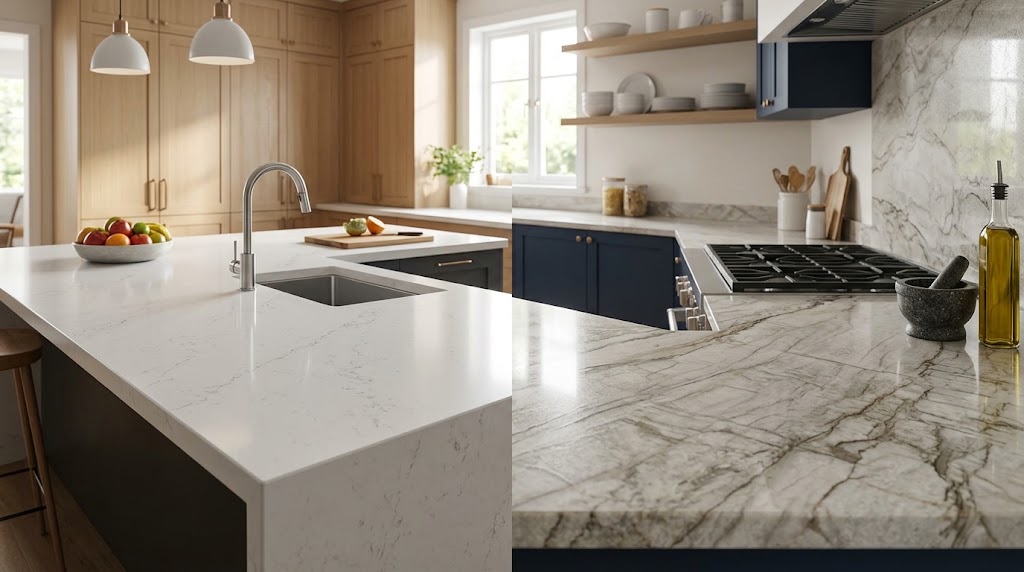
They sound almost identical, but they’re different materials that live differently. Quartz is an engineered surface. Fortress describes it as non-porous, without the periodic sealing natural stone needs, and it looks consistent from slab to slab. Quartzite is a natural stone, hard and resistant to kitchen acids. Whether it needs sealing depends on the specific slab, and no two slabs look alike. Neither one is the “better” counter. The right choice for a kitchen in Davis County comes down to how your household cooks and cleans, and how much variation you want to see.
I’ve been remodeling kitchens in Davis and Weber Counties since 1998. Below I walk through what each material actually is, how it behaves day to day, the mislabeling problem that catches people off guard, and the questions I’d ask a fabricator before templating.
Non-porous and consistent, with care rules set by the manufacturer.
Hard and acid-resistant, with color and porosity that vary slab to slab.
Stone guidance and quartz care guides both recommend protecting from hot pans.
Some slabs sold as “quartzite” turn out to be marble.
What People Commonly Get Wrong About Quartz and Quartzite
Most of the confusion starts with the names. Then it spreads to care routines, sealing and what a slab will look like once it’s on your island. These are the misconceptions I hear most often in kitchen design conversations.
“They’re basically the same thing with different branding.”
They aren’t. Quartzite forms in the ground. Quartz is manufactured. That one difference drives almost everything else: how each is cleaned, whether it ever needs sealing, and why you can order quartz from a sample but should pick quartzite by seeing the actual slab.
“If the tag says quartzite, it’s quartzite.”
This is the expensive one. The Natural Stone Institute, the stone industry’s trade association, has published that marble is frequently sold as quartzite, sometimes under the made-up label “soft quartzite.” Its position is blunt: there’s no such thing. A stone sold as soft quartzite is marble, and marble etches from lemon juice and vinegar in a way true quartzite doesn’t. NSI also warns that the stone’s name, its appearance, its country of origin and its price can’t tell you what it really is. Testing can.
“Sealing makes stone stain-proof.”
NSI says sealers used in the stone industry are really repellents. They make stone more stain-resistant, not stain-proof. Many stones don’t need sealing at all. With quartzite, it depends on how porous that particular slab is.
“Stone can take a hot pan, so I don’t need a trivet.”
NSI recommends trivets or mats even though many stones can withstand heat. Quartz manufacturers’ care guides say to put hot cookware on a trivet or hot pad. Whichever counter you choose, plan a landing spot for hot pans.
“The little sample tells me what my counter will look like.”
For quartz, a sample is a fair preview. For quartzite, it’s a rough idea at best. NSI notes that quartzite comes in a wide range of colors because of the minerals in each stone, and that each quartzite should be assessed on its own. The slab in the yard is the only reliable preview.
What Quartz and Quartzite Actually Are
Quartzite: sand that became stone
The Natural Stone Institute’s Building Stone Magazine explains it this way: quartzite begins as quartz sand on a beach, river delta or dune. Buried under more sediment, the sand is cemented into sandstone. Bury that sandstone deeper, add heat and pressure, and the grains recrystallize into a solid mass. That’s quartzite. Geologists call the process metamorphism.
Because the process varies, quartzite varies. Some quartzites were only lightly changed and still behave a bit like sandstone. Others were reworked so thoroughly that they’re dense and minimally porous. NSI uses White Macaubas as an example of the first kind and Taj Mahal as an example of the second. That range is why I treat every quartzite slab as its own decision.
Quartz: an engineered surface
Quartz countertops are manufactured, not quarried. As the Fortress cabinets and countertops page puts it, quartz is an engineered stone that’s non-porous and doesn’t require the periodic sealing that natural stone like granite does. Its care rules come from the manufacturer, and they differ a little from brand to brand. That’s why I always point homeowners to the care guide for the specific product they’re buying.
What this means for you: with quartz, you’re choosing a product, so you can compare samples and expect what you saw. With quartzite, you’re choosing a piece of the earth, so you choose the slab itself.
Stains, Heat and Etching: What to Verify for Each
Here’s a side-by-side look at how each material lives in a working kitchen. Everything on the stone side comes from the Natural Stone Institute. The quartz side reflects what quartz manufacturers’ care guides say, so confirm the details with the guide for the exact product you choose.
Quartz: an engineered, non-porous surface.
Quartzite: a natural metamorphic stone made of quartz.
Quartz: follow the manufacturer’s guidance on acidic and high- or low-pH products.
Quartzite: true quartzite won’t etch from typical kitchen acids. Marble sold as quartzite will.
Quartz: doesn’t need periodic sealing.
Quartzite: depends on how porous the slab is, from not required to sealing at install with reapplication.
Quartz: manufacturers say to use a trivet or hot pad.
Quartzite: NSI recommends trivets or mats even though many stones withstand heat.
Quartz: wipe spills right away and keep the surface dry.
Quartzite: blot immediately, don’t wipe and spread, then rinse with mild soap and water.
Quartz: use a cutting board to avoid scratches.
Quartzite: use a cutting board, because the stone is hard enough to dull your knives.
Quartz: consistent from slab to slab.
Quartzite: color and pattern vary, so you choose the slab in person.
Etching versus staining
These aren’t the same problem. Etching is a dull spot where acid has reacted with the surface. Staining is something soaking in. True quartzite resists etching because it’s made of quartz, but a porous quartzite can still absorb a spill if it isn’t protected. NSI’s quartzite guidance offers a simple homeowner check: if the stone darkens around the sink when it gets wet, it may need sealing, or the current sealer may be wearing off.
Daily cleaning
For natural stone, NSI recommends a neutral cleaner, stone soap or mild dish soap and warm water, then rinsing and drying with a soft cloth. NSI groups quartz-based stones like quartzite as generally resistant to kitchen acids. It still doesn’t recommend acidic cleaners, because a stone can contain trace minerals that are acid-sensitive. Use coasters under glasses, especially anything with citrus or alcohol.
One warning worth taping inside a cabinet door: NSI says many rust removers and some toilet bowl cleaners contain trace hydrofluoric acid, which attacks all stone, granite and quartzite included. Keep them off your counters.
For quartz, the manufacturer’s guide is the rulebook. Quartz care guides generally say to wipe spills right away, use caution with strong chemicals and test any new cleaner on an inconspicuous spot first.
Where this information comes from: the Natural Stone Institute’s consumer care guidance, its Use Natural Stone quartzite care article, and its Building Stone Magazine article on quartzite identification by geologist Karin Kirk. Quartz guidance reflects manufacturer care guides; always follow the guide for your specific product.
Why You Pick Quartzite in Person, Slab by Slab
Quartzite is a natural stone. Two slabs sold under the same name can differ in color, veining and porosity. That’s part of the appeal, and it’s also why I’d never choose quartzite from a photo.
Confirm it’s actually quartzite
Because of the labeling problem, ask your supplier or fabricator to show you NSI’s simple tests on a sample of the actual stone:
- The glass test. True quartzite scratches glass. Marble glides across it or leaves a mark that rubs off.
- The knife test. A knife tip barely marks quartzite but scratches marble easily.
- The lemon test. Lemon juice or vinegar left on an unsealed spot for at least 15 minutes leaves no etch on quartzite. A dull spot means you’re likely looking at marble.
NSI’s Use Natural Stone guide to caring for quartzite summarizes it simply: true quartzite doesn’t etch, can’t easily be scratched with a knife and will scratch glass. A good supplier won’t hesitate to show you. Don’t try stronger acids at home. Leave that to the stone professionals.
Plan the veining on your actual layout
Once you’ve found a slab you love, the next question is where its best parts land. On an island, you may want the strongest veining centered where people actually look. On a perimeter run, you may care more about how the pattern continues around a corner. That’s a layout decision, and it’s made with the real slab and your real cabinet plan, not a sample.
Bring your cabinet layout to the slab yard if you can, even a rough sketch with the island and sink marked. It’s much easier to picture where a dramatic vein should land when you can point to the spot on paper. If two slabs are needed for one kitchen, ask to see them side by side, because color can shift from one slab to the next even within the same stone.
Expect fabrication to take care
NSI notes that quartzite’s hardness can make it take longer to work and add wear on fabrication tooling. That’s not a reason to avoid it. It’s a reason to work with a fabricator who handles quartzite regularly and to ask about their experience with it.
A Week in Your Kitchen: How Each Surface Handles It
Material descriptions only go so far. Here’s how the published care guidance plays out on the days most Davis County kitchens actually have. None of this is a test result from my shop. It’s what the Natural Stone Institute and quartz manufacturers’ care guides say, applied to ordinary routines.
Saturday breakfast: orange juice and coffee
Someone sets down a glass of juice and walks away. On true quartzite, NSI says typical kitchen acids won’t etch the surface, but it still recommends coasters under glasses, especially citrus. On quartz, the manufacturer’s guide is your rulebook, and quartz care guides say to wipe spills right away and keep the surface dry. Either way, the habit is the same: a coaster, and a quick wipe.
Weeknight dinner: a hot skillet and no free burner
This is the moment people set a pan straight onto the counter. Don’t. NSI recommends trivets or mats for natural stone even though many stones can handle heat, and quartz care guides say hot cookware goes on a trivet or hot pad. Here’s the design lesson: plan a landing spot beside the range during the layout, so the trivet has somewhere to live and the pan has somewhere to go.
Cleanup night: what’s under the sink
Look at the bottles under your sink before the new counters go in. For natural stone, NSI recommends a neutral cleaner, stone soap or mild dish soap with warm water. It warns that some rust removers and toilet bowl cleaners contain hydrofluoric acid, which attacks quartzite and granite alike. For quartz, test any new cleaner on an inconspicuous spot first, as manufacturers advise. Ten minutes sorting that cabinet saves a lot of second-guessing later.
A few months in: the sink edge
With quartzite, watch the stone around the sink when it gets wet. If it darkens, NSI’s guidance is that the slab may need sealing, or the existing sealer may be wearing. If a sealer is used where food is prepared, NSI says it should be non-toxic and safe for that use. Your fabricator can tell you which product suits your specific slab. With quartz, there’s no sealing schedule to keep track of.
What this means for you: neither surface asks for much, but they ask for different things. Quartzite asks you to know your slab. Quartz asks you to know your product’s care guide. Pick the one whose habits fit your household.
Seams, Edges and Backsplash Coordination
Seams, edge profiles and backsplash details are where a countertop looks intentional or doesn’t. They’re also where every kitchen is different, so I won’t give you rules or dimensions here. Seam placement depends on your layout, the slab size and the material. What I’d recommend is settling these questions with your fabricator before templating:
- Where will the seams fall, and will any land in a spot you see every day, like the middle of the island?
- On quartzite, how will the veining be matched across a seam?
- Which edge profile fits how your family uses the counter, especially where kids or stools are?
- Will the backsplash be the same material, a different stone or tile, and how will the joint between them be handled?
- How will the sink and faucet openings be cut, and do they match the fixtures you’ve actually ordered?
One local note: if the new counters come with a new sink location, that’s no longer just a countertop project. In Davis County cities like Kaysville, the building department requires a permit for any plumbing work. Plan for that early.
Matching the Surface to How Your Household Cooks
This is the function-first part of the decision, and it’s more useful than any ranking. Neither material is the winner. Each one fits certain kitchens better. Here’s how I’d think about it.
If you want a consistent look
Quartz gives you a predictable surface that matches the sample you picked, which helps if you want the island and perimeter to read as one material.
If you want natural stone character
Quartzite gives you real veining and color variation. You’ll choose the slab yourself, and no one else will have the same counter.
If you’d rather not think about sealing
Quartz doesn’t need periodic sealing. With quartzite, ask whether your specific slab needs it, and watch the sink area over time.
If citrus and wine are daily
True quartzite resists etching from kitchen acids. Quartz should be cleaned per its manufacturer’s guidance. With either, wipe spills right away.
If you cook hot and fast
Plan a trivet spot next to the range either way. Both the stone guidance and quartz care guides recommend protecting the surface from hot cookware.
If you chop on the counter
Don’t, on either one. Quartz can scratch, and quartzite can dull your knives. Keep a cutting board within reach.
Here’s why I tie every trait back to daily use: a counter you have to baby is the wrong counter, no matter how good it looks in the showroom. Think about the busiest night of your week, whether that’s a Sunday dinner or a weeknight homework-and-tacos scramble, and picture each surface handling it. Your answer usually shows up there.
Counters are only one part of a kitchen that works. The Fortress kitchen remodel page covers how space planning, cabinetry and surfaces come together. The cabinets and countertops page goes deeper on storage and layout.
Questions to Ask Your Fabricator Before Templating
Templating is when the fabricator measures your cabinets to cut the stone. After that, changes get harder. Before that appointment, I’d want clear answers to these:
- For quartzite: has this slab been tested, and can you show me the glass and lemon tests on a sample?
- For quartzite: does this specific slab need sealing, with what food-safe sealer, and how will I know when to reseal?
- For quartz: which care guide applies to this exact product, and what cleaners does it say to avoid?
- Where will the seams fall, and how will the pattern be matched?
- Which part of the slab goes on the island, and can I see the layout before cutting?
- Which edge profile do you recommend for how we use this kitchen?
- Are the sink, faucet and cooktop cutouts based on the models we’ve actually ordered?
- How is the backsplash joint handled?
- How much experience do you have fabricating this material?
When we handle countertops as part of a kitchen remodel, these answers get settled during design, before anyone measures for stone. That’s the point of design-first remodeling: clear scope and no surprises when the slab shows up.
Frequently Asked Questions
Is quartz the same as quartzite?
No. Quartzite is a natural stone that forms when sandstone is recrystallized by heat and pressure. Quartz is an engineered countertop surface.
Does quartzite need to be sealed?
It depends on the slab. NSI says porosity varies across quartzites, so sealing ranges from not required to needed at installation and over time. Sealing improves stain resistance but doesn’t make stone stain-proof.
Can I set a hot pan on quartz or quartzite?
Use a trivet with both. NSI recommends trivets for natural stone, and quartz manufacturers’ care guides say to put hot cookware on a trivet or hot pad.
Will lemon juice or vinegar damage quartzite?
True quartzite won’t etch from typical kitchen acids. If a “quartzite” counter etches, it may actually be marble.
How do I know the slab I picked is real quartzite?
Ask for NSI’s simple tests on a sample: true quartzite scratches glass, resists a knife tip and doesn’t etch from lemon juice.
Why does my fabricator want me to see the slab?
Because quartzite varies in color, veining and porosity. Seeing the slab lets you choose it and plan where its best parts land.
Stuck between two countertop materials?
A design consult is the right first step for kitchens in Davis and Weber Counties. Bring your layout, your inspiration photos and how your family really uses the kitchen, and I’ll help you match the surface to the way you live.