

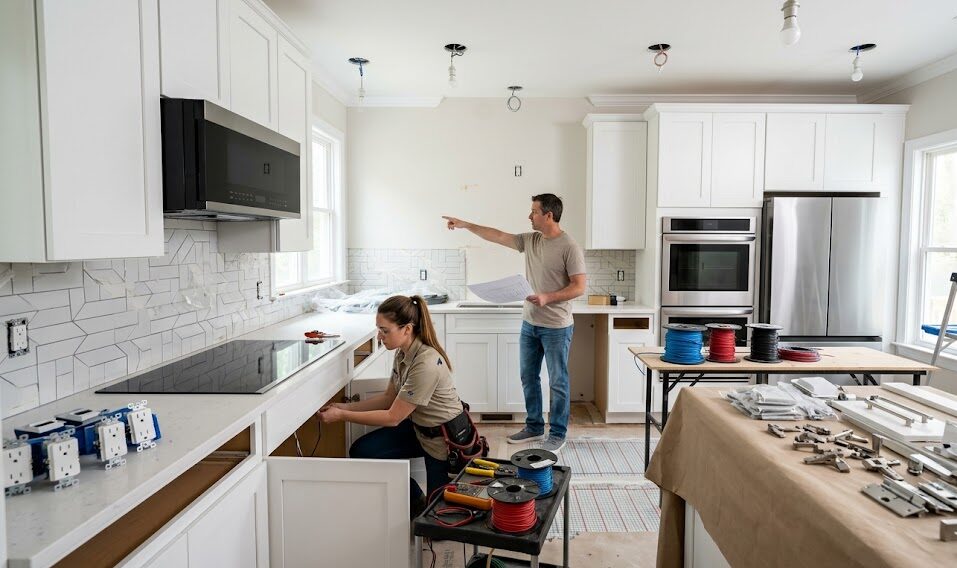

Gas Line vs. Electric for a Kitchen Remodel: What to Plan Early
A well-planned kitchen remodel saves time, money, and daily frustration—and one of the most important early decisions is whether the cooking setup should be gas or electric.
This is not only about appliance preference. It affects utility planning, ventilation, electrical capacity, cabinet coordination, range and hood selection, ordering timelines, and how the kitchen works for your household once the remodel is done. Homeowners often focus first on finishes, but the gas-versus-electric decision usually belongs much earlier in the process.
This guide explains gas line vs electric kitchen remodel planning in plain English. You will learn how to think about cooking style, hosting habits, utility needs, ventilation basics, clearances, appliance placement, and why these decisions should be coordinated before cabinets get ordered or demolition starts.
The Fortress Builders approaches remodeling through one core principle: strength through structure. Every kitchen project starts with a design blueprint that aligns client goals, appliance choices, utilities, and build sequence before materials are ordered. That early structure is what helps a kitchen feel intentional instead of reactive halfway through the job.
- How gas line vs electric kitchen remodel choices affect layout and utility planning
- How to choose appliances based on how your household cooks and hosts
- What to confirm about clearances, door swings, and ergonomic placement
- What to plan early for power, gas, water, drainage, and appliance coordination
- Why hood type, ducting, and noise should be discussed before cabinets are ordered
What gas vs. electric really affects in a kitchen remodel
At first glance, this can sound like a simple appliance preference. But when a kitchen is being remodeled, the choice between gas and electric usually reaches much farther than the range itself. It shapes what utilities need to be available, what kind of ventilation plan makes sense, what type of cooktop or range can be installed, and how other appliances and cabinets relate to the cooking zone.
It can also influence cost, timeline, and sequencing. If a homeowner assumes the final choice can be made late, it is easy for the remodel to back into rework, added trade coordination, or delayed ordering decisions.
Appliance Selection
Gas and electric open different paths for cooktops, ranges, and dual-fuel options, so the appliance shortlist changes early.
Utility Scope
The kitchen may need gas routing, upgraded electrical service, dedicated circuits, or other infrastructure planning.
Ventilation Needs
Cooking output, hood choice, ducting, and noise expectations should all be considered with the cooking fuel decision.
Cabinet Coordination
Range width, wall-oven layouts, nearby storage, and hood details all connect back to the cooking appliance choice.
Construction Timing
Utility work is easier when planned before framing, drywall, finish carpentry, and cabinet installation are too far along.
Daily Kitchen Experience
The final choice affects how the household cooks, cleans, entertains, and feels about the kitchen long after construction is over.
Choose appliances based on how you cook and host
The cleanest way to think through gas line vs electric kitchen remodel planning is to begin with behavior. How the household cooks matters more than trend or kitchen folklore. Some homeowners cook daily and care deeply about heat response and burner style. Others value easier cleaning, smoother surfaces, or the ability to integrate induction into a quieter modern kitchen. Some households host often and need a cooking setup that supports bigger meals and tighter timing. Others mostly want reliable, low-fuss function.
Daily cooking style
Homeowners who sauté, stir-fry, cook with high heat, or are emotionally attached to visible flame may lean toward gas. Homeowners who value a flatter surface, easier wipe-downs, or electric or induction performance may lean another way.
Hosting and meal volume
If the household regularly cooks for larger groups, the choice may hinge on burner layout, oven style, cooktop capacity, and how the kitchen is used under pressure. The right setup is not only about the energy source; it is about how the full appliance package supports real meals.
Cleaning expectations and daily upkeep
Many homeowners underestimate how much maintenance preference affects satisfaction. The right answer on paper can still feel wrong if it clashes with the way the household actually wants to clean and live.
Picture your busiest weeknight meal and your busiest hosting day. Which matters more in those moments: a visible flame, a smoother surface, easier cleanup, or a specific appliance feel you already know you prefer?
| Household Priority | What It Often Points Toward |
|---|---|
| Visible Flame Preference | Often points homeowners toward gas or a gas-based cooking setup |
| Low-Fuss Cleaning | Often points homeowners toward electric or induction-friendly surfaces |
| Frequent Entertaining | May push the decision toward whichever range layout and oven support the cooking routine best |
| Modern Kitchen Simplicity | May favor electric or induction, especially when paired with a cleaner design direction |
Homeowners working through this decision often also benefit from comparing it against a dedicated appliance-focused resource. The Fortress Builders article on Induction vs. Gas Cooking: Which Is Better for Your Remodel? helps sharpen the practical tradeoffs before utility work is finalized.
Confirm clearances, door swings, and ergonomic placement early
Once the household has a better sense of cooking preference, the next step is layout logic. The range or cooktop does not sit alone. It interacts with refrigerator doors, tall cabinet panels, island overhangs, landing space, hood width, oven access, pantry placement, and the overall work pattern of the room. This is why gas-versus-electric should be discussed while the layout is still flexible, not after cabinet ordering is already in motion.
Landing space matters
A cooking zone works best when hot cookware, prep items, and finished dishes have a safe and convenient place to land. The right cooking fuel choice still needs the right surrounding counter logic.
Nearby doors and drawers still count
Refrigerator doors, dishwasher doors, pantry pullouts, oven doors, and traffic around an island all affect how comfortable the cooking zone feels. What looks fine in plan view can still feel awkward in real life if swing paths are not thought through carefully.
Ergonomics should support the primary cook
Height, reach, turning movement, prep-to-cook flow, and how often one or more people work in the kitchen together all matter. A beautifully designed kitchen can still feel frustrating if the cooking zone is too cramped or too disconnected from prep space.
- Is there enough landing space on both sides of the cooking zone?
- Will nearby doors, drawers, and appliance panels conflict with normal cooking movement?
- Does the refrigerator or island crowd the range area during busy meal prep?
- Will the range hood, cabinetry, and backsplash all align cleanly with the chosen appliance width?
- Does the primary cook move through the space naturally during actual meal prep?
Related planning pages from your interlinking set that support this step include Work Triangle vs. Work Zones, Kitchen Island Size Guide, and Built-In Appliances Planning.
Plan utilities early: power, gas, water, and drainage
This is where the decision becomes construction reality. If the cooking setup will be gas-based, the kitchen may need gas-line routing, shutoff planning, and coordination with cabinetry and appliance placement. If the setup will be electric, the project may need dedicated power planning, circuit upgrades, or broader review of the home’s electrical capacity depending on the appliance type and the age of the house.
Gas line planning
A gas-fed cooking appliance needs more than the idea of gas availability. The route, connection point, shutoff access, and appliance placement all need to be coordinated while walls, floors, and cabinets are still being planned.
Electrical planning
Electric or induction ranges and cooktops often require more attention to dedicated circuits and service capacity. This does not automatically make electric more difficult, but it does mean the kitchen remodel should account for real electrical scope rather than assuming the existing setup will always be sufficient.
Water and drainage planning can still connect to the appliance wall
Even when discussing gas versus electric, the broader kitchen utility plan still matters. Ice makers, pot fillers, sinks, dishwashers, and nearby utility coordination can all affect how the full appliance and cabinet wall is planned. This is one reason appliance choices should not be made independently from the rest of the kitchen blueprint.
If the final appliance choice would force utility changes after cabinets are ordered or walls are closed, the decision was made too late.
| Utility Category | Why It Should Be Planned Early |
|---|---|
| Gas Routing | Location, shutoff access, and coordination with appliance placement affect the whole cooking zone |
| Electrical Capacity | Dedicated circuits, appliance load, and service review may affect whether the selected appliance can be supported cleanly |
| Water Planning | Related appliances like refrigerators, sinks, and pot fillers can shape the appliance wall and utility sequencing |
| Drainage Coordination | Nearby plumbing work can influence how efficiently the kitchen is roughed in during the remodel |
For homeowners who want the utility and appliance discussion framed more broadly, the most relevant interlinks from your approved set are Kitchen Appliances & Ventilation Upgrades, Kitchen Lighting & Electrical Designed for Real Life, and Kitchen Remodel Planning Checklist.
Ventilation basics: hood type, ducting, and noise matter more than homeowners expect
One of the biggest mistakes in kitchen remodeling is treating ventilation as a secondary detail. The cooking setup and the hood strategy should be discussed together, because performance, comfort, and day-to-day satisfaction often depend on both. This matters no matter which appliance path is chosen, but it becomes especially important when the cooking setup produces stronger output and the kitchen is part of a larger open living area.
Hood type should match the cooking setup and the kitchen
A hood that is too weak, too loud, or poorly integrated into the kitchen layout can make the finished room feel less comfortable even if the range itself is exactly what the homeowner wanted.
Ducting is not only a technical detail
Duct route, exterior termination, and how the system fits into framing or ceiling conditions all influence what kind of hood solution is realistic. This is why ventilation should be part of early layout conversations, not just appliance selection.
Noise changes whether people use the system consistently
Homeowners often focus on airflow only, but if a hood is excessively loud or feels disruptive in an open-concept home, it may not get used as often or as effectively as intended.
- What hood style fits the cooking setup and the design of the kitchen?
- Can the ducting route be handled cleanly within the actual house conditions?
- How much airflow is appropriate for the appliance and cooking habits?
- Will the noise level still feel acceptable in an open kitchen?
- Could the final system trigger related planning needs, such as make-up air, depending on the scope?
The most relevant interlinks from the set you shared for this section are Range Hood CFM Sizing Guide, Make-Up Air in a Kitchen Remodel, and Kitchen Appliances & Ventilation Upgrades.
Gas, electric, and induction are really part of one broader decision tree
Many homeowners begin with a gas-versus-electric question, then discover the real conversation is broader. Electric may mean a traditional electric range in one case, or an induction setup in another. Gas may still coexist with an electric oven in a dual-fuel configuration. The point is not to make the decision more complicated than it needs to be. The point is to recognize that the cooking system should be chosen as a whole, not just by fuel label.
Performance expectations matter
If the homeowner expects a particular responsiveness, cleaning experience, or cooking feel, it helps to identify that explicitly rather than using “gas” or “electric” as shorthand for qualities that may actually depend on specific appliance categories.
The kitchen style may influence the best fit
Some kitchens visually support a professional-style gas range more naturally. Others feel more at home with a sleeker electric or induction surface integrated into a quieter modern composition.
Budget and infrastructure should still be honest constraints
The best-performing theoretical option may not be the smartest remodel choice if it adds unnecessary infrastructure complications for the household’s actual needs.
Ordering timelines and coordination with cabinets
Kitchen remodel problems often begin when appliance decisions lag behind cabinetry and finish selections. If the cooking setup changes late, cabinet widths, hood details, filler conditions, power locations, gas routing, and even countertop cut decisions can all become more complicated than they needed to be.
Choose the appliance direction before cabinet release
Exact appliance dimensions, installation specs, and utility needs should be known early enough that the cabinet layout is based on real information, not assumptions.
Do not let demo outrun decisions
It is tempting to begin demolition while “still deciding” on the appliance package, but that often shifts important decisions into a higher-pressure part of the project.
Coordinate the full cooking wall as one composition
Range width, hood width, upper cabinet balance, backsplash width, nearby storage, and counter landing space all work best when treated as one complete design moment instead of a stack of unrelated decisions.
If the final appliance choice would force cabinet edits, hood redesign, utility relocation, or countertop revision late in the process, the kitchen plan did not lock the cooking zone early enough.
Appliance Specs First
Final appliance width and type should be known before cabinet ordering reaches a point of no easy return.
Utility Rough-In Timing
Gas and electrical work should be aligned with the exact appliance plan, not a placeholder assumption.
Hood and Cabinet Alignment
The wall looks best when the range, hood, uppers, and backsplash are composed together.
Reduced Rework
Early coordination protects the schedule, reduces trade overlap, and helps the project feel more controlled.
Helpful approved interlinks here are Built-In Appliances Planning, Kitchen Lighting & Electrical Designed for Real Life, and Kitchen Remodel Planning Checklist.
Common planning mistakes homeowners can avoid
Choosing fuel type without defining cooking priorities
Trends and assumptions create weaker outcomes than decisions based on real cooking and hosting habits.
Leaving utility decisions too late
Gas routing, electrical capacity, and related infrastructure are easier to plan early than to force into the project later.
Treating ventilation like a separate issue
Hood type, ducting, and noise should be discussed at the same time as the cooking appliance decision.
Ignoring clearances and daily movement
A kitchen can look beautiful in elevation and still feel frustrating if the cooking zone crowds the room in real life.
Ordering cabinets before appliance details are final
That is one of the fastest ways to create avoidable coordination problems and last-minute compromises.
How Fortress Builders would approach this choice in a real kitchen remodel
A strong design-build process would not frame this as a last-minute appliance purchase. It would place the gas-versus-electric decision inside the full kitchen plan: layout, utility access, ventilation strategy, cabinet design, landing space, and the way the household actually cooks and hosts.
That usually means clarifying the household’s priorities first, then checking whether the chosen appliance direction fits the physical kitchen cleanly. From there, gas, electrical, hood, and cabinetry decisions can all be coordinated together instead of fighting each other later.
That is where early planning pays off most. Small decisions made at the right stage prevent larger disruptions later, and the finished kitchen feels more coherent because the choices were made as one system instead of in fragments.