

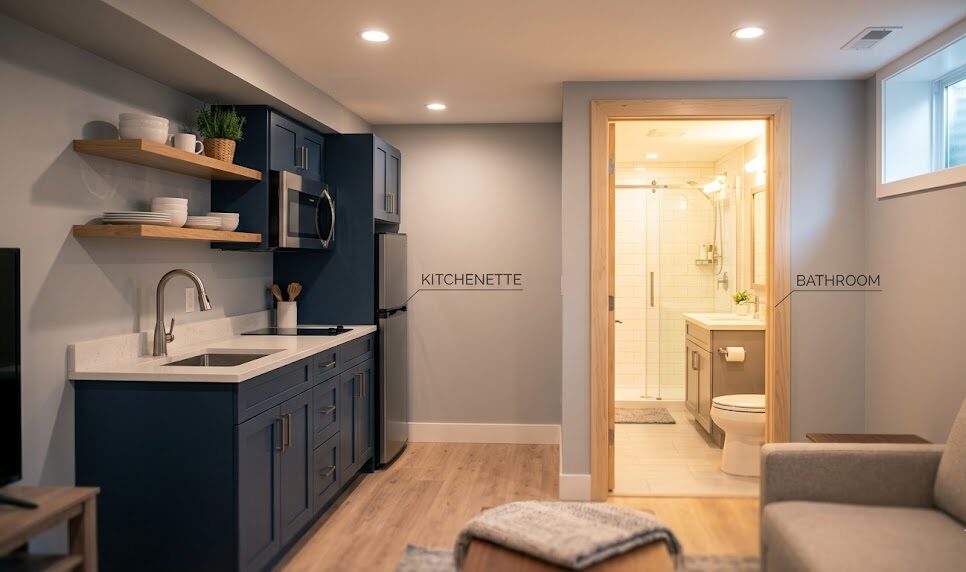
Basement Bathrooms & Kitchenettes That Add Function
A basement becomes dramatically more useful when it can support longer stays, everyday convenience, and true independence. That is why basement bathrooms and kitchenettes are often some of the highest-impact upgrades in a basement finishing project. A well-placed bath keeps guests and family from constantly running upstairs. A thoughtfully planned kitchenette or wet bar makes the lower level feel more complete, more flexible, and more worth using.
But these additions only work well when they are planned carefully. Basement bath planning and basement kitchenette planning are not just about fitting fixtures into leftover square footage. They depend on plumbing layout, venting, appliance scope, storage, circulation, and how the basement is meant to function now and years from now.
In this guide, you’ll learn:
- when a basement bathroom or kitchenette makes sense and when it may not,
- how basement plumbing layout influences room placement and efficiency,
- how to think through venting, fixtures, appliance scope, and storage,
- what helps these spaces feel integrated instead of tacked on,
- and how to use basement utility upgrades to create a more functional lower level overall.
The Fortress Builders approaches basement remodeling through a design-build process rooted in one principle: strength through structure. That means bathrooms and kitchenettes are planned as part of the whole basement system—alongside comfort, zoning, lighting, storage, and long-term livability—rather than dropped in late as isolated wish-list items.
Helpful Fortress Builders pages while you plan:
Why basement bathrooms and kitchenettes add so much function
Homeowners often think of these additions as “extras,” but in many finished basements they are what make the space genuinely practical. A basement lounge without a nearby bathroom may still be nice, but it is less convenient for movie nights, long visits, or guest stays. A basement guest suite without beverage access, sink access, or a kitchenette may still work, but it feels less independent and less comfortable.
These upgrades often add value because they support longer, easier use of the space.
- Bathrooms support daily use: especially for family hangout zones, bedrooms, theaters, gyms, or guest areas.
- Kitchenettes support independence: drinks, snacks, basic prep, and light meal support make the basement much easier to use.
- Both support flexibility: they help the basement adapt to guests, in-law living, entertaining, teen zones, or future household changes.
Homeowner takeaway: Basement bathrooms and kitchenettes are rarely just decorative upgrades. They are function upgrades. They make the basement easier to live in for longer stretches and for more types of use.
Start with the role the basement is supposed to play
Not every basement needs both a bathroom and a kitchenette. The smarter question is what role the basement is supposed to serve in the home. Once that is clear, the right level of plumbing and utility upgrades usually becomes easier to see.
Entertainment-focused basement
A bathroom is often a strong move here. A wet bar, beverage station, or compact kitchenette may also make sense if people will spend long stretches downstairs.
Guest or in-law basement
This is where both a bathroom and some level of kitchenette support often become especially valuable. Independence and privacy matter more in these scenarios.
Family overflow basement
If the basement is meant for kids, teens, lounging, gaming, or flexible family use, a bathroom can still add huge convenience even if a full kitchenette is unnecessary.
Future-adaptable basement
Some homeowners are not sure exactly how the basement will evolve. In that case, planning for the right utility opportunities early can preserve options later.
The 5-minute basement function profile
- Will people spend long stretches of time downstairs?
- Will the basement host overnight guests or relatives?
- Is the space mainly for entertaining, relaxing, or semi-independent living?
- Would frequent trips upstairs weaken the experience of using the basement?
- Does the household want the basement to become more self-sufficient over time?
Why this matters: These answers usually clarify whether you need a basic bath, a more complete bath, a wet bar, or a fuller kitchenette strategy.
Basement plumbing layout usually determines what is realistically easiest
Homeowners often begin with a dream layout, then discover the plumbing logic pushes the bathroom or kitchenette somewhere else. That is why basement plumbing layout should be part of the earliest planning conversation. It does not determine everything, but it shapes the smartest and most efficient options.
Existing rough-ins matter
If the basement already has bathroom rough-in conditions in place, that often creates a natural starting point for bath planning.
Utility proximity affects efficiency
A kitchenette or bath located in a sensible relationship to plumbing and mechanical conditions often reduces unnecessary complexity and helps the rest of the basement layout stay cleaner.
The best layout is not always the most obvious sketch
Sometimes a bathroom or kitchenette works best slightly differently than homeowners first expect because the utility logic is stronger there. Related resource: Basement Bathroom Rough-In Guide.
Best practice: Start with function, but let utility logic inform the layout before walls and room labels get too fixed. It is easier to adapt a good plan early than to force a weak one later.
Basement bath planning: what kind of bathroom does the basement actually need?
One of the most common mistakes in basement bath planning is assuming every basement needs the same type of bathroom. In reality, a small entertainment-zone powder bath, a family-use three-quarter bath, and a guest- or in-law-oriented full bath serve very different purposes.
Powder bath
This is often a strong choice for entertainment-focused basements where convenience matters but showering does not. It keeps the basement functional without overcommitting square footage.
Three-quarter bath
A bath with a shower often makes more sense when the basement includes a bedroom, gym, longer-stay guests, or more serious daily use.
Full bath
This may be the right move when the basement is approaching suite-level functionality or needs to support the home in a more flexible long-term way.
| Basement Bathroom Type | Often Makes Sense When… |
|---|---|
| Powder bath | The basement is mainly for gathering, lounging, or entertaining and needs convenience first. |
| Three-quarter bath | The basement may include guests, workouts, bedrooms, or longer visits. |
| Full bath | The basement is being planned for broader living flexibility or suite-like use. |
Kitchenette planning: decide how far the lower level really needs to go
“Kitchenette” can mean very different things. In some basements it means a beverage zone with cabinetry, a sink, and a built-in refrigerator. In others it means a more complete lower-level prep area that supports real food use. The right scope depends on what the basement is meant to support.
Simple beverage station
This is often enough for entertainment-focused basements. It can support hosting without trying to duplicate the full kitchen upstairs.
Wet bar
A wet bar adds more function and can make basement entertaining feel much more complete. Related resource: Wet Bar Design 101.
True kitchenette
This makes the most sense when the basement is meant for longer stays, in-law use, semi-independent living, or more serious flexibility. Related resource: Basement Kitchenette Planning.
Simple rule: A basement kitchenette should support the basement’s role, not compete with the main kitchen unnecessarily.
Efficient layouts keep bathrooms and kitchenettes from weakening the basement
Bathrooms and kitchenettes add function, but they also consume some of the basement’s most flexible square footage. That means placement and efficiency matter. The goal is to add these features without letting them fragment the basement or steal the best space from the zones that need it most.
Use support zones wisely
Bathrooms and kitchenettes often work best along logical support edges of the layout rather than in the middle of the best open gathering space.
Keep circulation clear
A bathroom door, kitchenette peninsula, or appliance wall should not make the basement feel tighter or harder to navigate than it needs to be.
Let utilities help organize the plan
Sometimes the smartest placement for these functions also helps define the edge between public and private zones, which can strengthen the whole basement layout.
Questions worth asking during layout planning
- Is the bathroom close enough to where it will be used most?
- Does the kitchenette support the entertainment or guest zone without overtaking it?
- Are these features located where plumbing and venting logic still makes sense?
- Do they preserve the basement’s best open space for the most valuable living uses?
- Will the layout still feel flexible if the basement’s purpose evolves later?
Storage and appliance scope can make or break a basement kitchenette
A kitchenette that looks attractive but lacks functional storage or realistic appliance support often becomes more decorative than useful. At the same time, too many appliances can make the basement feel overbuilt or cluttered if the household does not actually need them.
Decide what the kitchenette must do
Should it hold drinks and snacks? Support coffee and breakfast? Handle light entertaining? Support guest independence? Those answers shape the right scope.
Built-ins usually make the space feel more intentional
Integrated refrigeration, shelving, cabinetry, and simple prep surfaces often make a basement kitchenette feel like part of the architecture rather than furniture parked against a wall.
Storage matters as much as appliances
Glassware, snacks, paper goods, coffee supplies, and serving items all need a home if the kitchenette is supposed to stay tidy and useful.
| Kitchenette Goal | What Often Belongs in the Plan |
|---|---|
| Entertaining support | Beverage storage, sink, serving surface, practical cabinetry |
| Guest convenience | Mini-fridge or built-in refrigerator, microwave or light prep support, storage, sink where appropriate |
| In-law or longer-stay use | More complete appliance planning, better cabinetry, stronger daily-use support |
| Casual family use | Simple snack and beverage zone without overbuilding the space |
Ventilation, electrical, and utility details are part of function too
Bathrooms and kitchenettes are utility-heavy zones. Even when the design looks simple, they rely on careful planning behind the walls. That is why basement utility upgrades should be part of the design conversation early enough to support the room’s real use.
Bathrooms need more than fixtures
Bath planning often includes plumbing, venting, lighting, electrical support, and fan strategy that all need to work together.
Kitchenettes need realistic electrical support
Appliance scope, lighting, convenience outlets, and future use all affect how a kitchenette should be wired and supported.
Requirements vary by home and scope
Permits, venting, plumbing, electrical requirements, inspection needs, and appliance-related details can vary by project and jurisdiction. Final technical details should always be confirmed with qualified professionals and local authorities where applicable.
Important note: Plumbing, venting, electrical, rough-in, appliance, and inspection requirements can vary by home, layout, and local rules. Basement baths and kitchenettes should always be planned with qualified professionals and local authorities in mind.
Privacy matters when the basement is serving guests or longer stays
If the basement will be used by guests, adult children, or an in-law arrangement, the bathroom and kitchenette should support privacy rather than only convenience. This is where room placement and zoning matter as much as the actual fixtures or cabinetry.
Bathrooms should feel convenient without being intrusive
A guest bathroom should not require walking through the loudest part of the basement to use it. A better placement often makes the whole basement feel more respectful and more complete.
Kitchenettes should support independence without isolating the basement completely
A basement can become more self-sufficient while still feeling connected to the rest of the house. The design should reflect the role the space is meant to play in family life.
Privacy zones work best when planned as part of the whole lower level
Related resource: Basement In-Law Suite Planning.
Privacy planning prompts
- Will guests or family members use the basement for overnight stays?
- Should the bathroom serve public use, private use, or both?
- Does the kitchenette support short visits or longer semi-independent living?
- Can the basement feel more self-sufficient without losing good connection to the rest of the home?
Common basement bath and kitchenette mistakes homeowners regret
Mistake 1: Adding a bathroom in the wrong location just because it “fits”
A basement bath should support the way the lower level is used. A poor location can make the whole plan feel less comfortable.
Mistake 2: Overbuilding the kitchenette beyond what the basement needs
Too much appliance scope can eat space and budget without improving the basement meaningfully.
Mistake 3: Underbuilding the kitchenette so it becomes decorative only
If the basement truly needs more support, a half-committed kitchenette may not solve the real convenience problem.
Mistake 4: Waiting too long to resolve plumbing logic
The smartest layouts usually come from understanding rough-in, utility, and venting realities early.
Mistake 5: Letting these features steal the basement’s best living space
Bathrooms and kitchenettes should add function without taking the most valuable open area away from the spaces that need it most.
Practical truth: Basement bathrooms and kitchenettes feel best when they make the lower level easier to use without making the lower level harder to layout.
How Fortress Builders would approach basement bathrooms and kitchenettes
A strong basement design build process starts by asking what level of function the lower level actually needs. Not every basement requires the same bath or kitchenette scope. But once the role of the basement is clear, utilities, layout, privacy, and storage can be planned in a way that feels deliberate rather than reactive.
That usually means:
- placing utility-heavy functions where plumbing logic supports them,
- choosing the right scale of bath and kitchenette for the basement’s real use,
- keeping circulation clean and preserving the best open living areas,
- and planning for the basement to stay flexible over time.
When those decisions are coordinated early, the basement feels more complete, more livable, and more valuable without feeling overcrowded or overbuilt.
FAQ: Basement bathrooms and kitchenettes
Should every finished basement have a bathroom?
Not always, but many finished basements benefit significantly from one. If the lower level will be used often, for entertaining, guests, or bedrooms, a bathroom usually adds strong convenience and long-term value.
Do I need a full kitchenette or just a wet bar?
That depends on how the basement will be used. Entertainment zones may only need a bar or beverage station, while guest or in-law basements often benefit from a more complete kitchenette plan.
What is the most important part of basement bath planning?
Utility logic and layout placement are usually the starting point. A basement bath should support the way the lower level functions and make sense for plumbing and venting realities.
How do I keep a kitchenette from overwhelming the basement?
Match the appliance scope and cabinetry to the basement’s actual use. The best kitchenette usually supports the basement rather than trying to compete with the main kitchen upstairs.
When should I plan plumbing and utility upgrades?
As early as possible. Bathrooms and kitchenettes affect layout, venting, electrical planning, and overall basement efficiency, so the earlier those decisions are coordinated, the better.
Conclusion: the best basement utility upgrades are the ones that support real life
Basement bathrooms and kitchenettes add function when they are sized and placed for the way the lower level will actually be used. They are not just amenities. They are the features that can make a basement easier to host in, easier to stay in, and easier to adapt over time.
That is why the strongest basement utility upgrades are rarely the biggest or most elaborate. They are the ones that solve the right problem, fit the layout cleanly, and support the basement’s role in the home without compromising the rest of the space.
Thinking about adding a basement bathroom or kitchenette?
If you’re finishing a basement in Davis or Weber County, Fortress Builders can help you think through bath planning, kitchenette scope, plumbing layout, privacy, and the utility decisions that make the lower level truly more functional.
Request a Design Consult Explore Basement Finishing Read the Rough-In Guide
Bring your layout ideas, your must-haves, and the way you want the basement to support guests, family life, or future flexibility. Fortress Builders can help turn that into a plan that is efficient, comfortable, and built to last.