

The Most Durable Kitchen Surfaces for Utah Families: Floors, Backsplashes, and Counters That Age Well
Compare kitchen flooring, backsplashes, and hard surfaces for durability, maintenance, style, and daily wear in busy Utah homes.
There is no single most durable floor, backsplash, or countertop for every Utah family. The right choice for a kitchen in Davis or Weber County depends on the exact product, substrate, installation, daily traffic, moisture, tracked grit, pets, spills, heat, cleaning habits, transitions, and the amount of maintenance you are willing to keep doing.
A durability-first finish plan compares where the material will be used, how it will be cleaned, what documentation applies, and how it meets cabinets, appliances, adjoining floors, walls, and wet-prone areas. Appearance matters. Daily use decides whether you will still like the choice later.
Snow, grit, shoes, pet nails, chair legs, water, oils, acids, heat, impact, sunlight, and cleaning products affect different locations.
Read current care instructions for the exact product and finish. “Easy care” is not a complete maintenance plan.
Substrate, moisture, movement, flatness, transitions, support, edges, seams, grout, and radiant heat are project-specific.
Ask how a damaged piece, stained grout, scratched board, chipped edge, or failed component would be repaired or matched.
- Durable against what kind of wear in this exact location?
- What cleaning, sealing, protection, or other care does the exact product require?
- What substrate and installation conditions must be present?
- What will normal variation, wear, repair, and replacement look like over time?
What Does “Durable” Mean in Your Household?
Durability is not one property. A material can resist one kind of use and remain vulnerable to another.
Start by describing the kitchen at its busiest. Do wet boots or tracked grit move through the room? Do pets cross the same path? Are stools dragged at the island? Do children drop hard objects? Does the sink area stay wet? Are acidic foods, hot cookware, oils, cosmetics, craft supplies, or strong cleaners used on the counter? Does direct sunlight reach one part of the floor more than another?
Now describe your care tolerance. Some households are comfortable following product-specific cleaner instructions, periodic sealing where applicable, prompt spill cleanup, protective pads, and a more careful routine. Others want a surface that can handle ordinary cleaning without a specialized process. Neither preference is wrong, but the selection should acknowledge it before ordering.
I would also separate visible wear from functional failure. A floor may develop character without losing function. A glossy surface may show every footprint while remaining intact. A matte surface may hide smudges but reveal scuffs differently. Natural variation may be part of the material, while an exact-match expectation may be unrealistic after products age or lots change.
The kitchen flooring and surfaces plan should put those household conditions beside the product documents. That lets you compare what the material is declared and instructed to do rather than relying on a broad category reputation.
Which Flooring Tradeoffs Matter for Snow, Grit, Pets, Spills, and Heavy Traffic?
Porcelain tile, engineered wood, luxury vinyl plank or tile, natural stone, and other flooring options can all be appropriate in a kitchen. None should be described as universally waterproof, scratch-proof, stain-proof, slip-proof, maintenance-free, or the longest-lasting choice without exact product and project evidence.
Porcelain and other hard tile
Hard tile can offer a wide range of formats and finishes, and it can coordinate with wet-prone entries or adjoining areas. The result depends on the exact tile, product-use classification, substrate, flatness, movement accommodation, grout, transitions, installation, and household expectations. A tile surface is not automatically slip-proof because it has texture, a small format, or a particular visual style.
Ask what use classification the manufacturer declares for the product and condition. ANSI A326.3 includes Interior Dry, Interior Wet, and Interior Wet Plus classifications for hard-surface flooring. That classification is a product-use input, not a promise that a person cannot slip.
Engineered wood
Engineered wood may create continuity with nearby living areas and provide the warmth of a real wood surface. Construction, veneer, finish, board size, installation method, substrate, moisture limits, sunlight, pet wear, cleaning, repair, and refinishing possibilities vary. Do not assume every engineered product behaves the same or can tolerate the same kitchen conditions.
LVP and LVT
Resilient flooring can offer many visual options and may feel different underfoot from tile. Product thickness, wear layer, core, locking or adhesive system, substrate preparation, moisture requirements, temperature limits, transitions, rolling loads, indentation, cleaning, and warranty vary. “Waterproof” marketing should not be translated into a claim that the entire installed floor, seams, perimeter, substrate, or surrounding structure cannot be affected by water.
FloorScore is a third-party certification for specified VOC-emissions criteria under California Section 01350. It can verify that defined emissions scope for an exact certified resilient product or adhesive. It does not prove a product is nontoxic, allergen-free, medically safer, or otherwise superior in every environmental category.
Natural stone flooring
Stone varies by type, finish, absorption, surface texture, fabrication, installation, care, and exposure. Some stones may react to acids or abrasion. Ask for stone-specific guidance, samples large enough to show variation, and a plan for grout, sealing where applicable, transitions, and cleaning.
Compare: product-use classification, surface, format, grout, substrate, movement, transitions, and underfoot expectations.
Do not assume: every textured or small-format tile prevents slips or tolerates every substrate.
Compare: construction, finish, sunlight, moisture limits, pet wear, cleaning, repairs, and adjoining-floor continuity.
Do not assume: all engineered products share the same wear, water, or refinishing characteristics.
Compare: exact product, substrate, locking or adhesive system, indentation, seams, moisture, transitions, and warranty.
Do not assume: a “waterproof” label makes the full assembly immune to water or installation problems.
Compare: stone type, finish, acids, abrasion, variation, care, grout, sealing where applicable, and installation.
Do not assume: every stone has the same maintenance or reaction to household products.
Compare: repairability, replacement pieces, height, transitions, cabinets, appliances, radiant heat, and the actual household route.
Do not assume: a sample alone establishes performance in the completed kitchen.
How Should Countertop and Backsplash Maintenance Shape the Choice?
Countertops receive concentrated use. Backsplashes receive splashes, heat-adjacent conditions, cleaning, and visual attention at eye level. They should be selected together, but they do not need to be the same material.
For counters, compare the exact product’s response to heat, impact, scratching, staining, acids, UV exposure where relevant, seams, edges, cutouts, supports, overhangs, and cleaning products. Quartz, quartzite, granite, marble and other stones, porcelain or sintered slabs, solid surfaces, wood, and other products vary. Do not transfer a claim from one brand, finish, or material to an entire category.
Natural stone is a clear example of why care matters. The Natural Stone Institute warns that lemon, vinegar, and other acids may dull or etch calcareous stones and that abrasive cleaners may scratch some stone. That does not make natural stone a poor choice. It means the household should accept the exact material’s care and visual behavior.
Backsplash decisions include tile or slab material, format, layout, grout, edge treatment, corners, outlets, windows, hood, open ends, countertop movement, and cleaning near the range and sink. Small grout joints do not eliminate grout care. Dark grout does not hide every residue. A full-height slab may reduce some joints but adds fabrication, seam, outlet, handling, and replacement questions.
Ask what happens at the counter-to-backsplash joint, behind the range, at the hood, around the window, and where the material ends without a cabinet. Those transitions often determine whether the finished kitchen feels resolved.
What Do Grout, Edges, Seams, and Floor Transitions Reveal Over Time?
Durability becomes visible at edges and meeting points because those areas collect movement, impact, water, cleaning, and normal variation.
Grout should be selected with the tile, joint, exposure, cleaning routine, installation system, and manufacturer guidance. Color affects how residue, staining, and variation read, but it does not remove maintenance. Ask how the grout is cleaned, whether sealing applies, how repairs are handled, and what movement or changes in plane require from the installation system.
Countertop edges receive hands, hips, cookware, stools, and impact. The profile affects appearance, touch, projection, fabrication, and possible chipping behavior for the selected material. A thin-looking edge may be built in different ways depending on the product. Review the actual detail rather than an inspiration photo.
Seams depend on material, slab or sheet size, pattern, cutouts, access, fabrication, support, and installation. A seam can be necessary without being a defect. The key is to understand likely location, pattern relationship, visibility, and approval before fabrication.
Floor transitions must account for height, thickness, substrate, direction, expansion or movement, doorways, cabinet footprint, appliances, and the material in the next room. A transition that is ignored during selections can become a last-minute strip in the most visible path.
Where new work meets old work, exact matching may not be possible. Existing wood, stone, grout, tile, and finishes change over time. Decide whether the goal is a documented match attempt, a coordinated contrast, or a deliberate transition.
Grout and joints
Review exposure, color, joint size, cleaning, sealing where applicable, movement, repair, and the full installation system.
Counter edges
Review touch, projection, impact areas, support, fabrication, thickness appearance, and compatibility with the selected material.
Counter seams
Review location, pattern, cutouts, access, slab size, support, fabrication, and who approves the layout before work begins.
Floor transitions
Review height, substrate, direction, movement, adjacent materials, doors, cabinetry, appliances, and visibility from other rooms.
Which Product Documents and Certifications Are Worth Checking?
Marketing language is broad. Product documents are specific.
For every selected surface, collect the current technical data, installation instructions, care and maintenance guide, warranty, use limitations, approved cleaners, substrate requirements, temperature or moisture limits where relevant, and certification documentation that matters to your priorities.
A certification should be used only for what it actually covers. A hard-surface use classification helps communicate intended conditions related to slip-resistance properties and manufacturer declarations. It does not guarantee no one will slip. FloorScore addresses defined VOC-emissions criteria for certified resilient products and adhesives. It does not establish overall health, durability, or environmental superiority.
Manufacturer warranties may depend on substrate, installation, acclimation, environmental conditions, cleaning, transitions, movement, and authorized products or installers. Do not treat the warranty as a substitute for design and installation review.
Radiant-floor compatibility also needs exact verification. The heat system, flooring, adhesive or underlayment, substrate, controls, temperatures, and manufacturer instructions must agree. This article cannot say that every tile, engineered wood, LVP, stone, or other material will work over every radiant system.
The current 2026 U.S. Houzz & Home Study found a more selective national planning environment, and 37% of respondents who set an initial budget exceeded it, with higher-end materials and scope expansion among reported reasons. That is not a Utah flooring budget. It is a reminder to define performance and maintenance priorities before attractive upgrades expand the selection package.
Source basis: Houzz’s national renovation study provides the 2026 planning context, while the 2026 U.S. Houzz Kitchen Trends Study confirms that countertops, backsplashes, cabinets, and appliances remain core renovation elements. Product care still comes from exact technical sources, illustrated by the Natural Stone Institute’s warning about acids and abrasives on some stone. National trend data should not be converted into local material performance, pricing, or return claims.
How Should You Test Samples in Daylight and Evening Light?
A small sample is a screening tool. It may not show the full pattern, board variation, sheen, grout relationship, seam, edge, or how the product reads across a larger area.
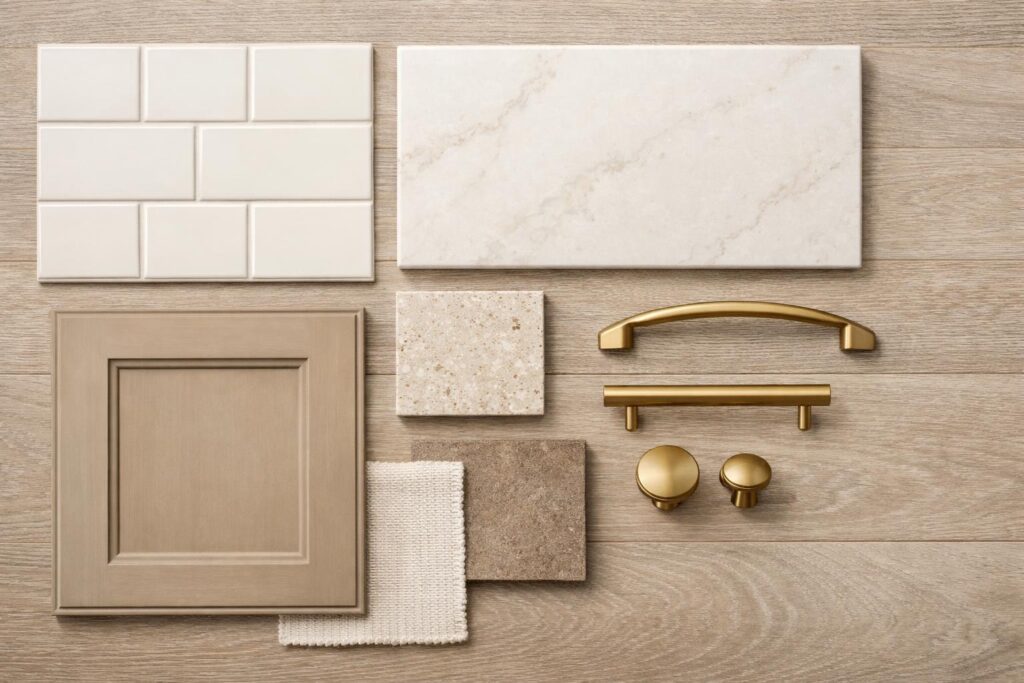
Place samples together: flooring, cabinet finish, countertop, backsplash, grout, hardware, paint, and any adjoining material that remains. Look at them in the actual room if possible. Move them near windows, under the planned task light, and into evening conditions. A warm cabinet can shift beside a cool floor. A quiet slab can become busy across a full island. A glossy tile can reflect under-cabinet lighting more strongly than expected.
Test cleaning on approved sample material using only allowed products. Observe fingerprints, water, crumbs, pet hair, and common household residue. Do not intentionally damage a supplier sample without permission, and do not assume a test on one sample predicts every installed condition.
For variable natural materials, view a larger sample or the full slab or lot when the process allows. Clarify acceptable range, orientation, pattern placement, seams, and who approves the material before fabrication or installation.
Keep a labeled selection record. Product name, color, finish, size, lot or slab information where applicable, grout, edge, installation direction, care document, and approval date reduce confusion when several warm neutrals look similar.
How Do Pets, Chairs, and Entry Traffic Change the Flooring Conversation?
A floor does not experience “family use” as one generic condition. It experiences specific points of wear. Map the route from the most-used exterior door to the kitchen. Mark the places where wet shoes, snow residue, grit, pet paws, chair legs, stools, rolling items, food bowls, trash, and repeated turns concentrate. Then compare the exact flooring product and installation plan against those exposures.
Pets can introduce claws, water around bowls, food, tracked soil, and repeated movement along the same path. Children can introduce dropped objects, craft materials, chairs, and fast traffic. Hosting can add stool movement, serving spills, and more people using the same transitions. None of that proves a broad material category will succeed or fail. It tells you which product documents, samples, edges, maintenance instructions, and repair questions deserve attention.
Transitions matter because traffic rarely stops at the kitchen line. Compare the new floor with the adjacent hall, family room, mudroom, exterior entry, and stair. Review height changes, reducers, thresholds, trim, door clearance, and the visual break. A durable field of flooring can still create frustration when the transition catches debris, feels abrupt underfoot, or looks improvised.
Ask how chairs and stools will be protected, what cleaning products are approved, how standing water should be handled, and whether entry mats or maintenance practices are compatible with the product. A realistic use plan is more useful than calling any floor pet-proof, waterproof, scratch-proof, or maintenance-free.
What Does Repairability Mean Before You Buy?
Durability is not only resistance to damage. It is also what happens when damage occurs. Before ordering, ask whether a damaged plank, tile, slab area, grout joint, edge, or backsplash piece can be repaired or replaced, what access the repair requires, and whether matching material is likely to be available. Do not promise an invisible repair or future match; dye lots, quarry variation, print runs, finish aging, and product availability can change.
For flooring, consider whether individual pieces can be removed without disturbing a large area and whether cabinets or islands trap the material. For tile, keep records of product, color, size, finish, trim, grout, layout, and installation details. For counters, ask the fabricator what types of chips, seams, stains, or damage may be repairable for the exact material and finish. For natural stone, use current care and repair guidance rather than a category-level assumption.
Document the selections at closeout and store a practical amount of approved spare material only when the project team and product conditions support that plan. Label it clearly. Keep manufacturer care instructions, warranty information, color and lot data where available, and the names of the responsible supplier or fabricator.
Repairability does not make a delicate product durable, and it does not guarantee matching. It gives you a more complete way to compare finishes: daily performance, maintenance, visible wear, repair path, replacement path, and the consequences if a problem appears in the busiest part of the room.
What Belongs in a Durability-First Finish Review Before Ordering?
- Define wear by location: entry path, sink, range, island seating, pantry, pet route, and adjoining rooms.
- Compare exact product documents, care, limitations, warranty, use classification, and relevant certifications.
- Verify substrate, flatness, moisture, movement, support, installation system, and radiant-heat compatibility where applicable.
- Review floor height, cabinet footprint, appliance clearances, transitions, doorways, and replacement access.
- Review counter seams, edges, cutouts, supports, overhangs, backsplash, outlets, windows, hood, and exposed ends.
- Review tile layout, grout, trim, corners, changes of plane, cleaning, and repair.
- View samples in daylight and evening light beside the actual finish package.
- Decide how normal variation, wear, matching, repair, and maintenance fit your expectations.
Use the Fortress Builders portfolio to identify visible material relationships, but do not infer the exact product, substrate, waterproofing, movement accommodation, care, or long-term performance from a photograph. The broader kitchen remodel plan should coordinate the selected surfaces with layout, cabinets, appliances, lighting, and installation.
Frequently Asked Questions
What is the most durable kitchen flooring for a Utah family?
There is no universal best. Compare exact products against the household’s traffic, water, grit, pets, impact, cleaning, substrate, transitions, repair expectations, and maintenance tolerance.
Is LVP waterproof enough for every kitchen?
Do not extend a product-level “waterproof” claim to the full installed assembly, seams, perimeter, substrate, walls, or every water event. Review exact product and installation documents.
Is porcelain tile slip-proof?
No surface should be called slip-proof. Review the exact tile’s declared use classification, surface, format, grout, installation, environment, cleaning, and household conditions.
Does natural stone always need sealing?
Requirements vary by stone, finish, treatment, exposure, and supplier guidance. Review the exact material’s current care and installation instructions rather than applying one rule to all stone.
Can every kitchen floor work over radiant heat?
No universal answer is safe. The flooring, adhesive or underlayment, substrate, radiant system, controls, temperatures, installation, and manufacturer instructions must be compatible.
What samples should I bring to a finish review?
Bring flooring, cabinet finish, countertop, backsplash, grout, hardware, paint, and adjoining materials that remain, along with exact product names and current care documents.
What kind of wear must your kitchen surfaces handle—and what care will you realistically keep doing?
Request help comparing kitchen surface options in Davis or Weber County. Ask Fortress Builders for a durability-first finish review before flooring, counters, backsplash, grout, and transitions are ordered.