

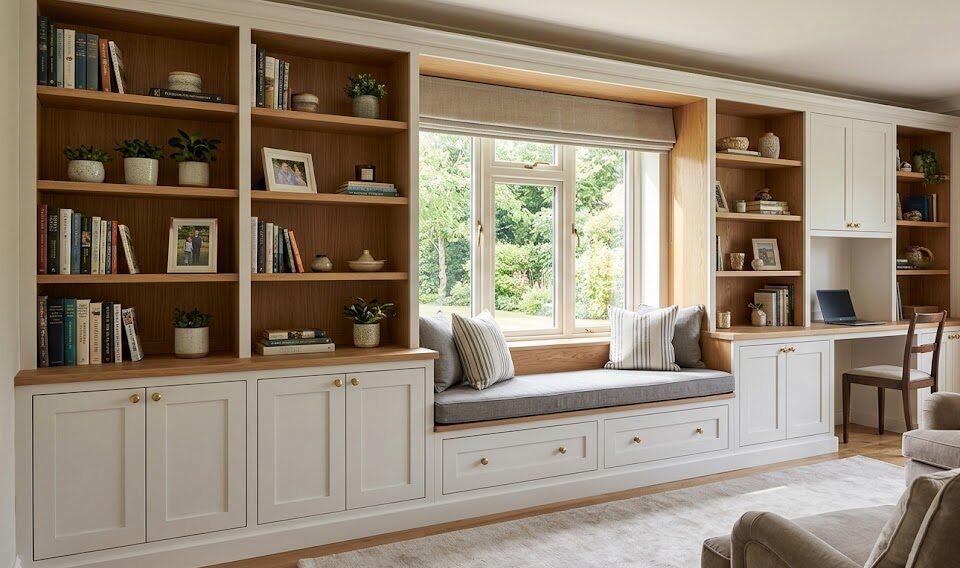
Custom Carpentry & Built-Ins Crafted to Fit Your Home
Custom carpentry is what often makes a remodel stop feeling assembled and start feeling intentional.
Cabinets, shelving, trim details, mudroom storage, media walls, office built-ins, and tailored niches can solve real problems that off-the-shelf pieces never fully fix. They can use awkward space better, reduce clutter, support daily routines, and help rooms feel more finished without making them feel overdesigned.
This guide walks through how to think about custom carpentry built ins from a homeowner’s perspective. You will learn where custom built ins at home add the most value, how to plan mudroom, media wall, and shelving solutions that actually work, what matters in home storage carpentry, and how built-in design ideas should be evaluated for both beauty and daily use.
The Fortress Builders approaches custom carpentry through one core principle: strength through structure. Every project begins with a design blueprint that aligns the way you use the space, the surrounding finishes, and the build sequence before fabrication and installation begin. That is what helps custom work feel like part of the home—not like furniture pushed into a gap.
- How to think about custom carpentry as a functional upgrade, not just a decorative one
- Where custom built ins at home improve storage, flow, and visual calm most
- How to plan mudroom, media wall, shelving, and office carpentry more intentionally
- What makes built-in design ideas feel timeless instead of trendy
- How custom carpentry should be coordinated with lighting, trim, and surrounding finishes
Why custom built-ins change how a home feels
Custom built-ins do more than fill empty walls. They shape how a room functions, how clutter is controlled, and how architecture supports daily life. Off-the-shelf pieces can be useful, but they often leave dead zones, awkward gaps, and visual noise that remind homeowners the room is still working around compromise.
Custom carpentry changes that because it can be sized, proportioned, and detailed for the specific room it lives in.
Better Use of Space
Custom work can turn alcoves, niches, and underused walls into storage or function instead of wasted square footage.
Cleaner Visual Lines
Built-ins reduce the pieced-together look that often comes from combining too many standalone furniture pieces.
Storage That Matches Real Life
Good home storage carpentry is designed around what needs to be hidden, reached, displayed, or used daily.
Stronger Room Identity
A media wall, mudroom, or office often feels more complete once the carpentry gives it structure and purpose.
More Cohesive Remodeling
Custom carpentry can tie a remodel together by aligning trim, materials, and room proportions more intentionally.
Long-Term Value
When designed well, built-ins often keep delivering both function and visual benefit long after trend-driven décor changes out.
Start by asking what the built-in actually needs to solve
One of the most common mistakes homeowners make with built-ins is starting with appearance before identifying the actual problem. A room may need more storage, better organization, stronger display balance, a cleaner media setup, or a more intentional drop zone. Until that is clear, it is difficult to know what the built-in should be.
Storage and clutter control
Many custom built-ins home projects begin because the room visually feels busy. Open surfaces collect too much. Everyday items lack a place to land. The right carpentry can reduce that friction dramatically.
Room anchoring
Some built-ins do not just store things—they give the room a focal point. Media walls, library shelving, and office built-ins often help a room feel settled.
Architectural finish
There are spaces that simply feel underdeveloped without trim detail, paneling, shelving, or a more tailored wall treatment. Custom carpentry can bring that missing layer of resolution.
If this custom piece disappeared tomorrow, what daily frustration would come back first? That is usually the best clue to what the design should prioritize.
| Problem Type | Custom Carpentry Response |
|---|---|
| Visual Clutter | Concealed storage, better proportion, and clearer organization zones |
| Awkward Wall Space | Fitted shelving, built-in cabinetry, or architectural trim that gives the wall purpose |
| Weak Function | Purpose-built work surfaces, storage access, or daily-use features integrated into the room |
| Disconnected Design | Trim, paneling, and built-ins that align the room with the rest of the home more cohesively |
Where custom carpentry and built-ins usually add the most value
Some of the strongest custom carpentry projects happen in places homeowners already know are underperforming: mudrooms, media walls, office alcoves, entry zones, spare walls in family rooms, niche storage areas, and transitional spaces that never quite know what to do. Those are often the areas where custom work pays off fastest.
Mudroom media wall shelving and drop zones
Mudrooms and family drop zones are some of the clearest examples of built-ins solving everyday life. Bags, shoes, coats, keys, sports gear, and household overflow all need an organized home if the rest of the house is going to stay calmer. In other rooms, shelving and media walls can solve a similar issue—organizing what would otherwise become loose clutter or a messy focal zone.
Home office built-ins
Custom office shelving, desks, cabinetry, and printer/storage zones often make a room feel much more purposeful. This is especially true when homeowners are converting a spare room office and want the result to feel intentional instead of temporary. Related service page: Home Office & Flex Space.
Living room and family room built-ins
Media walls, fireplace surrounds, shelving, and lower cabinetry can anchor large living spaces and reduce the need for mismatched freestanding furniture.
Hallways, alcoves, and underused walls
These are often the spaces where built-in design ideas become most rewarding because a small amount of tailored work can unlock a surprising amount of usefulness.
- the room has awkward gaps or underused wall areas
- freestanding furniture never quite fits correctly
- storage needs are specific and repeated daily
- the room needs a stronger focal wall or architectural anchor
- the space needs to feel more integrated with the rest of the remodel
Built-in design ideas should follow proportion, not just inspiration
It is easy to collect beautiful inspiration images for built-ins. The harder part is translating those ideas into something that fits your home’s architecture, wall dimensions, ceiling height, trim language, and actual use patterns. This is where proportion matters much more than trend.
Scale has to match the room
A dramatic built-in wall can feel elegant in one house and heavy in another. The right size, depth, and profile depend on the room’s architecture and how much visual weight the space can comfortably carry.
Open and closed storage should be balanced
Some homeowners love the look of open shelving until they realize how much visual maintenance it creates. Others go too far into closed cabinetry and lose the chance for warmth and display. Good design balances both.
Built-ins should feel like part of the room, not furniture trapped inside it
That means thinking through reveals, trim transitions, ceiling relationships, and how the built-in meets the floor and adjacent walls.
If the built-in were empty, would it still feel like it belongs to the room architecturally? If not, the design may be relying too heavily on styling instead of structure.
The design decisions that shape whether custom carpentry feels timeless or overbuilt
Good custom carpentry is not about adding detail everywhere. It is about using the right detail in the right amount. The most successful projects usually feel disciplined. They solve the problem clearly, align with the house, and avoid overcomplication.
What should be hidden and what should be shown?
This is one of the most useful questions in home storage carpentry. Items used daily but not meant to be seen constantly usually belong behind doors or in drawers. Decorative objects, books, and a few chosen display pieces may belong on open shelving.
How permanent should the solution be?
Some rooms need a strong built-in anchor because the use is unlikely to change much. Other rooms benefit from custom work that feels tailored but still leaves some flexibility for the future.
What style language already exists in the home?
Profiles, trim proportions, panel styles, shelf thickness, and material tone should all feel consistent with the home rather than imported from a different design vocabulary entirely.
Open vs Closed Storage
Balance display and concealment based on what the room actually needs to hold daily.
Depth and Proportion
Right-sizing the piece keeps it useful without making the wall feel too heavy.
Trim Language
Profiles and details should feel related to the rest of the house, not disconnected from it.
Long-Term Use
The strongest built-ins solve today’s problem while still making sense years from now.
Trim integration, finish matching, and why custom carpentry should not feel added late
Custom carpentry feels best when it is coordinated with the room instead of inserted after every other finish choice is already locked. Paint, stain, floor transitions, lighting placement, outlet locations, and surrounding trim all affect whether the final result feels smooth and well resolved.
Trim integration matters
Baseboards, casing, crown conditions, wall paneling, and adjacent details should all relate naturally to the new built-in work so the room reads as one composition.
Finish matching should be intentional
That does not always mean everything has to match exactly. It means the tones, textures, and paint or stain choices should feel coordinated enough that the custom work belongs.
Sequencing protects quality
Custom work often looks best when installed in the right stage of the remodel, after the necessary infrastructure is prepared but before final finish details are rushed. This is one reason broader remodeling coordination matters so much. Related service hub: Additional Remodeling Services.
- alignment with surrounding trim and casing
- clean coordination with outlets, switches, and lighting
- paint or stain choices that suit the room and wear expectations
- protection of floors and surrounding surfaces during install
- final detailing that makes the work feel complete, not hurried
Built-ins should support daily routines, not just fill walls
There is a reason some built-ins feel instantly valuable and others become background scenery. The difference is usually routine. Good custom carpentry is designed around how the space gets used every day.
Mudroom and entry storage should reduce transition chaos
If the goal is calmer entry and exit routines, the built-ins should support shoes, coats, bags, and drop-zone needs directly instead of just looking tidy in theory.
Media walls should do more than hold a television
The strongest media carpentry helps conceal cords, support equipment, reduce clutter, and give the room a stronger focal point without making the wall feel bulky.
Office built-ins should improve workflow
If the office still needs visible bins and extra furniture to function after the built-ins are installed, the design may not have solved enough of the real problem.
When custom carpentry is the right upgrade—and when it is not
Custom carpentry is not the answer to every room problem. Sometimes better layout or broader remodeling work matters more than built-ins. But when the room already functions reasonably well and needs stronger organization, a better focal wall, integrated storage, or more architectural finish, custom work can be one of the highest-impact upgrades available.
It is usually a strong move when the problem is spatially specific
If one wall, alcove, entry, office, or family room area is underperforming, custom carpentry can often solve it precisely without requiring a larger renovation.
It may not be enough when the whole room is wrong
If the room lacks good light, proper flow, or enough area for its purpose, built-ins alone may dress up the problem without fixing it.
It works especially well as part of a broader remodel
Custom carpentry often shines most when it is coordinated as one layer of a bigger design-build effort instead of being asked to compensate for unresolved issues elsewhere.
Is the room already basically right but missing tailored function—or are you hoping built-ins will solve a deeper layout problem they were never meant to fix?
Permits, electrical, lighting, and related requirements can still matter
Custom carpentry may seem simpler than kitchens, baths, or additions, but it can still interact with important project systems. Built-ins that coordinate with lighting, outlets, office tech, media equipment, or surrounding remodeling work should be planned carefully enough that the finished room performs as well as it looks.
Electrical and lighting coordination may be part of the project
Built-in desks, media walls, and shelving zones often interact with outlets, switches, integrated lighting, or concealment needs that should be resolved before installation.
Other requirements may vary by scope
If carpentry work is being installed as part of a larger remodel, permitting, inspections, electrical requirements, ventilation, or similar details may also be part of the full project and should be verified appropriately.
Professional coordination protects the final look
Even simple built-ins can feel compromised if surrounding infrastructure decisions were left vague for too long.
- Electrical, lighting, trim, and installation requirements can vary depending on the built-in type and the larger project scope.
- If permits, inspections, ventilation, electrical, or other requirements apply, confirm final details with qualified professionals and local authorities where applicable.
- Custom work looks best when it is coordinated with the surrounding remodel instead of treated like a late-stage add-on.
Common custom carpentry mistakes homeowners regret later
Designing around appearance before function
Beautiful shelving does not help much if it does not actually hold what the room needs it to hold.
Using too much open storage
Rooms often feel visually busier when homeowners underestimate how many daily-use items really need concealment.
Ignoring proportion
A built-in can be high-quality and still feel wrong if its depth, scale, or visual weight does not match the room.
Forgetting about finish integration
If trim, paint, flooring, and surrounding details were not part of the plan, the final result may feel inserted instead of intentional.
Overbuilding for a trend instead of a routine
The most successful built-ins tend to follow how the family lives, not just what is popular in inspiration photos.
How Fortress Builders approaches custom carpentry and built-ins
A strong design-build process starts by understanding what the custom work needs to solve. Is it storage, visual calm, display, room anchoring, trim integration, or daily routine support? Once that is clear, the built-in can be designed with the right proportion, finish strategy, and installation timing to feel like part of the home from the beginning.
That usually means measuring carefully, coordinating with lighting and surrounding finishes, selecting details that support the home’s broader style, and building for long-term durability rather than short-term visual effect. The result is not just a better-looking room. It is a room that works better because the carpentry is doing real functional work.
That is what makes custom carpentry so valuable. It turns leftover walls, awkward niches, and underperforming spaces into useful parts of the home while strengthening the design of the room at the same time.
FAQ: Custom carpentry and built-ins
Are custom built-ins worth the investment?
Where do custom built-ins usually add the most value?
Can custom carpentry match the rest of my home?
Should built-ins be open shelving, closed storage, or both?
Is custom carpentry only for large remodels?
Curated Custom Carpentry Resources
See how Fortress Builders approaches custom built-ins, finish carpentry, and tailored storage as part of a cohesive design-build process.
Explore where office built-ins, custom desks, shelving, and storage solutions can turn a spare room into a more intentional workspace.
Review projects where custom carpentry helps tie larger remodeling work together through stronger function and finish integration.
Explore More Fortress Builders Pages
Thinking about custom built-ins that truly fit your home?
Bring your storage frustrations, your underused walls, and the way you want the room to function better. Fortress Builders can help turn that into a custom carpentry plan that feels intentional, durable, and genuinely useful.
This content is informed by the experience of Troy Lybbert, Founder of Fortress Builders. As a licensed general contractor since 1998, Troy brings over two decades of hands-on residential construction experience in remodeling and custom home building throughout Northern Utah.