

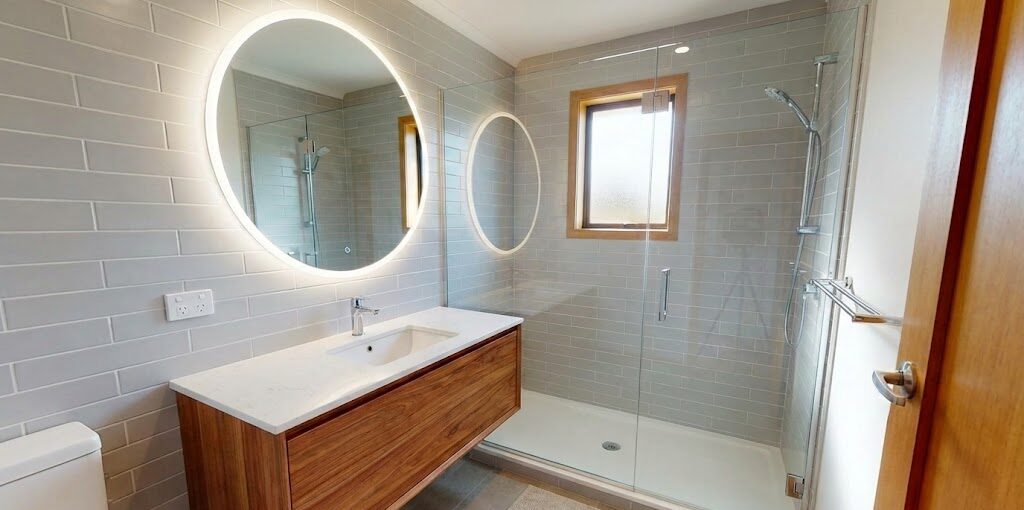
Small Bathroom Vanity Guide: Storage, Clearance, and Daily Comfort
A small bathroom vanity can make the room feel bigger… or it can make it feel like you’re doing a daily obstacle course.
That’s because the vanity isn’t just a cabinet. It’s the place where morning routines happen, where storage either works or doesn’t, and where clearances can quietly make (or break) comfort—especially in tight bathrooms where every inch counts.
This small bathroom vanity guide helps you choose a vanity size and storage layout that matches real life:
- How to measure for bathroom vanity clearance (doors, drawers, toilet, and traffic flow)
- How to choose the right vanity size for a small bathroom (width, depth, and height)
- Storage vanity drawers vs doors: which works better for daily routines
- Narrow depth vanity options and when they’re worth the trade-offs
- Sink, faucet, mirror, and lighting decisions that make a small vanity feel more comfortable
The Fortress Builders is a Utah design–build company built on one principle: strength through structure. That means we plan what’s behind the finishes—layout, storage, plumbing, lighting, and ventilation—so your bathroom feels great every day, not just on photo day.
Helpful internal resources while you plan:
- Bathroom Remodeling in Utah: Built to Last
- Bathroom Fixtures & Lighting That Elevate Daily Routines
- Bathroom Lighting Plan: Vanity Sconces, Mirrors, and Overhead Lighting
- Water-Efficient Bathroom Fixtures: Comfort, Performance, and Savings
- Timeline and What to Expect
- Request a Design Consult
Important note: If changing vanity size means moving plumbing, electrical outlets, or lighting, requirements and permitting/inspection rules can vary by location and scope. Confirm details with qualified professionals and local authorities, and follow manufacturer installation instructions for any vanity, faucet, sink, or electrical component.
Your vanity can shrink or expand how a bathroom feels
In a small bath, the vanity is often the biggest “piece of furniture,” the most-used storage zone, and the main place you stand. That means it influences three things you feel every day:
- Space: Does the room feel open—or cramped?
- Storage: Are essentials easy to reach—or scattered around the room?
- Comfort: Can two people use the bathroom without shoulder-checking each other?
Big idea: Start with clearances and routines, then pick a vanity. A vanity that “fits the wall” can still fail if it blocks drawers, crowds the toilet, or steals the only comfortable walking path.
We’ll walk through this like a practical decision tree: measure clearances first, choose width and depth second, then pick storage and sinks based on how your household actually uses the space.
Step 1: Measure clearances first (before you shop)
If you only take one thing from this small bathroom vanity guide, take this: measure how the room works, not just how the vanity fits.
In small bathrooms, the problems usually aren’t “the vanity didn’t fit.” The problems are:
- the vanity drawer hits the toilet,
- the bathroom door hits the vanity corner,
- the walkway feels pinched,
- there’s nowhere to set anything down,
- storage is technically there, but it’s awkward to use.
What to measure (quick checklist)
Grab a tape measure and capture these basics:
- Wall-to-wall width where the vanity will go (baseboard to baseboard, not just “drywall to drywall”).
- Available depth from the vanity wall to the nearest obstruction (toilet, tub, shower glass, doorway swing).
- Door swings (bathroom door, shower door, linen closet door) and where they overlap with the vanity zone.
- Toilet proximity (is the toilet next to the vanity, and will a drawer/door collide?).
- Existing plumbing location (drain and supply lines) and whether you want to keep them or move them.
- Outlet and switch locations near the vanity, plus lighting locations (vanity light, sconces, overhead).
- Notes on daily traffic: where people enter, where they stand, and what feels tight.
Pro tip: draw a “top-down sketch”
You don’t need software. A simple top-down sketch on graph paper (or a notes app) helps you see the clearance issues immediately. Include:
- doors and their swing arcs,
- toilet and shower/tub footprint,
- vanity area and how far it projects into the room,
- and any wall bump-outs or weird corners.
If your remodel includes layout changes, this is also the time to decide whether you’re staying “in the same footprint” or making a strategic change (like shifting the toilet or shower). Bigger moves can create a dramatically better vanity zone—but they require more planning.
Related (for homeowners planning a bigger sequence): Whole-Home Remodel Sequencing: The Order That Saves Time and Rework.
Step 2: Choose vanity width (the size that changes everything)
When people search “vanity size for small bathroom,” they often want a single magic number. In reality, the “right” width depends on:
- how many people use the bathroom daily,
- how much storage you need at the sink,
- how tight your clearances are,
- and whether you can add storage elsewhere (medicine cabinet, linen cabinet, shelving).
Common small vanity widths (and what they usually feel like)
Vanities come in many sizes, but these are common “small bathroom” categories. Treat these as typical, not universal—always check product specs.
| Vanity Width (Common Range) | What It’s Good For | Common Trade-Off |
|---|---|---|
| 18–24 inches | Powder rooms, very tight guest baths, minimal routines | Less counter space; storage is limited unless cleverly designed |
| 24–30 inches | Many small full baths; good balance of comfort + footprint | You may need smart storage (drawers, medicine cabinet) to avoid clutter |
| 30–36 inches | Most “comfortable” single-sink zone; better counter + storage | Can crowd toilets/doors in tight layouts—measure clearance carefully |
| 36–48 inches | Primary baths where one sink is okay but storage matters | Often too large for true small baths unless layout is adjusted |
A quick “routine test” for vanity width
Ask these questions:
- Do you need space for two toothbrush stations, hair tools, skincare, and everyday items?
- Do you like to keep the counter mostly clear?
- Do you need a landing zone for contact lenses, makeup, shaving, or kids’ routines?
If the answer is “yes” to most, it usually means you either need:
- a slightly wider vanity, or
- better vertical storage (like a recessed medicine cabinet), or
- a more drawer-forward vanity layout.
Homeowner-friendly rule: If you’re trying to make a small bathroom feel bigger, prioritize a vanity that fits cleanly without forcing awkward clearances. A slightly smaller vanity with smarter storage often feels better than a larger vanity that makes the room tight.
Step 3: Choose vanity depth (standard vs narrow depth vanity options)
Depth is the sneaky dimension. You can choose a vanity that’s “the right width,” but if it’s too deep, it can choke the room—especially in bathrooms where the vanity faces a toilet or shower door.
What’s “standard depth” and what’s “narrow depth”?
Many vanities are built around a standard depth that feels comfortable for handwashing and counter use. But there are also narrow depth vanity options designed for tight spaces.
Instead of locking onto a specific number, think in categories (and confirm exact specs for the vanity you’re considering):
- Standard depth: typically feels more comfortable, more counter space, more sink options
- Narrow depth: saves walkway space and reduces “pinch points,” but can limit sink size and counter usability
When narrow depth is a win
A narrow depth vanity often makes sense when:
- the bathroom is truly tight and the walkway feels cramped,
- a standard depth vanity would collide with a door swing,
- the toilet is very close to the vanity and you need breathing room,
- you want the bathroom to feel less “crowded” at entry.
Common trade-offs with narrow depth
Narrow depth can be amazing—but it’s not free. Watch for:
- Smaller sink bowls (more splashing if the faucet isn’t well matched).
- Less countertop landing (where do soap, toothbrushes, and daily items go?).
- Less cabinet volume (which can be fine if you plan other storage).
Decision tip: If you go narrow on depth, “make it up” with smarter storage: drawers, a recessed medicine cabinet, and/or better towel and toiletry organization—so the counter doesn’t become storage.
Step 4: Storage vanity drawers vs doors (the choice you’ll feel daily)
In a small bathroom, storage is either effortless—or it’s a slow drip of daily frustration. That’s why the storage vanity drawers vs doors decision matters more than most homeowners expect.
Why drawers usually outperform doors in small baths
Drawers tend to win because they:
- use space efficiently (you can see everything),
- reduce “digging” behind plumbing,
- make it easier to organize categories (hair, skincare, first aid, kids’ items),
- help keep counters clear because storage is easier to access.
That said, doors still have a place—especially for tall items, cleaning supplies, and waste bins.
| Storage Style | Best For | Watch Out For |
|---|---|---|
| Mostly drawers | Daily routines, keeping counter clear, quick access for kids/partners | Top drawer may need a “U-shaped” cutout for plumbing depending on sink/drain layout |
| Doors + interior shelves | Taller items, cleaning supplies, flexibility | Stuff disappears into the back; plumbing can steal usable space |
| Drawers + one door section | Best of both: organized daily storage + tall item zone | Door/drawer swings can conflict in very tight clearances—measure! |
| Open shelf vanity | Airier look, quick grab towels/baskets, smaller visual footprint | More visual clutter unless baskets are used; items can collect dust |
Clearance check: drawers need space to open
Drawers are amazing—until they smack into a toilet or block the doorway. When you’re checking bathroom vanity clearance, simulate the drawer depth with painter’s tape on the floor or cardboard cutouts. In tight baths, that simple test prevents expensive mistakes.
Small-bath strategy: If drawer clearance is tight, consider a slightly narrower vanity width, a narrower depth, or a drawer layout that avoids the conflict zone (for example: drawers on one side, door storage on the side nearest the toilet).
Step 5: Sink choices that change storage and comfort
Two vanities can be the same size—but feel totally different—because the sink choice changes how you use the counter and how much storage is truly usable inside the cabinet.
Integrated top vs separate sink + counter
Many small vanities come with an integrated top (counter + sink together). These can be practical because they’re designed as a package and often simplify installation. Separate counters and sinks can offer more customization, but they also add decisions (and coordination).
Offset sinks: underrated in small bathrooms
If you need storage more than symmetry, an offset sink can be a smart move. It can create:
- more uninterrupted counter space on one side (great for daily items),
- more usable drawer layout on the other side,
- better organization for couples or families (one side becomes “the station”).
Offset sinks are especially helpful when you’re trying to squeeze better function out of a 24–36 inch vanity without changing the footprint.
Make sure the faucet and sink match (especially for narrow depth)
With narrow depth vanity options, the sink bowl is often smaller. That means faucet reach and angle matter. If the water stream hits too close to the drain or too close to the front edge, you can get more splash and mess. This isn’t about being picky—it’s about choosing a setup that works day-to-day.
If you’re also upgrading fixtures, this guide pairs well with vanity planning: Water-Efficient Bathroom Fixtures: Comfort, Performance, and Savings.
Step 6: Plan storage before final plumbing locations (it saves regret later)
Here’s where small bathrooms get expensive: a vanity choice that forces last-minute plumbing changes, or a plumbing layout that ruins the storage you were counting on.
Keeping plumbing where it is (often the simplest path)
If your new vanity is similar in size and layout, keeping plumbing locations can reduce scope and complexity. It’s not always possible, but it’s often worth exploring—especially if you’re aiming for a smoother remodel.
When moving plumbing can be worth it
Sometimes a small plumbing move creates a big usability upgrade. Examples include:
- shifting the drain to support a drawer-friendly vanity layout,
- centering or offsetting plumbing to match the sink design,
- adjusting supply/shutoff access for easier service.
Important note: Plumbing changes can impact cost, timeline, and permits/inspections. Requirements vary by jurisdiction and scope, so confirm with qualified professionals and local authorities.
Homeowner checklist for vanity plumbing planning:
- Where will the shutoff valves be (and can you reach them easily)?
- Will the vanity design still allow service access to the drain trap and supply lines?
- Will plumbing interfere with the top drawer (or do you need a drawer cutout layout)?
- Are you changing faucet type (single-hole vs widespread) and does the top support it?
- Are you adding any features that need planning (hot water recirc controls, specialty faucets, etc.)?
Step 7: Add storage without adding bulk (small bathroom moves that work)
If you’re stuck with a smaller vanity footprint due to clearances, you can still get a highly functional bathroom by adding storage in smarter places.
1) Recessed medicine cabinets (big storage, low visual weight)
A recessed medicine cabinet can be one of the best upgrades in a small bathroom because it adds storage without projecting far into the room. It also reduces counter clutter—one of the fastest ways to make a small bathroom feel larger.
If you’re thinking about mirrors and lighting together (which you should), this is a helpful companion guide: Bathroom Lighting Plan: Vanity Sconces, Mirrors, and Overhead Lighting.
2) Tall, narrow storage (when wall space is limited)
A tall, narrow cabinet (or linen tower) can add a surprising amount of storage in a small footprint—if your layout has a wall that can support it. The goal is vertical storage that doesn’t block clearances.
3) Open shelving (only if you can keep it tidy)
Open shelves can look great and feel airy, but they require organization. If your household tends to “pile,” open shelves can quickly turn into visual clutter.
Best practice for open shelves:
- use baskets or matching containers,
- limit the number of “categories” stored there,
- avoid storing lots of tiny, mismatched items.
4) Think through towel strategy
Small bathrooms often feel cramped because towels and mats don’t have a place to dry. A few simple decisions help:
- hooks or bars placed where towels can dry (and not bunch up),
- a spot to hang a bath mat,
- keeping textiles out of the vanity if they stay damp.
If your remodel includes ventilation improvements, it can also make towels and rugs dry faster. Related: Bathroom Ventilation & Moisture Control Done Right.
Step 8: Pair the vanity with the right mirror and lighting
Vanity selection isn’t just about the cabinet. The mirror and lighting determine how the space feels and how usable it is—especially for grooming tasks.
Mirror sizing (simple, homeowner-friendly guidance)
Many homeowners prefer a mirror that feels visually connected to the vanity—often similar in width or slightly narrower, depending on style. But practical factors matter too:
- Will the mirror center on the sink and faucet?
- Will it work with sconces if you’re adding them?
- Does it provide enough viewing height for the household?
Lighting placement matters more than brightness
In small bathrooms, harsh overhead-only lighting can create shadows on faces. Many homeowners prefer a plan that includes some type of vanity-focused lighting (sconces or a good vanity fixture) for more even light.
For a full breakdown (without contractor jargon), see: Bathroom Lighting Plan: Vanity Sconces, Mirrors, and Overhead Lighting.
Important note: Bathroom electrical requirements (including outlet placement and GFCI protection) can vary. Confirm details with a qualified electrician and local authorities during planning—especially if you’re relocating outlets, changing lighting, or adding new circuits.
Comfort details: height, toe-kick, and “daily ergonomics”
Small bathrooms get a lot of use, which means small comfort details matter.
Vanity height: what feels right?
Vanity height varies widely by product and household preference. Some feel more comfortable at “counter height,” while others prefer a lower height for kids or specific accessibility needs.
Instead of chasing a number, focus on:
- who uses the bathroom most (kids vs adults),
- how long people spend at the sink (quick handwashing vs grooming routines),
- whether you want a furniture-style look (often influences toe-kick and height).
Toe-kick vs furniture legs
Furniture-style vanities (legs, open bottoms) can look lighter in a small space. The trade-off is practical:
- toe-kick vanities can feel more stable and hide floor variations,
- furniture legs can collect dust and require more careful cleaning,
- open bottoms can feel airy but may reduce “hidden” storage.
Materials that hold up in small bathrooms (what to look for)
Bathrooms are tough on cabinets. Water drips. Steam happens. Cleaning products get used. The goal isn’t “perfect materials”—it’s choosing a vanity that can handle real life.
Cabinet construction and hardware
As a homeowner, you don’t need to memorize every construction type. But you can look for signs of quality that tend to matter long-term:
- Drawer glide quality: smooth operation, good extension, solid feel
- Door hinges: adjustable and sturdy
- Finish durability: a finish that can handle occasional splashes without swelling or peeling
- Interior finish: sealed surfaces are easier to wipe clean
Countertop and edge considerations
Countertops for vanities should be water-friendly and easy to clean. Whatever material you choose, pay attention to:
- how water behaves on the surface (easy wipe-down vs constant spotting),
- the edge profile (some edges catch water more than others),
- whether you want a short backsplash to protect the wall (especially in kid-heavy bathrooms).
If you’re coordinating vanity finishes with other bathroom materials, this service page is a helpful overview of how finishes come together: Bathroom Remodeling in Utah: Built to Last.
Common mistakes homeowners make with small bathroom vanities
Most vanity mistakes are predictable—and avoidable—if you plan around clearance and routines.
1) Picking depth based on looks, not walkway
In a small bath, depth often matters more than width. Don’t assume “standard depth” will work. Measure and test clearances.
2) Ignoring drawer swing conflicts
A great drawer vanity can become annoying if it collides with a toilet or blocks the bathroom door. Always simulate drawer opening in your plan.
3) Choosing storage that fights your routines
If you hate bending and digging for items, doors-only storage might frustrate you. If you need tall storage for cleaning supplies, a drawers-only vanity might not be ideal. Choose based on what you store.
4) Not planning outlets, lighting, and mirror together
Vanity placement affects lighting. Mirror choice affects sconce spacing. Outlets affect hair tools and daily routines. Plan it as a set, not as separate purchases.
5) Underestimating “wet reality”
Bathrooms need moisture planning. If you’re going for a furniture-style vanity or DIY build, make sure the bathroom is ventilated well and that materials are protected. This guide helps homeowners think about moisture as a system: Mold Prevention in a Bathroom Remodel: Design + Ventilation Basics.
Decision checklist: choose the right vanity for a small bathroom
Copy/paste checklist for vanity planning:
- Clearance: Can you stand comfortably at the sink without blocking the path or bumping fixtures?
- Door/drawer swings: Do vanity doors/drawers open fully without hitting the toilet or door?
- Width: Is the vanity wide enough for your routine (counter space + storage) without crowding the room?
- Depth: Do you need standard depth, or would narrow depth vanity options improve comfort?
- Storage style: Do you want drawers vs doors based on what you store every day?
- Sink choice: Does the sink size/shape fit the depth and reduce splash?
- Mirror + lighting: Is the lighting plan flattering and functional (not just bright)?
- Outlets: Are outlets planned where you actually use hair tools or chargers?
- Plumbing reality: Are you keeping plumbing locations, or are you moving them (scope + permits + cost)?
- Moisture plan: Do you have a ventilation strategy that keeps cabinetry and finishes drier long-term?
Questions to ask your remodeler before final selections
- “Based on our layout, what vanity width and depth gives the best comfort?”
- “Will drawers or doors work better with our plumbing location?”
- “Do we need to move plumbing to make storage work, or can we keep it where it is?”
- “How will you plan mirror and lighting so the vanity area is actually usable?”
- “Do any changes require permits or inspections in our area?”
FAQ: quick answers homeowners search for (SERP/PAA-style)
What is a good vanity size for a small bathroom?
A good vanity size for a small bathroom is one that preserves comfortable clearances while still providing enough counter and storage for your daily routine. Many homeowners do well with a compact-to-mid-size single-sink vanity, but the “right” size depends on door swings, toilet proximity, and whether you can add storage elsewhere (like a recessed medicine cabinet).
How much clearance do you need in front of a bathroom vanity?
You want enough open floor space to stand comfortably at the sink and pass by without feeling pinched. Minimum clearance guidelines and code requirements can vary by location and project conditions, so it’s best to confirm with your remodeler and local authorities—especially if you’re changing layout or fixture locations.
Are drawers better than doors in a bathroom vanity?
Often, yes—especially in small bathrooms. Storage vanity drawers vs doors usually comes down to daily use: drawers make it easier to access items quickly and keep counters clear, while doors can be better for tall items and flexible storage. Many homeowners prefer a mix: drawers for daily items and one door section for taller items or a bin.
Are narrow depth vanities worth it?
Narrow depth vanity options can be very worth it when a standard vanity makes the room feel tight or causes door/drawer conflicts. The trade-off is less counter space and potentially a smaller sink bowl—so it’s important to plan storage (medicine cabinet, shelves) and match the sink and faucet to reduce splash.
Should I move plumbing to fit a new vanity?
Sometimes moving plumbing is worth it if it dramatically improves storage, symmetry, or function—but it can add scope, cost, and permitting/inspection considerations. In many remodels, homeowners choose a vanity that works with existing plumbing to keep the project simpler. A design–build team can help you weigh the trade-offs early.
How Fortress Builders helps you plan a small bathroom vanity that actually works
Vanities seem simple until you start measuring a tight bathroom. That’s where a clear plan matters.
Fortress Builders helps homeowners in Davis and Weber Counties:
- choose a vanity size that protects bathroom vanity clearance and daily comfort,
- plan storage layouts that match routines (and reduce counter clutter),
- coordinate plumbing, electrical, mirror, and lighting decisions early,
- and manage the remodel with a structured design–build process from concept through final walkthrough.
Explore:
- Bathroom Remodeling in Utah: Built to Last
- Bathroom Remodel Portfolio — Utah Homes
- Your Guide to a Seamless Remodel
Want help choosing the right vanity before plumbing gets locked in?
Let’s plan your vanity size, storage, mirror, and lighting as one system—so your small bathroom feels easier every day.
Request a Design Consult Explore Bathroom Remodeling Remodeling Resources