

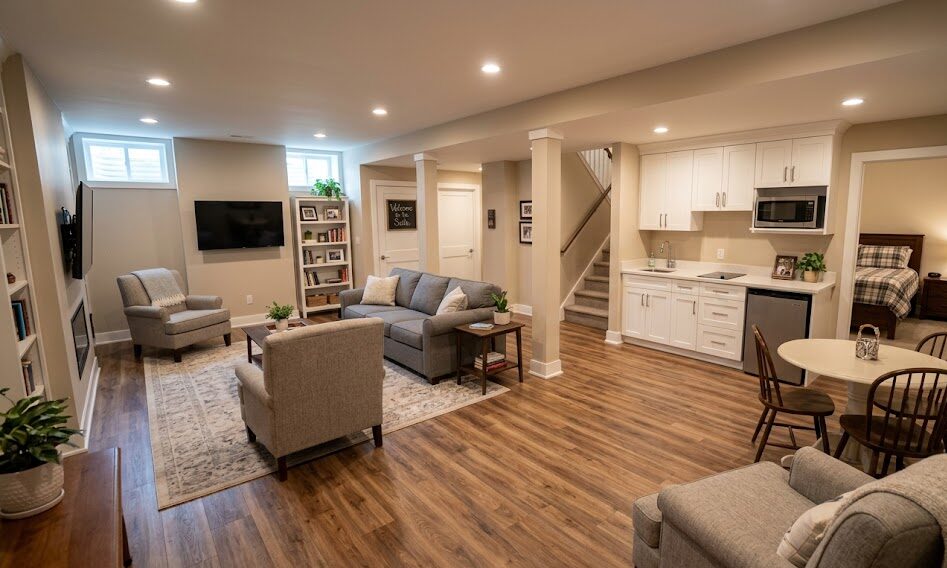
Basement In-Law Suites & Apartments Designed for Comfort
A basement in-law suite can be one of the most meaningful upgrades a home ever gets. It can create privacy for aging parents, breathing room for adult children, better guest accommodations, or a more flexible multigenerational living setup that makes the whole house work better. But a lower-level suite only succeeds when it is designed for real comfort, real privacy, and real day-to-day function.
That is why basement in law suite planning should never begin with furniture or paint colors alone. It starts with layout, circulation, privacy zones, bathroom placement, kitchenette scope, storage, lighting, sound control, and the comfort systems that help the lower level feel intentional instead of secondary.
In this guide, you’ll learn:
- how to approach basement apartment design with a design-build mindset,
- how to plan lower level suite privacy without making the basement feel chopped up,
- what matters most for bathrooms, kitchenettes, storage, and independent living comfort,
- how to think through a multigenerational basement remodel that supports dignity and daily ease,
- and how to create a basement suite that feels warm, functional, and built to last.
The Fortress Builders approaches basement remodeling through a design-build process rooted in one principle: strength through structure. That means a lower-level suite is planned as a complete living environment—comfort, privacy, utility planning, and long-term flexibility included—rather than as a typical basement with a bed and a small bar added later.
Helpful Fortress Builders pages while you plan:
Why in-law suites and basement apartments have become such an important remodeling priority
Families are asking more from their homes than they used to. Parents may need to stay closer. Adult children may need a launch space with some independence. Guests may stay longer. Homeowners may want future flexibility even if the basement suite is not fully occupied today. That is why a multigenerational basement remodel often has as much to do with long-term family planning as it does with square footage.
A strong lower-level suite can support several goals at once:
- Privacy: giving people room to live near each other without living on top of each other.
- Comfort: making the basement feel like genuine living space instead of overflow.
- Flexibility: supporting guests, family transitions, future care needs, or changing household dynamics.
- Value: turning unfinished or underused lower-level square footage into space with clearer purpose and stronger usefulness.
Homeowner takeaway: The best basement suite is not simply “extra sleeping space downstairs.” It is a carefully planned environment that supports privacy, routine, and dignity for the people using it.
Basement in law suite planning starts with the level of independence the space needs
Not every in-law suite or basement apartment needs the same level of independence. Some households want a guest-style suite with stronger privacy and a bathroom. Others want a semi-independent apartment-like setup with kitchenette support, lounge space, and room for longer-term daily living.
Short-stay guest or parent suite
This may need a bedroom, bathroom, storage, and a comfortable sitting area, but not necessarily a full kitchenette or apartment-level setup.
Longer-stay family suite
This often benefits from a kitchenette or stronger food-and-beverage support, better storage, and more thoughtful zoning between sleep, sitting, and utility needs.
Apartment-style lower level
This is where basement apartment design becomes more complex. It may require more intentional planning around independence, privacy, kitchenette scope, bathroom completeness, and how the suite relates to the rest of the house.
The 5-minute suite planning profile
- Who will use the suite? Aging parents, adult children, longer-stay guests, or a mix?
- How long will people typically stay there? Occasional visits, months at a time, or ongoing full-time use?
- How independent should the space feel? Bedroom-plus-bath, guest suite, or near-apartment level?
- Does the suite need cooking or only light food support?
- How much privacy should the lower level offer without disconnecting it from the home completely?
Why this matters: These answers shape how much of the basement should be devoted to bathroom, kitchenette, storage, and separation strategies.
Lower level suite privacy is one of the biggest layout priorities
Privacy is what often separates a successful in-law suite from a basement that still feels like family overflow. That does not mean the space has to feel isolated or disconnected. It means the layout should give the people downstairs some control over noise, movement, and daily routine.
Separate public and private zones
If the basement will still include shared entertainment or family-use areas, the suite should be arranged so sleeping and quieter living zones are not directly exposed to the loudest circulation or media areas.
Protect the sleeping area
The bedroom zone should not feel like it opens right into the basement’s busiest space unless the entire lower level is being planned as one fully private suite.
Bathroom placement affects privacy too
A bathroom that forces people to cross through semi-public basement areas to use it weakens the suite’s comfort immediately. Related resource: Basement In-Law Suite Planning.
Best practice: A basement suite feels more respectful and more livable when its quiet zones are protected from the lower level’s louder or more public functions.
Basement apartment design should still feel connected to the house
Homeowners often struggle between two goals: wanting the basement suite to feel independent, but not wanting it to feel detached from the home. The strongest designs usually find a middle ground. The suite should support autonomy without making the lower level feel like an unrelated add-on.
Independence does not have to mean disconnection
A suite can support privacy and everyday routine while still feeling like part of the home’s overall design language and circulation logic.
The suite should still benefit from the home’s design-build thinking
Lighting, comfort, sound control, and material choices should help the space feel intentional rather than improvised.
Shared access points matter
How people move between the main level and the basement suite shapes whether the arrangement feels graceful or awkward in daily life.
| Suite Goal | Design Priority |
|---|---|
| Guest-style suite | Comfort, privacy, strong bath access, and simple lower-level hospitality |
| In-law living suite | Privacy, bathroom access, kitchenette support, comfort, and longer-stay livability |
| Apartment-style basement | Clear zoning, more complete utility support, storage, and stronger day-to-day independence |
| Future-flex family suite | Adaptability, sensible utility planning, and room for needs to evolve over time |
Bathrooms are one of the most important parts of basement suite comfort
A lower-level suite can tolerate many compromises more easily than it can tolerate a weak bathroom plan. Bathroom access is one of the clearest markers of whether the space feels truly livable. For longer stays especially, the bath should feel like part of the suite’s dignity and independence—not an afterthought squeezed in because “there was room.”
Think about the right bathroom type
A powder bath may be enough for some entertainment-focused basements, but a true in-law suite or apartment-style basement usually benefits from a shower-equipped bathroom and a more complete routine experience.
Placement matters as much as fixtures
The bathroom should be convenient to the sleeping and living zones of the suite without forcing awkward movement through louder areas.
Plumbing logic still matters
Basement bathroom planning should coordinate with rough-in and utility realities early in the process. Related resource: Basement Bathroom Rough-In Guide.
Basement bath planning checklist
- Does the bathroom support the expected length of stay?
- Is it close enough to the sleeping and lounge portions of the suite?
- Will it feel private enough for the person living downstairs?
- Does the bath size match the basement’s actual use rather than wishful overbuilding?
- Has plumbing logic been considered early enough to avoid awkward layout compromises?
Kitchenettes can add a lot of function, but only when the scope is right
In many basement suite projects, the kitchenette is where independence either becomes real or stays mostly symbolic. A basement kitchenette does not need to be oversized to be useful, but it does need to support the actual routines the suite will be expected to handle.
Light support kitchenette
This may be enough for short stays or partial independence—drinks, snacks, simple breakfast, and light prep.
More complete kitchenette
This is more relevant in apartment-style or longer-term multigenerational basement remodels where lower-level living needs to feel more self-sufficient.
Do not let the kitchenette overwhelm the suite
A well-scoped kitchenette supports the room. An oversized one can consume space better used for lounge comfort, storage, or circulation. Related resource: Basement Kitchenette Planning.
Simple rule: The best basement kitchenette is not the biggest one. It is the one that supports the lower level’s real daily life without crowding out the rest of the suite.
Storage is one of the biggest quality-of-life features in a basement suite
Basement suite comfort is not only about bathrooms and kitchenettes. Storage is one of the clearest differences between a space that feels temporary and one that feels genuinely livable. The person using the suite needs places for clothing, linens, pantry-type overflow, toiletries, luggage, and everyday essentials.
Bedroom storage still matters
If the suite is meant for more than occasional overnight use, the bedroom should support real living, not just a bed and a lamp.
Kitchenette storage helps the space stay functional
Even a modest kitchenette becomes much more useful when there is enough cabinetry or shelving to keep the counters from becoming cluttered.
General suite storage supports dignity and calm
The lower level feels more apartment-like when people have enough storage to settle in rather than constantly living out of temporary bags or baskets.
| Storage Need | Why It Matters in a Basement Suite |
|---|---|
| Bedroom storage | Helps the suite feel like real living space instead of occasional guest overflow |
| Bathroom storage | Supports everyday routine, organization, and privacy |
| Kitchenette storage | Makes light food support and daily use much more practical |
| General suite storage | Keeps the lower level calmer, more adaptable, and less clutter-prone over time |
Multigenerational basement remodels should prioritize comfort, not just privacy
Privacy matters, but basement suite comfort goes further than having a door and a bathroom. The lower level should also feel warm, quiet, and supportive enough that someone can truly settle into it. That means temperature, lighting, sound control, and overall room softness deserve real attention.
Comfort affects how long the suite stays successful
A basement that is too cold, too noisy, or too dark may still “work,” but it will rarely feel like a thoughtful living environment.
Sound control matters in both directions
The person in the suite may want relief from upstairs noise, and the rest of the house may need some separation from lower-level TV, calls, or daily activity.
Lighting affects emotional comfort too
A suite that feels dim or cave-like often feels more temporary. Better lighting makes the lower level feel more welcoming and more normal as a place to live.
Best practice: A basement suite should feel like a place someone can live well, not just somewhere someone can sleep.
Accessibility and aging-in-place thinking may influence the layout
Some in-law suites are specifically being built for parents or relatives who may need easier circulation, better bathroom usability, and lower-effort daily living. Even when those needs are not urgent today, it can be smart to think ahead where possible.
More room to move can improve comfort now, not just later
Layouts that feel less cramped are usually better for everyone, even when the suite is not being designed around immediate mobility needs.
Bathrooms especially deserve future-minded thinking
Shower choice, clearances, storage placement, and general usability may matter more over time than homeowners first expect.
Future adaptability adds value
A suite that can age gracefully with the family tends to stay useful longer than one built around only the household’s current moment.
Accessibility-minded planning prompts
- Will the suite likely be used by aging parents or relatives?
- Does the bathroom feel realistically usable for longer stays?
- Would slightly more circulation space improve daily ease?
- Can the lower level remain flexible if care or mobility needs change later?
Utilities, permits, and code-related details should be addressed early
Basement suites involve more than layout and finish choices. Plumbing, electrical, ventilation, egress, inspections, and permitting can all become important depending on the scope of the project and how the lower level is intended to function. That is why early planning matters so much.
Bathrooms and kitchenettes add technical scope quickly
Even modest versions of those spaces rely on behind-the-wall coordination that should not be left until the design is already rigid.
Bedrooms and suite use may affect egress planning
If the lower level includes true sleeping spaces, egress and related requirements often deserve careful attention early.
Requirements vary
Permits, inspections, plumbing, venting, electrical, ventilation, and room-use requirements can vary by home, scope, and jurisdiction. Final technical and code-related decisions should always be confirmed with qualified professionals and local authorities where applicable.
Important note: Basement suite requirements can vary based on project scope, plumbing and electrical conditions, room use, egress, and local code environment. Confirm all final design and construction decisions with qualified professionals and local authorities.
Common in-law suite and basement apartment mistakes homeowners regret
Mistake 1: Prioritizing “extra rooms” over privacy logic
A suite with the wrong adjacencies or bathroom placement will feel awkward no matter how attractive it looks.
Mistake 2: Underbuilding the utility support
A basement suite meant for real daily living needs more than a bed and a television.
Mistake 3: Overbuilding the kitchenette beyond what the suite needs
Too much kitchenette can consume square footage that should have gone to lounge space, storage, or circulation.
Mistake 4: Treating comfort as optional
If the lower level is cold, noisy, or dim, the suite will rarely feel fully successful as living space.
Mistake 5: Planning only for today’s family arrangement
The strongest lower-level suites usually stay flexible enough for future guest use, changing family roles, or longer-term life-stage shifts.
Practical truth: The best basement suite is not the one with the most features. It is the one where privacy, comfort, and function are aligned closely enough that the space feels easy to live in.
How Fortress Builders would approach basement in-law suites and apartments
A strong basement in law suite planning process starts by defining the suite’s role clearly. Is it mainly for guests, for parents, for adult children, or for more apartment-like lower-level living? Once that is clear, the design can be organized around privacy, bathroom access, kitchenette scope, storage, comfort, and how the suite fits the rest of the basement.
That usually means:
- placing the sleeping zone where privacy is strongest,
- making sure the bathroom serves the suite naturally,
- sizing the kitchenette to support real life without overwhelming the layout,
- building in enough storage that the lower level feels settled and calm,
- and preserving flexibility so the suite can evolve with the household over time.
When those decisions are handled early, the basement starts to feel less like “the downstairs” and more like an intentional extension of the home designed for real people and real routines.
FAQ: Basement in-law suites and apartments
What should a basement in-law suite include?
That depends on how independent the space needs to be, but the most common priorities are a strong sleeping zone, a well-placed bathroom, enough storage, good lighting, and some level of lounge or kitchenette support depending on the expected length of stay.
Do I need a kitchenette in a basement suite?
Not always. For shorter guest stays, a bathroom and comfortable room arrangement may be enough. For longer stays or more independent living, a kitchenette often becomes much more valuable.
How do I make a basement suite feel more private?
Protect the bedroom zone from louder basement areas, place the bathroom logically, use thoughtful sound control, and avoid making the suite dependent on awkward circulation through active spaces.
What is the difference between a guest basement and a basement apartment design?
A guest basement is usually lighter on independence and utility support. A basement apartment-style design tends to prioritize stronger privacy, kitchenette support, more complete storage, and better day-to-day self-sufficiency.
When should I plan the bathroom and kitchenette?
As early as possible. Those decisions affect layout, plumbing, electrical support, storage, privacy, and the overall function of the lower level.
Conclusion: the best basement suites are designed for real living, not just extra square footage
Basement in-law suites and apartment-style lower levels add the most value when they support real daily comfort. Privacy, bathroom access, kitchenette scope, storage, lighting, and sound control all matter because the goal is not simply to finish the basement. The goal is to create a lower-level environment where someone can live well.
That is what makes thoughtful basement suite planning so important. A strong design helps the lower level feel respectful, comfortable, and flexible enough to serve the family not just today, but through future changes as well.
Thinking about creating a basement in-law suite or apartment-style lower level?
If you’re planning a basement remodel in Davis or Weber County, Fortress Builders can help you think through privacy zones, bathrooms, kitchenettes, storage, comfort, and the design decisions that make a lower-level suite feel complete and built to last.
Request a Design Consult Explore Basement Finishing Read the In-Law Suite Planning Guide
Bring your family goals, your basement layout ideas, and the way you want the lower level to support guests or multigenerational living. Fortress Builders can help turn that into a basement suite plan that is comfortable, functional, and thoughtfully designed from the start.