

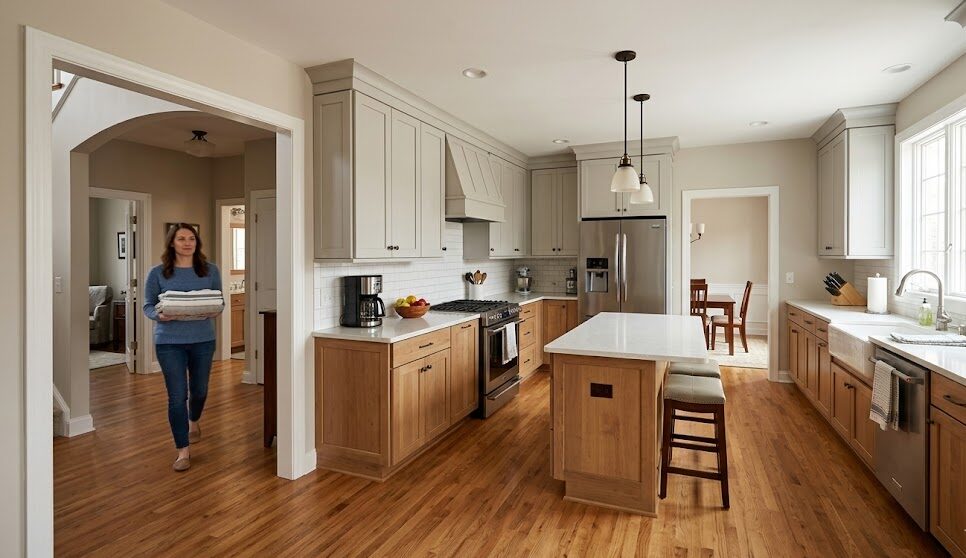
Kitchen Door and Walkway Clearances: Avoiding Pinch Points
Kitchen clearances are one of those “invisible” decisions that determine whether your remodel feels effortless—or frustrating.
On paper, a layout can look perfect. In real life, you’re carrying groceries, unloading a dishwasher, opening the fridge, helping kids, and moving past someone cooking. That’s where tight walkways and bad door swings show themselves.
In this homeowner-friendly guide, you’ll learn:
- the most important kitchen clearances for doorways and walkways,
- how to plan aisle widths around islands, ranges, and sinks,
- how to test door swings (fridge, dishwasher, ovens, pantry doors),
- where “pinch points” happen most often—and how to avoid them,
- and a practical checklist you can use before ordering cabinets and appliances.
The Fortress Builders is a Utah design–build company built on “strength through structure.” Every project begins with a detailed design blueprint that aligns vision, budget, and timeline—so you can lock layout decisions early and avoid expensive changes later.
Helpful internal pages while you plan:
- Kitchen Remodeling in Utah: Built to Last
- Design and Layouts for Kitchens
- Work Triangle vs. Work Zones: Which Kitchen Layout Works Best?
- Kitchen Island Size Guide: Clearances, Seating, and Storage
- Built-In Appliances: Layout Tips for Fridges, Wall Ovens, and Microwaves
- Timeline and What to Expect
- Request a Design Consult
What “kitchen clearances” actually means
In remodel planning, “clearances” are the usable spaces that allow people, doors, drawers, and appliances to operate without collisions.
Clearances aren’t about perfection—they’re about preventing daily friction, like:
- the dishwasher blocking the only walkway,
- the fridge door hitting an island stool,
- two people not being able to pass each other when the oven is open,
- or a pantry door colliding with a cabinet pull-out.
Homeowner takeaway: A kitchen layout that “meets minimums” can still feel cramped. The goal is to plan clearances that work for your household’s real routines.
The 4 clearance zones that matter most
If you only check four things before finalizing a kitchen design, make it these:
- Main walkways: the paths through the kitchen to get from room to room.
- Work aisles: the space between opposing counters (or island and perimeter).
- Appliance operation space: what happens when doors open (fridge, dishwasher, ovens).
- Seating + pass-through space: where stools, knees, and people overlap with traffic flow.
This aligns closely with work-zone thinking. If you want a quick framework first: Work Triangle vs. Work Zones.
Kitchen walkway width: what to aim for (and why it changes)
Walkway width isn’t a single magic number because it depends on whether the space is:
- a through-walkway (people pass through),
- a work aisle (people stand and work),
- or a work aisle with appliances opening into it.
Practical targets most homeowners find comfortable:
- ~36″ minimum for a simple pass-through walkway (tight in real life).
- ~42″ for a family kitchen work aisle (more comfortable with traffic).
- ~48″ when two people regularly work/pass, or when doors frequently open into the aisle.
Reality check: the “best” width is the one that matches your daily traffic level and your appliance door swings.
Where pinch points happen most often
1) The dishwasher pinch point
Dishwashers open straight down into the aisle. If the aisle is too tight, one open dishwasher can shut down the kitchen.
What to check:
- Can someone pass behind an open dishwasher?
- Can you still open the fridge or a cabinet door while the dishwasher is open?
- Is there a clear unload path to upper cabinets and drawers?
Built-in appliances and door swings matter more than most people expect. Related: Built-In Appliances: Layout Tips for Fridges, Wall Ovens, and Microwaves.
2) The fridge door + island stool collision
This is one of the most common remodel mistakes: the fridge door opens right into the stool zone (or hits an island corner).
What to check:
- Fridge door swing clearance (especially with counter-depth fridges).
- Whether drawers inside the fridge can open fully.
- Whether the path from fridge → sink/prep is direct (without cutting through seating).
3) The range/oven “hot door” conflict
Oven doors swing down into the work aisle—right where people walk. In busy kitchens, someone inevitably tries to pass right behind the cook.
What to check:
- Space behind the cook when the oven is open.
- Whether the main walkway runs directly behind the range.
- Where kids/pets tend to move through the kitchen (and how to route them around the cook zone).
4) Pantry and interior door conflicts
Pantry doors and nearby interior doors can collide with cabinet doors, pull-outs, or appliances—especially if the kitchen is near a garage entry or hallway.
What to check:
- Does the pantry door hit a cabinet pull-out when opened?
- Do two doors open into the same space (kitchen + pantry, kitchen + laundry)?
- Is the doorway wide enough for two-way traffic during meal prep?
Island clearances: the three measurements you must validate
Islands add storage and seating—but they also create the most common clearance problems. Before finalizing an island, validate:
1) Island-to-perimeter work aisle
This is the main work aisle where most cooking and clean-up happens.
Best practice: Use your household traffic level to decide whether you’re aiming closer to 42″ (family comfort) or 48″ (two-person workflow and heavy traffic).
Helpful guide: Kitchen Island Size Guide: Clearances, Seating, and Storage.
2) Seating clearance behind stools
Stools aren’t just “chairs.” They create a knee zone and a push-back zone.
- Can someone walk behind a seated person without squeezing?
- Do seated kids block the path to the fridge or pantry?
- Does the stool zone overlap a doorway?
3) Door swings + appliance doors into the island zone
Test the fridge door, dishwasher door, oven door, and any nearby doors in the home—then overlay the island footprint. This is where “pinch points” show up fast.
Quick planning mantra: Don’t design the island first. Design the aisles first. The island is what fits after the aisles work.
Door swings: how to check them the right way
Door swings are easier to catch early than to fix later. Here’s a homeowner-friendly way to check them:
Door Swing Checklist (do this before ordering cabinets):
- Refrigerator: door swing + internal drawer clearance + landing zone for groceries.
- Dishwasher: open door + pass-through space + unload path.
- Wall oven: open door + safe pass space behind cook.
- Microwave drawer / speed oven: pull-out clearance (don’t block an aisle).
- Pantry door: open door without colliding with pull-outs or appliance handles.
- Nearby interior doors: garage entry, laundry, basement, hallway doors opening into the kitchen zone.
Appliance planning often solves 80% of clearance problems. Related: Built-In Appliances Planning.
Walkways, zones, and why “traffic flow” is the hidden deal-breaker
Many kitchens fail not because they’re too small—but because the traffic path cuts through the work zone.
Examples:
- Kids use the cook aisle as the fastest route to snacks.
- Guests pass behind the cook to get to the backyard.
- The pantry is placed so every meal requires crossing the clean-up zone.
Fix the traffic path before you “decorate” the kitchen
When Fortress Builders plans kitchens, we treat traffic flow as a design constraint. That’s why layout guidance lives here: Design and Layouts for Kitchens.
Common clearance mistakes (and how to avoid them)
Mistake 1: Choosing the island size before the aisle size
Homeowners often pick a big island, then “force” the aisles to fit. This creates pinch points that never go away.
Fix: Choose aisle clearances first, then size the island to what the room can comfortably support.
Mistake 2: Ignoring “two-doors-open” scenarios
A kitchen can look fine until two things open at once (dishwasher + fridge, oven + pantry, etc.).
Fix: Test common overlaps on your plan—especially during peak times (breakfast and dinner).
Mistake 3: Putting seating in the main traffic lane
If stools are in the route from fridge to pantry or kitchen to backyard, your kitchen will feel crowded even when it’s not.
Fix: Route traffic around seating—not through it.
Practical pre-order checklist: lock these decisions before cabinets
Use this checklist before you order cabinets or schedule demo:
- Main walkways: Do you have a clear path through the kitchen without crossing the cook zone?
- Work aisle widths: Are you closer to “minimum” or “comfortable” based on your household traffic?
- Dishwasher: Can someone pass when it’s open? Can you unload without blocking traffic?
- Fridge: Does the door open fully without hitting stools or island corners? Can drawers open?
- Oven/range: Does an open oven door create a bottleneck behind the cook?
- Pantry door: Does it collide with cabinet doors, pull-outs, or appliance handles?
- Seating: Is there pass space behind seated people?
- Landing zones: Do you have a place to set groceries, dishes, and hot pans without crossing paths?
- Lighting/electrical: Are switch locations and lighting planned to match the final layout?
How clearances connect to budget and timeline (and why planning saves money)
Clearance mistakes are expensive because they often show up late—after cabinets are ordered or after rough-ins are done. Fixing them can mean:
- re-ordering cabinets,
- moving plumbing or electrical,
- changing appliance selections,
- or redesigning an island after flooring is installed.
This is why Fortress Builders emphasizes early planning. If you want to understand how remodel phases fit together, start here: Timeline and What to Expect.
Want a second set of eyes on your kitchen layout before you commit?
If you’re planning a kitchen remodel in Davis or Weber County, Fortress Builders can review your layout for door swings, aisle widths, and pinch points—so your finished kitchen feels comfortable, not crowded.
Request a Design Consult Explore Kitchen Remodeling Island Size & Clearances
Bring a rough floor plan (even hand-drawn), your appliance list, and a few photos of the space. We’ll help you lock the layout before ordering materials or starting demo.