

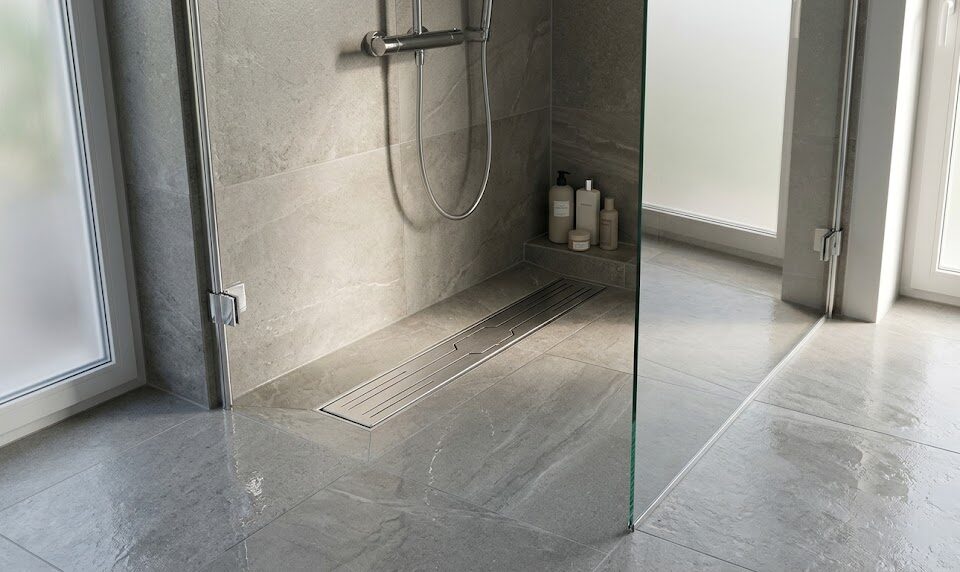
Linear Drain vs. Center Drain: Which Is Better for a Walk-In Shower?
Bathrooms fail fast when layout, moisture control, and details are not planned early, and drain choice is one of the most overlooked details in a walk-in shower.
This guide explains linear drain vs. center drain in plain English and highlights the decisions worth making before you commit. The short answer is that neither drain style is automatically “better” in every bathroom. A linear drain can be a smart choice when the shower design is aiming for a more streamlined look, large-format tile, or a curbless entry strategy that benefits from single-direction slope. A center drain often remains a very strong choice because it is familiar, practical, widely compatible with many layouts, and can be cost-effective and reliable when the shower is built correctly. The better option depends on waterproofing strategy, slope planning, tile format, cleaning expectations, curb or curbless design, and how disciplined the installation team is with details.
That is why the drain decision should never be treated as just a cosmetic finish choice. A walk-in shower does not succeed because the drain looks modern. It succeeds because the shower is designed as a complete water-management system from substrate to slope to tile to edge details. If that planning is weak, neither a linear drain nor a center drain will save the shower. If the planning is strong, either option can work beautifully in the right situation.
The Fortress Builders approaches remodeling through one core principle: strength through structure. Every project begins with a design blueprint that aligns client goals, layout constraints, budget, and build sequence before materials are ordered. That structure matters here because drain location affects slope geometry, waterproofing details, tile layout, glass placement, cleaning experience, and how the entire shower performs over time. The best results come when those questions are answered early instead of being improvised once tile work is already moving.
- How linear drains and center drains actually differ in a walk-in shower
- Why waterproofing and slope planning matter more than the visible drain grate alone
- How tile size, grout lines, and texture affect maintenance and drain performance
- Which shower details should be coordinated early with the drain plan
- What red flags to watch for before and during installation
Why drain choice matters more than many homeowners expect
Many homeowners think about the shower drain only after bigger decisions like tile, glass, or fixtures. But the drain influences the whole floor strategy of the shower. It affects how the floor slopes, how water is guided, what tile sizes are practical, how clean the shower is likely to look, and whether the entry can be designed in a more open or curbless way. That makes the drain part of the shower’s structure, not just part of its appearance.
This is especially important in walk-in showers, where the room often depends on clean geometry and reliable water control to feel comfortable and durable. A poor drain plan can lead to awkward tile cuts, a floor that feels visually busy, slower drainage, puddling, or edges that never quite feel resolved. A good drain plan helps the shower feel calm, intentional, and easier to live with.
Slope Planning
The drain location changes how the shower floor has to be pitched and how the tile layout responds to that pitch.
Water Management
The drain is part of how the whole shower handles water, not a separate piece added after the waterproofing logic is set.
Tile Compatibility
Certain drain strategies pair more naturally with larger-format tile, while others work especially well with smaller floor tile.
Maintenance Feel
Drain choice can influence how easy the shower is to keep clean and how visible buildup becomes over time.
Curbless Potential
Drain placement often becomes more important in curbless and barrier-free shower designs where water control is critical.
Install Sensitivity
A beautiful drain still depends on disciplined waterproofing, proper slope, and clean execution to perform well.
Understand the waterproofing system behind the tile first
The first mistake to avoid is comparing drain styles as if they sit outside the waterproofing discussion. They do not. A shower works when the drain, waterproofing system, slope, drain connection, and tile assembly are all coordinated as one system. That is why homeowners usually benefit more from understanding the shower as a whole than from obsessing over which grate shape looks more modern.
Tile is the finish, not the waterproofing plan
Whether the shower uses a linear drain or a center drain, the real durability comes from what is behind the tile: waterproof membranes, drain integration details, slope execution, and the handling of penetrations and transitions.
Drain selection should follow system compatibility
Some showers can support either drain strategy well, but the right answer still depends on how the shower is being built and what details need to align for the assembly to work long-term.
Drain choice does not override workmanship
A premium drain does not fix weak waterproofing, poor slope, or sloppy installation. The whole shower still has to be built with discipline.
The better drain is the one that fits the shower’s waterproofing and slope strategy cleanly, not simply the one that looks more high-end in a product photo.
That is why the drain discussion belongs alongside tile and waterproofing systems, shower waterproofing basics, and walk-in shower planning.
Linear drains: where they shine, and where they ask more from the plan
Linear drains are often chosen for their clean, modern appearance and for how they can support a single-direction floor slope. That makes them appealing in walk-in showers, especially in curbless applications or in designs where large-format tile is part of the goal. Because the drain usually sits along one edge or at the entry side of the shower, the floor can often pitch in a more uniform direction rather than sloping inward from all sides.
Where linear drains often make sense
They are often compelling in modern bathrooms, in showers designed with larger floor tile, and in curbless showers where the single-slope approach can simplify some aspects of the floor geometry and visual layout.
Why homeowners find them attractive
Many people like the look of a linear drain because it can make the shower floor feel calmer and less interrupted. In the right installation, it can also support cleaner tile layouts with fewer small cuts.
Where they ask more attention
Linear drains still require careful slope execution, cleaning access, and coordination with the full waterproofing system. They are not automatically easier just because they look streamlined.
| Linear Drain Strength | Why It Appeals to Homeowners |
|---|---|
| Single-Direction Slope | Often works well with cleaner floor geometry and can simplify the visual feel of the shower floor |
| Large-Format Tile Compatibility | Can pair naturally with larger tile because the slope is often easier to manage in one direction |
| Modern Look | Many homeowners prefer the more minimal appearance of a linear grate in a contemporary shower |
| Curbless Appeal | Frequently considered in barrier-free shower designs where controlling the plane of the floor matters a great deal |
- the shower is designed around a clean, modern floor layout
- the project wants to use larger floor tile in the shower
- a curbless or very open shower design is part of the plan
- the waterproofing and slope strategy are being coordinated carefully from the start
- the homeowner is prepared to evaluate cleanout and maintenance details, not just appearance
Center drains: why they still remain a strong and practical choice
Center drains remain very common for a reason. They are familiar, broadly compatible with many shower layouts, and can perform extremely well when the shower floor is sloped correctly and the waterproofing details are executed properly. In many bathrooms, a center drain is not the “basic” option in a negative sense. It is simply the logical option.
Where center drains often make sense
They are often a strong fit in standard curb or walk-in showers where the floor is being built around smaller-format tile and where the shower design does not need the aesthetic or geometric advantages of a linear drain.
Why they remain practical
Center drains work within a long-standing and widely understood shower-floor logic. Many installers are deeply familiar with them, and they can integrate well into a wide range of layouts without forcing the project into a more design-specific drain strategy.
What the homeowner should remember
A center drain is not a downgrade. It is often the better choice when it fits the floor plan, tile strategy, and budget more cleanly than a linear drain would.
Broad Compatibility
Center drains work well in many shower sizes and formats, especially when the floor uses smaller tile suited to multidirectional slope.
Familiar Geometry
The slope pattern is widely understood, which can make planning and execution feel more straightforward in many showers.
Strong Practical Value
For many homeowners, a center drain delivers excellent performance without asking the shower to adopt a more design-specific system.
Reliable Choice
When paired with proper waterproofing and a disciplined tile layout, a center drain can be a very durable long-term solution.
A center drain is often the smarter choice when the shower does not need what a linear drain offers and when the classic floor-slope logic fits the room more naturally.
Drainage and slope basics that prevent leaks and puddling
One of the biggest reasons homeowners should care about drain type is that it changes how the shower floor is sloped. A linear drain often allows the floor to pitch more like a single plane. A center drain usually asks the floor to pitch inward from multiple directions. Neither approach is wrong, but each one changes tile layout, edge conditions, and what the floor needs to do to move water consistently.
Linear drains often simplify the slope plane
This can be a design advantage, especially when the project wants fewer floor interruptions or larger tile pieces.
Center drains often pair naturally with smaller floor tile
Because the floor is sloping from multiple directions, smaller tile usually adapts more comfortably to that geometry without awkward lippage or strained cuts.
Good drainage depends on execution, not theory alone
The correct slope, proper drain integration, and well-built transitions matter more than which drain category was chosen on paper.
- the drain style changes how the floor should pitch
- the tile size should support the slope pattern, not fight it
- water should be guided intentionally, not left to chance or wishful flat spots
- curbless and walk-in showers need especially disciplined water-control planning
- details vary by system and project, so final methods should be confirmed with qualified professionals and local authorities where applicable
This is why related pages like curbless shower planning and tile and waterproofing systems are so important when evaluating drain choice.
Tile size, texture, and grout decisions affect maintenance more than many homeowners expect
Drain choice and tile choice should not be separated. One of the most practical homeowner questions is not simply “Which drain looks better?” but “Which drain works better with the tile we want and the maintenance level we can live with?” This is where many shower plans either become elegantly coordinated or quietly frustrating.
Linear drains often pair well with larger floor tile
Because the floor may slope in a simpler direction, larger tile can sometimes fit the geometry more gracefully and give the shower a cleaner, calmer look.
Center drains often pair well with smaller shower-floor tile
Smaller tile adapts more easily to multidirectional slope and can help support good traction in wet conditions.
Grout and texture still matter
Even the most beautiful tile choice can become a maintenance headache if the texture, grout strategy, and wet-floor performance were not considered realistically.
| Tile Consideration | Why It Matters to Drain Choice |
|---|---|
| Large-Format Tile | Often aligns more naturally with linear-drain slope strategies in walk-in showers |
| Small Mosaic Floor Tile | Often works especially well around center-drain slope geometry and can improve slip resistance |
| Grout Lines | More grout can mean more maintenance, but also greater flexibility on a sloped shower floor |
| Texture and Slip Resistance | Wet-floor comfort and safety should still guide the shower-floor tile choice regardless of drain style |
- choose floor tile that cooperates with the slope strategy
- do not separate appearance decisions from traction and cleaning expectations
- remember that more grout can mean more maintenance but also more flexibility
- evaluate tile, drain, and waterproofing as one coordinated floor system
- if tile safety, cleaning, or performance questions apply, review specifics with qualified professionals
These choices connect directly to bathroom tile slip-resistance planning and low-maintenance grout planning.
Niches, benches, glass, and edge details should be planned with the drain, not after it
Drain location influences more than the floor. It can also shape how the rest of the shower comes together. Benches, niches, glass panels, curb details, and curbless thresholds all need to respond to the shower’s water flow and floor geometry. That is why the drain should be settled before these details are treated as final.
Niches and benches affect the waterproofing picture
They are not independent accessories. Their placement interacts with the wet-zone design and should be thought through as part of the system.
Glass placement should support water control
An open shower looks clean on paper, but the splash pattern and drain strategy still need to work together in the real room.
Edges and transitions are where great showers often separate themselves
The strongest showers usually feel resolved because the drain, floor, tile cuts, threshold, and glass all look like they were planned together from the beginning.
Shower Niches
Need to be coordinated with waterproofing and tile layout, not just centered visually on a wall.
Benches and Shelves
Can add comfort and storage, but they also increase the need for disciplined water-management details.
Glass Placement
Should support splash control and entry comfort rather than simply following a trendy open-shower look.
Thresholds and Edges
Drain style, slope, and shower entry all influence whether the edge details feel resolved or improvised.
This is why related planning pages like shower niches and shelves, curbless shower planning, and walk-in shower design matter so much in this comparison.
Red flags to watch for during install
Homeowners do not need to become shower-build experts, but it helps to know the kinds of warning signs that suggest the drain and floor system are not being coordinated as carefully as they should be.
The drain is being discussed like an isolated product
If the conversation is only about grate style and not about waterproofing, slope, and floor geometry, the planning is probably too shallow.
The tile choice and slope strategy do not seem coordinated
A mismatch here often leads to awkward cuts, lippage, or a floor that never feels as refined as the homeowner expected.
No one is clearly explaining how water will move through the shower
If the path of water, slope, and drain logic are vague, the room may be headed toward avoidable performance issues.
Cleanout and maintenance are being ignored
Any drain that looks great but is hard to maintain can become less satisfying over time.
Threshold and glass details are being finalized too late
Those details should reinforce the drain and slope plan, not force last-minute compromises after tile work is already moving.
When the shower team can explain the drain, slope, waterproofing, tile, and edge details as one integrated system, that is usually a good sign the planning is where it needs to be.
So which is better: linear drain or center drain?
For many homeowners, the best answer is not “linear is better” or “center is better.” The better answer is: which one supports the shower design you are actually building? If the shower is modern, potentially curbless, and designed around a cleaner single-slope floor with larger-format tile, a linear drain may be the stronger fit. If the shower uses a more traditional floor plan, smaller shower-floor tile, and does not need the design-specific benefits of a linear drain, a center drain may be the smarter and more practical choice.
That is what makes this a planning decision, not a trend decision. The drain should fit the shower, the waterproofing system, the tile, and the homeowner’s maintenance expectations. Once those are clear, the better option usually becomes much easier to see.
- linear drains often shine in curbless or highly design-driven walk-in showers
- center drains remain strong, practical choices for many standard shower layouts
- tile size and slope geometry should support the drain, not fight it
- the shower will only perform as well as the waterproofing and installation behind it
- when in doubt, prioritize the system over the trend