

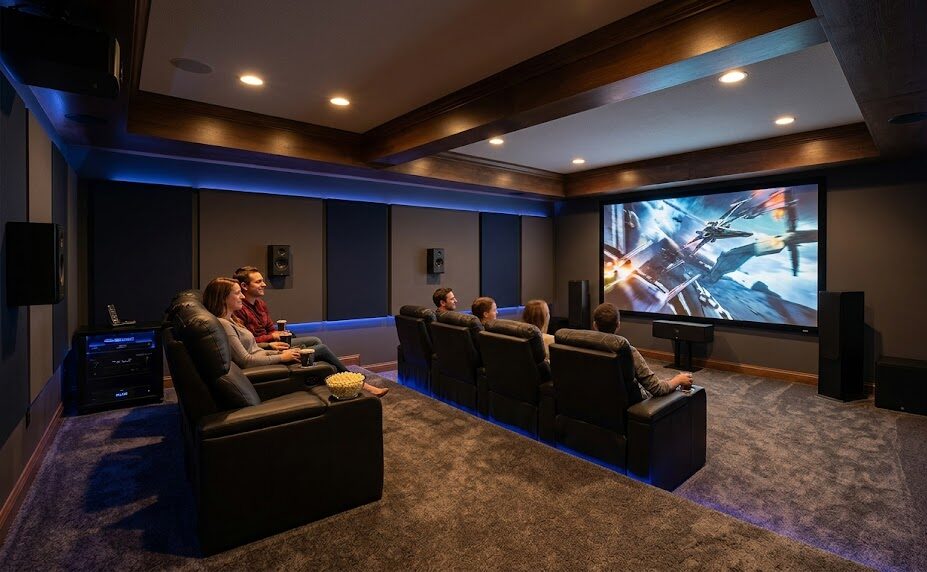
Basement Home Theater Design & Build in Davis & Weber Counties
A basement home theater can become one of the most enjoyable rooms in the house—but only when it is designed for more than a big screen and a dark paint color. The best theater spaces work because layout, seating, sound control, lighting, comfort, and equipment planning are all handled together from the start.
That is why strong basement home theater design is not really about buying expensive gear first. It is about understanding how the room should feel, how people will use it, what the basement can realistically support, and how to avoid the common mistakes that turn a promising movie room into an awkward, echoey, underused lower-level space.
In this guide, you’ll learn:
- how to approach basement theater planning before construction begins,
- how seating layouts, sightlines, and screen walls shape the room,
- why theater seating acoustics lighting should be planned as one connected system,
- what comfort, sound, and electrical decisions matter most in a basement theater,
- and how to create a home theater basement layout that feels immersive, flexible, and built to last.
The Fortress Builders approaches basement remodeling through a design-build process rooted in one principle: strength through structure. That means a basement theater is planned as part of the whole lower-level experience—comfort, lighting, sound, circulation, and construction sequencing included—rather than treated like a media room idea that gets figured out after the walls are already closed.
Helpful Fortress Builders pages while you plan:
Why a basement is such a natural place for a home theater
Basements often lend themselves well to movie rooms because they already offer some of the conditions homeowners want for an immersive viewing experience. They tend to be more separated from the busiest main-floor spaces, often have less natural light to fight against, and can be planned around entertainment without disrupting the everyday rhythm of kitchens, living rooms, or bedrooms upstairs.
That does not mean every basement automatically makes a great theater. But it does mean the lower level often gives homeowners a strong starting point for a dedicated or semi-dedicated media environment.
- Less daylight interference: darkening the room is often easier than in main-floor spaces.
- Better separation: movie watching, gaming, and louder audio can be kept farther from the center of the home.
- More flexibility: basements often allow for deeper seating, larger screens, and more intentional acoustics planning.
- More value from finishing: a theater can become a major reason the finished basement gets used regularly.
Homeowner takeaway: A basement theater works best not because it is below grade, but because the basement can be designed around immersion, comfort, and control in a way many upstairs rooms cannot.
Basement theater planning should start with how the room will really be used
Before choosing a projector, screen size, or theater seats, it helps to define what kind of theater you actually want. Some households want a fully immersive movie-first room. Others want a flexible media basement that handles movies, sports, gaming, and gathering. The layout and technical priorities change depending on that answer.
Movie-first theater rooms
These usually prioritize the screen wall, sightlines, acoustic control, lighting isolation, and seating comfort above all else.
Family media rooms
These often need more flexibility. The room may still feel cinematic, but it also has to support casual hanging out, kids, games, or multi-purpose basement living.
Hybrid theaters with bar or lounge support
Some basements combine a theater zone with a bar, game area, or open family room. In that case, zoning and sound control become even more important because the theater cannot just assume the whole basement is dedicated to one activity.
The 5-minute basement theater profile
- Is this room mainly for movies, or for mixed entertainment use?
- How many people should it seat comfortably most of the time?
- Does the room need one row of seating or two?
- Will the space need to feel theater-dark, family-casual, or both?
- How much does sound containment matter to the rest of the basement or house?
Why this matters: These answers shape the layout, acoustic strategy, lighting plan, and comfort priorities far more than equipment shopping alone.
Home theater basement layout: give the room the right shape and priorities
A basement theater does not begin with the screen. It begins with the room. The shape, depth, ceiling conditions, and circulation paths all influence whether the theater will feel intentional or compromised. That is why home theater basement layout planning should happen before product decisions get too far ahead.
Choose the best part of the basement for the theater
The theater zone should usually get the portion of the basement that supports the cleanest sightlines, the most sensible wall for the screen, and the least interruption from awkward traffic paths.
Protect the screen wall
The screen wall is one of the biggest anchor decisions in the room. It should not have to compete with doorways, major windows, or awkward furniture compromises if that can be avoided.
Think about entry and movement
People need to enter and move through the room without disrupting the whole experience. This matters even more when the theater includes multiple seating rows or is integrated into a larger basement plan.
Best practice: The strongest theater layouts feel simple when you are sitting in them because the difficult decisions about walls, paths, and priorities were handled early in the design.
Screen wall planning: size, position, and what the room can really support
Homeowners often start by saying they want “the biggest screen possible.” In practice, the better question is what size screen the room can support comfortably and convincingly. Bigger is not always better if it overwhelms seating distance, wall proportions, or the overall feel of the room.
Screen size should match viewing distance
A good theater feels immersive, not uncomfortable. The relationship between seat placement and screen size matters more than size alone.
The screen wall should feel anchored
A theater room usually works best when the screen wall feels intentional and visually centered, not squeezed into an awkward leftover area.
Keep visual clutter low near the focal wall
Too many distractions around the screen can weaken the theater effect. The room should help the eye settle where it belongs. Related resource: Home Theater Basics: Screen Wall, Seating Distance, and Sightlines.
| Screen-Wall Priority | Why It Matters |
|---|---|
| Correct wall placement | Creates better sightlines and stronger room focus |
| Screen size matched to seating distance | Helps the room feel immersive without visual strain |
| Low visual distraction | Keeps the room feeling cinematic instead of cluttered |
| Balanced room proportions | Makes the theater feel intentional rather than forced into the basement |
Theater seating acoustics lighting: why these three should be planned together
Seating, acoustics, and lighting are often discussed separately, but in a basement theater they interact constantly. A room with the wrong seating depth makes the screen feel wrong. A room with poor acoustics makes the audio feel disappointing. A room with weak lighting control never feels fully cinematic even if the equipment is good.
Seating depth changes the whole room
The number of rows, the spacing between them, and how people move in and out of them all affect whether the room feels generous or cramped.
Acoustics affect comfort, not just performance
Bad sound is not only a technical issue. It changes how relaxing and immersive the room feels over time.
Lighting control sets the mood
The best theater rooms can move from practical pre-show brightness to low-light cinematic comfort smoothly, without feeling either harsh or unsafe.
Simple rule: A basement theater succeeds when seating, sound, and light all tell the room the same story: sit down, settle in, and stay awhile.
Seating layouts: one row, two rows, and circulation that still works
Homeowners are often tempted to maximize seat count, but a great theater room is rarely defined by the most chairs possible. It is defined by seats that actually work—comfortable viewing, clean access, and enough space that the room still feels enjoyable during long movies.
Single-row theaters
These often feel cleaner, more open, and easier to integrate into mixed-use basement spaces. A single strong row can outperform two compromised rows.
Two-row theaters
These can be a great option when the room depth supports them properly. But they require more careful attention to sightlines, walking paths, and the relationship between the front and rear rows.
Do not ignore entry paths
People need to reach their seats without making the room feel like a maze. That is one reason circulation deserves just as much thought as the chairs themselves.
Seating planning checklist
- How many seats does the room need most of the time, not only at maximum?
- Will one good row outperform two crowded ones?
- Can people enter, sit, and move around without disrupting the whole room?
- Are the seats positioned for comfortable viewing rather than just capacity?
- Does the layout still leave room for acoustic and lighting strategy to work properly?
Sightlines are one of the most important design details in the room
Even a high-end theater can feel frustrating if sightlines are weak. If one row sees the screen beautifully and another row feels compromised, the room may never feel as successful as it should. Sightlines should be solved in the planning stage, not left to chance after the chairs arrive.
Every seat should feel considered
The goal is not just to make the best seat good. It is to make the room feel thoughtfully designed for everyone who will use it.
Two-row layouts require extra care
Rear seating should still feel included rather than like an afterthought placed wherever the room happened to allow.
Ceiling height and room depth can influence sightline comfort
This is another reason why the theater should usually be given the portion of the basement that offers the cleanest viewing geometry rather than only the leftover corner with the fewest other uses.
Best practice: Sightlines should feel obvious and effortless by the time the room is finished. If they still feel “close enough,” the layout probably needed more refinement earlier.
Acoustics planning: the theater should sound good inside and behave better outside
When homeowners think about basement theaters, they often focus on speaker quality first. But the room itself shapes the sound more than many people expect. A strong theater needs acoustic control inside the room and some level of sound containment relative to the rest of the basement or house.
Room sound quality matters
A theater that feels echoey, overly reflective, or acoustically harsh can undermine even strong equipment.
Sound containment matters too
If the theater is close to guest rooms, offices, or active family zones, sound bleed can become one of the room’s biggest frustrations.
Acoustics should be planned before finishes go in
Once the room is framed, drywalled, and decorated, the easiest chances to improve acoustic performance are largely behind you. Related resource: Basement Soundproofing Strategies.
Questions to ask about theater acoustics
- Does the room need to contain sound from disturbing the rest of the basement?
- Will the ceiling need extra attention because of activity above?
- Is this a dedicated movie room or a mixed-use entertainment space?
- Will the theater sit next to bedrooms, offices, or guest spaces?
- Are the wall, ceiling, and finish choices supporting or fighting the sound goals?
Lighting design is what helps the room feel like a theater
A basement theater does not need to be pitch-black at all times, but it does need better lighting control than a normal lounge space. This is where the room often shifts from “TV area” to “theater.”
General light for arrival and cleanup
The room still needs practical light when entering, cleaning, adjusting seats, or hosting a group before the movie starts.
Low-level light for safe movement
A theater should be able to stay navigable without destroying the viewing experience.
Accent or step-style lighting can add both mood and usability
When used thoughtfully, subtle lighting layers make the room feel richer and more custom without overcomplicating the ceiling. Related resource: Basement Lighting for Low Ceilings.
Practical truth: A basement theater should feel different when the movie starts. Lighting is one of the biggest reasons that transition feels cinematic instead of casual.
Comfort planning: temperature, air, and staying in the room for a full movie
A theater room should not only look immersive. It should feel easy to stay in for two hours or more. That means comfort deserves real attention. A room that is stuffy, chilly, noisy from above, or slightly cramped will never feel fully successful even if the screen and speakers are impressive.
Basement HVAC comfort still matters
Because theaters often involve multiple people sitting in one room for extended periods, airflow and temperature consistency can become more noticeable than in other basement spaces.
Seat comfort and room comfort are different things
Even luxurious chairs cannot make up for a room that feels stale, too cool, or acoustically fatiguing.
Quiet contributes to comfort
Theater comfort is not only about softness and temperature. It is also about the room feeling calm enough that the movie experience takes over.
| Theater Comfort Issue | Why It Matters |
|---|---|
| Temperature balance | Long viewing sessions make even small comfort issues more noticeable |
| Air movement | Helps the room feel fresher and more enjoyable over time |
| Noise from above or adjacent spaces | Can break immersion quickly even if the picture and audio are strong |
| Seat spacing and room ease | Affects whether the theater feels premium or cramped |
Basement theaters work best when they fit the rest of the basement plan
Even a dedicated home theater still lives inside a larger basement. That means the room’s placement relative to bars, bathrooms, bedrooms, offices, and circulation paths matters. A theater that ignores the rest of the basement often creates avoidable conflicts.
Protect quieter spaces from the theater when possible
If the basement includes bedrooms, guest rooms, or offices, theater placement and sound strategy should respect that early.
Support entertaining flow
In mixed-use basements, the theater may work best near a lounge or bar area, but still separated enough that movies do not compete constantly with open social traffic.
Do not sacrifice the whole basement to one room unless the theater is truly the priority
The strongest design balances the theater’s needs with the rest of the lower level’s function.
Simple rule: A great basement theater should elevate the lower level, not make the rest of the basement harder to live with.
Electrical, equipment, and technical planning deserve early coordination
Basement theaters are more equipment-sensitive than many other basement spaces. Screen wall planning, speaker locations, control needs, power strategy, lighting controls, and device placement all benefit from being resolved before the room is closed up.
Plan for what the room needs, not only what the gear list says today
Technology changes, layouts evolve, and homeowners often refine their setup over time. A well-planned room gives some flexibility for that.
Keep the room visually calm
Good theater design makes the equipment feel integrated instead of scattered.
Requirements vary by room scope and equipment plan
Electrical, low-voltage, equipment support, lighting-control, and code-related details can vary depending on the project and local requirements. Final details should always be confirmed with qualified professionals and local authorities where applicable.
Important note: Electrical layout, equipment support, low-voltage needs, lighting-control strategies, permits, inspections, and other technical requirements can vary by project scope, home conditions, and local jurisdiction. Final decisions should always be confirmed with qualified professionals and local authorities where applicable.
Common basement theater mistakes homeowners regret later
Mistake 1: Buying equipment before the room plan is solved
A great theater is room-first, gear-second. Otherwise the room ends up bending awkwardly around purchases instead of supporting them well.
Mistake 2: Overcrowding the room with seating
More seats are not always better. A cramped theater often feels less premium and less enjoyable.
Mistake 3: Underestimating acoustics and sound containment
Even good speakers can disappoint in a room that was not planned to sound right.
Mistake 4: Treating lighting as an afterthought
A theater without proper lighting control rarely feels as immersive as homeowners hoped.
Mistake 5: Ignoring the rest of the basement
A theater still has to coexist with the basement’s circulation, bedrooms, guest use, or entertaining flow.
Practical truth: The basement theater homeowners love most is rarely the one with the longest product list. It is usually the one where the room, seating, sound, and comfort were planned to work together from the start.
How Fortress Builders would approach a basement home theater
A strong basement home theater design process begins by asking what the room should do, how cinematic it should feel, and how it fits the whole basement plan. From there, the focus shifts to layout, screen wall, seat count, acoustics, lighting, comfort, and technical coordination.
That usually means:
- giving the theater the best room or zone for sightlines and comfort,
- resolving seating and movement before finishes are locked in,
- planning acoustic control before drywall closes opportunities,
- using lighting to support both function and atmosphere,
- and coordinating the theater so it strengthens the entire finished basement rather than competing with it.
When those pieces come together early, the result feels more immersive, more comfortable, and more clearly built with intention.
FAQ: Basement home theater design and build
What is the best layout for a basement home theater?
The best layout usually gives the room a clean screen wall, comfortable seating distance, clear circulation, and enough acoustic and lighting control to support immersive viewing. The right answer depends on the basement’s size and how dedicated the theater will be.
How many seats should a basement theater have?
Enough to support how the household will actually use the room most of the time. In many cases, one strong row or two well-planned rows are better than trying to maximize capacity at the expense of comfort and sightlines.
Do I need soundproofing for a basement theater?
In many cases, yes—or at least some level of acoustic and sound-containment planning. This is especially important if the theater sits near bedrooms, offices, or spaces where quiet matters.
Should theater lighting be on dimmers?
Usually yes. Lighting control is one of the most important parts of making the room feel cinematic and flexible rather than either too dark to navigate or too bright to feel immersive.
When should I plan the theater during a basement remodel?
As early as possible. Seating, screen wall, acoustics, lighting, and technical support all work best when they are built into the basement plan before framing and finishes are finalized.
Conclusion: a great basement theater is designed as a room, not assembled as equipment
Basement home theater design works best when the room is treated as a complete environment. The seating, screen wall, acoustics, lighting, comfort, and circulation all matter because the room is the experience. Equipment helps, but the room is what makes the theater actually feel worth using again and again.
That is what separates a good-looking movie room from a basement theater that really works. It is not only about what you install. It is about what you plan early enough to support the experience long term.
Thinking about building a basement theater that feels truly immersive?
If you’re finishing a basement in Davis or Weber County, Fortress Builders can help you think through seating layouts, screen-wall planning, acoustics, lighting, sound control, and the construction decisions that turn a lower-level room into a real theater experience.
Request a Design Consult Explore Basement Finishing Read the Theater Basics Guide
Bring your basement layout, your entertainment goals, and the way you want the room to feel. Fortress Builders can help turn that into a basement theater plan that is comfortable, functional, and built to last.