

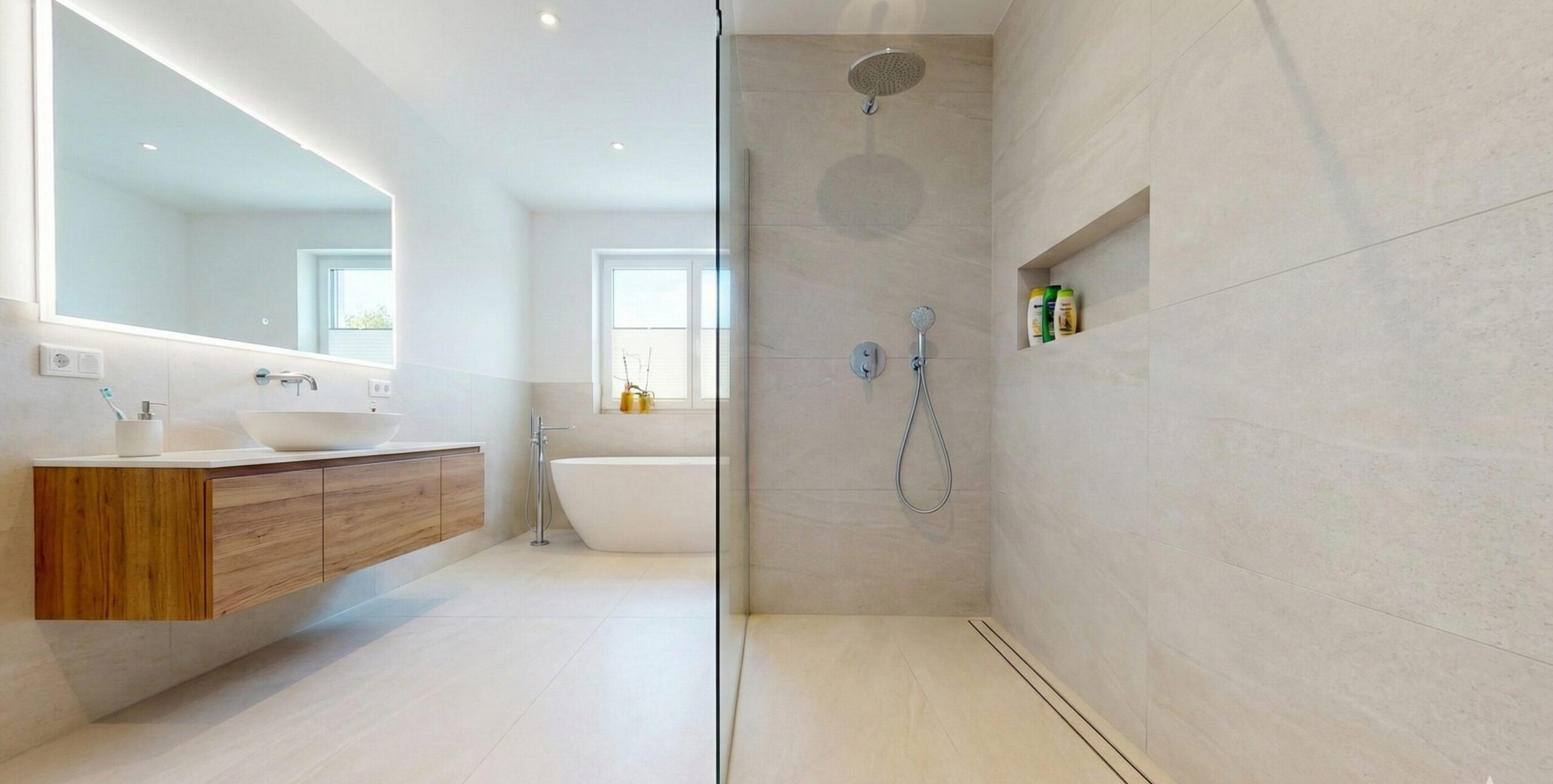
Bathroom Remodels
Curbless vs. Curb Shower: Which Walk-In Shower Is Right for You?
The entry to your shower seems like a small detail—until you live with it every day. A curb can help keep water contained, but it’s also a step to cross. A curbless shower feels open and modern, but it asks more of the structure, the slope, the drainage, and the waterproofing.
This guide compares curbless shower vs curb options in plain English, with an honest look at accessibility, curbless shower waterproofing, cleaning, and curbless shower cost factors. The goal is simple: help you choose a walk-in shower design that fits how you move, how you clean, and how your bathroom is built.
If you’re planning a full bath remodel, start with the bigger picture here: Bathroom Remodeling in Utah: Built to Last. For walk-in shower specific planning, see Why Walk-In Showers Are Taking Over Home Remodeling.
Why the shower entry changes how the whole bathroom feels
When homeowners debate curbless vs. curb, it’s rarely just about looks. The shower entry affects:
- How accessible the shower is (today and years from now)
- How “open” the room feels (especially in smaller bathrooms)
- How easy it is to keep water where it belongs
- How the shower is built underneath (structure + slope + drain placement)
- How the bathroom performs long-term (waterproofing and moisture control)
Before you choose, ask yourself:
- Is this an accessibility shower remodel (aging in place, mobility concerns, future-proofing)?
- Do you want a doorless walk-in shower design, or will you use a door/panel?
- How much daily splashing happens in your household (kids, pets, fast showers, handheld sprayers)?
- Is your bathroom on a slab or a framed floor (joists)?
- Are you okay paying more for complexity if curbless is your priority?
There’s no single “best” choice—only the best match for your home and your needs.
Curbless shower vs curb: the quick comparison you actually need
Here’s the simplest way to think about it: a curb helps with containment. A curbless shower prioritizes access and visual openness. Everything else—cost, drain choices, glass decisions—flows from those two priorities.
|
Curbless Shower — Best Fit When…
Primary tradeoff: Water containment has to be designed, not assumed. The build needs precision. |
|
Curb Shower — Best Fit When…
Primary tradeoff: There is a step/threshold to cross (though it can be designed low and clean). |
A practical decision rule (most homeowners relate to):
- If accessibility is a top priority (or you want to future-proof), curbless is often worth exploring.
- If water containment is your top priority (busy household, tight layout), a curb or low-threshold curb can be the smarter move.
- If you want “best of both,” many bathrooms do a low curb with a wide entry and clean glass—modern look, less splash risk.
What makes a shower “curbless” (and why structure matters)
A curbless shower isn’t just “remove the curb and tile it.” The floor still needs to slope toward the drain so water doesn’t run into the rest of the bathroom. That slope has to happen somewhere, and how you achieve it depends on what your bathroom is built on.
The key idea: the shower floor must be lower (or shaped differently)
In most curbless designs, the shower floor is either:
- recessed so the shower area can slope down to the drain while the bathroom floor stays level, or
- built up (the bathroom floor outside the shower is slightly raised) so the shower can still slope without a curb.
Either approach can work. The “best” approach depends on your structure, your drain location, and the finished floor height you’re aiming for.
Framed floor (joists) vs slab: why your home matters
Many Utah homes have a mix of floor types depending on level and era. Here’s the homeowner-friendly difference:
- Framed floors (joists): You may be able to recess the shower area by adjusting the subfloor and framing details. But structural changes have rules—joists can’t be cut “just because.” Any structural modifications should be designed and executed by qualified professionals.
- Concrete slabs: Curbless may involve different planning around drain placement and slope. The feasibility depends on existing plumbing location, slab conditions, and how the shower assembly is designed.
Bottom line: Curbless is often possible, but it’s not always “simple.” A good design-build team treats curbless as a structure-and-drain problem first, and a tile problem second.
How slope works (without getting overly technical)
Shower floors are typically built with a noticeable slope toward the drain so water doesn’t pool. Many showers use a slope around 1/4 inch per foot toward the drain, but exact requirements can vary by waterproofing system and local code. Your installer should follow manufacturer guidelines and local requirements.
Why slope is the curbless “make or break” detail:
- If the slope is too shallow, water can linger and stain grout, or migrate outside the shower area.
- If the slope is too aggressive, it can feel awkward underfoot and make tile layout harder.
- If the floor isn’t flat enough where it needs to be (especially around drains), the shower can look great but perform poorly.
That’s why curbless showers reward precision—and punish shortcuts.
Curbless shower waterproofing: what’s different (and why it matters)
Both curb and curbless showers need excellent waterproofing. The difference is that a curb gives you a physical “dam” at the entry—so minor splash or spray is less likely to escape. Curbless showers rely more heavily on proper slope, drainage, and careful transitions between wet and dry areas.
If you want the deeper breakdown on what’s behind a great shower build, see: Tile & Waterproofing Systems Built for Longevity and Bathroom Waterproofing 101: What’s Behind Great Tile Work.
Think in “systems,” not products
Homeowners often ask, “What’s the best waterproofing?” The better question is: Is the entire system designed and installed correctly? A durable shower build typically includes:
- a properly sloped shower pan or shower floor assembly
- a continuous waterproofing layer (membrane or liquid-applied system)
- watertight seams, corners, and penetrations
- a correct connection at the drain (where many failures happen)
- tile and grout installed as the finish layer (tile is not the waterproofing)
Curbless adds “transition risk”
In curbless showers, the shower floor meets the bathroom floor without a curb. That transition area must be planned carefully so it doesn’t become a water escape route. Depending on layout, your design team may consider things like:
- shower length (more distance = easier containment)
- glass panel placement (to block spray without closing the shower entirely)
- drain type and location (to pull water away efficiently)
- waterproofing extent (sometimes extending beyond the shower footprint)
Waterproofing must-haves (homeowner checklist)
- Confirm which waterproofing system will be used and how it’s detailed at corners and seams.
- Ask how the drain connection is made and verified.
- Discuss where waterproofing stops (shower only vs extended wet zone).
- Plan niches, benches, and any penetrations early—each one needs careful detailing.
- Confirm the plan for ventilation (a beautiful shower won’t stay beautiful if humidity isn’t controlled).
Because building code, inspection requirements, and accepted waterproofing methods can vary by location and product, confirm specifics with qualified professionals, manufacturer guidance, and local authorities.
Drainage options: center drains vs linear drains (and what changes with curbless)
Drain decisions are a big part of walk-in shower design, especially in curbless layouts. The drain type influences the slope shape, tile layout, water flow, and even cleaning routines.
Center drain (traditional) and a “four-way slope” floor
With a center drain, the shower floor typically slopes from multiple directions down toward the drain. This is common, proven, and works well with many tile sizes.
Homeowner tradeoff: Some tile layouts are harder with a four-way slope (especially large format tile) because the floor changes plane as it moves toward the drain. Skilled installers can still make it look excellent, but it’s a design consideration.
Linear drain (trench-style) and a single-direction slope
A linear drain is a long, narrow drain—often placed along one edge of the shower. One reason linear drains are popular in curbless showers is that they can allow a single-direction slope (a simpler plane), which can make certain tile layouts easier.
Homeowner tradeoff: Linear drains can add cost, and cleaning is different. Hair and debris still need to be maintained—just in a different format than a center drain.
Where the drain sits matters
Drain placement affects where water wants to go. For example, if a shower is designed to be more open (doorless), you want the “water action” happening where the slope and drain can capture it reliably—especially with handheld sprays or rain heads.
|
Drain decision checklist
|
Glass and containment: the most overlooked curbless “success factor”
When people picture a curbless shower, they often imagine a wide open entry with minimal glass—something that feels high-end and effortless. That look is absolutely achievable in many bathrooms, but it requires smart containment planning.
Doorless (open) showers: beautiful, but not automatic
A doorless walk-in shower design can work well when the shower is large enough and the shower head placement minimizes direct spray toward the opening. Common containment tools include:
- A fixed glass panel positioned to block spray
- A longer shower footprint so water has distance to slow down before the opening
- Careful shower head placement so spray doesn’t blast toward the exit
Reality check: The smaller the shower, the harder it is to keep a doorless design tidy and dry outside the shower area.
Frameless glass doors: curb or curbless, it’s a strong option
If your priority is a clean, modern look and strong water control, a frameless door can be a great fit in either curb or curbless designs. You get a more open feel than a traditional framed enclosure while still keeping water contained.
Half-walls and “pony walls”: useful, but detail-heavy
Some bathrooms use a partial wall to define the shower and support glass. This can look great—but any horizontal surface in a wet area needs careful waterproofing and slope so it doesn’t become a water shelf. If you choose a half-wall, ask specifically how it will be waterproofed and how water will drain off it.
Cleaning and maintenance: what changes between curb and curbless?
Most homeowners focus on the build (understandably), but daily maintenance matters too—especially in a space that gets wet and steamy every day.
Curbless showers can feel easier to clean—if the details are right
Curbless showers often have fewer “edges” at the entry, which can feel simpler visually and physically. But they may include larger wet zones, more glass, or longer drain surfaces, depending on your design. Cleaning tends to be easier when you plan for:
- Simple surfaces (large-format wall tile, fewer grout lines where possible)
- Smart niches and storage (built to drain and waterproofed correctly)
- Glass strategy that minimizes water splatter outside the shower
- Good airflow to reduce lingering moisture
For storage details that stay dry and durable, see: Shower Niches, Benches, and Shelves: Storage That Doesn’t Leak.
Curb showers can be lower maintenance for splash control
A curb naturally catches small amounts of water that would otherwise run out. In a busy home—especially with kids or multiple shower users—this can reduce the amount of wiping needed outside the shower after each use.
Grout and tile choices matter either way
Floor tile in showers is often smaller (like mosaic) because it conforms to slope better and can be more slip-resistant. More grout lines can mean more cleaning over time. If low maintenance is a priority, discuss grout choices and maintenance with your tile pro. Related reading: Low-Maintenance Grout Choices: Color, Type, and Where It Matters Most.
Ventilation is part of shower durability
Even the best waterproofing can’t protect a bathroom from constant humidity if ventilation isn’t designed properly. A good vent strategy helps protect:
- grout and caulk lines
- paint and drywall outside the shower
- wood vanities and trim
- overall air quality and comfort
For homeowner-friendly guidance, see: Bathroom Vent Fan Sizing: How to Control Humidity and Odors and Bathroom Ventilation & Moisture Control Done Right.
Curbless shower cost factors: what tends to increase price (and why)
It’s hard to talk about cost without seeing your bathroom, because existing conditions drive the budget. But in general, curbless showers can cost more because they often require more planning and more labor in the “invisible” parts of the build.
|
Common cost drivers in curbless showers
Important note: A curb shower can also be “premium” and costly if you choose high-end materials and custom details. The difference is that curbless often adds structural and drainage complexity on top of finish choices. |
Why “simple-looking” curbless showers aren’t always simple to build
Curbless designs look minimal—no curb, clean lines, seamless floor. Achieving that minimalism usually means more precision behind the scenes:
- tight tolerances for slope and flatness
- more careful waterproofing transitions
- drain and tile layout coordination
- glass placement that supports containment without clutter
Accessibility shower remodel: when curbless is the right call
If your remodel is driven by accessibility—or you simply want a bathroom that works for the long haul—curbless showers are often worth serious consideration. The obvious benefit is entry: no step to cross. But accessibility is bigger than “no curb.” It also includes how the shower is used.
Accessibility-friendly features to consider (curbless or curb)
- Stable footing: slip-resistant floor tile and safe slope design
- Handheld shower: easier control, especially for seated or assisted bathing
- Bench or seat: can improve safety and comfort
- Grab bar planning: installed with proper backing and placement (plan during framing)
- Clear space: room to move comfortably without bumping glass or fixtures
Exact accessibility requirements and recommended clearances vary depending on needs and whether you’re designing to a specific standard. If accessibility is a key goal, coordinate early with qualified professionals so the design supports safe, comfortable use.
Aging in place tip: Even if you don’t need full accessibility today, consider planning the bathroom so it can adapt. That might mean reinforcing walls for future grab bars, choosing a shower layout with comfortable entry, and prioritizing ventilation and moisture control for long-term durability.
When a curb shower is the smarter choice (and still looks high-end)
Curbless showers are popular, but curb showers are not “outdated.” In many bathrooms, a curb is the practical choice—especially when you want strong water control in a tighter footprint.
Choose a curb shower when…
- Your bathroom is small and you can’t spare extra shower length for doorless containment
- You have kids, pets, or a high-splash household
- You want a simpler waterproofing and containment approach
- You want to minimize structural changes or keep scope tighter
How to make a curb shower feel modern
- Keep the curb clean and proportional (not bulky or oversized)
- Use the same tile on the curb top for a seamless look
- Choose frameless or minimal hardware glass where appropriate
- Upgrade lighting and niches to make the shower feel intentional
A well-designed curb shower can feel just as “luxury” as curbless—especially when tile layout, grout choices, and glass details are handled with precision.
When a curbless shower makes sense (and what to plan so it works)
Curbless showers shine when you’re after openness, accessibility, and a streamlined look. But the success of a curbless shower depends on planning the details that keep the bathroom dry.
Curbless tends to work best when…
- You have enough shower footprint to manage spray (or you’re okay with glass)
- You’re willing to coordinate structure, drain, slope, and tile layout early
- You prioritize a barrier-free entry for accessibility or future-proofing
- Your bathroom layout supports good containment (not a direct blast of water toward the opening)
Common curbless pitfalls (and how good planning avoids them)
|
Pitfall #1: Water escaping the shower area
This is usually a layout/containment issue (shower size, glass placement, shower head direction) or a slope/drain issue. A good design anticipates spray patterns and plans for them. |
|
Pitfall #2: “Looks great, feels puddly”
If the slope and flatness aren’t dialed in, water can pool in corners or along edges. Precision in the pan build and tile setting is what prevents this. |
|
Pitfall #3: Underestimating waterproofing detail work
Curbless transitions are less forgiving. The waterproofing system needs correct seam and drain detailing, plus smart planning around niches, benches, and penetrations. |
|
Pitfall #4: Choosing finishes before the build details
Tile size, drain type, and slope shape influence each other. It’s best to coordinate these choices early so the final look and performance match. |
Feasibility check: can your bathroom actually support a curbless design?
This is where many homeowners get stuck—because the answer is “it depends,” but not in a hand-wavy way. It depends on specific conditions that a qualified remodeler can verify quickly during planning.
Curbless feasibility checklist (bring this to a consult)
- Floor type: Is this bathroom on a slab or a framed floor?
- Drain location: Where is the drain now, and will it need to move?
- Joist direction (if framed): Does the structure allow a recessed shower area without risky cuts?
- Shower size: Do you have enough length/space for containment (especially if doorless)?
- Glass plan: Are you open to a fixed panel or door to control spray?
- Ventilation: Will the fan and airflow handle increased wet-area exposure?
- Heated floors (optional): If you want radiant heat, can it be coordinated with the tile and waterproofing system?
- Timeline and access: Will you be living at home during the remodel, and do you need a second bathroom?
Tip: If any of these are uncertain, that’s normal. This is exactly what a design-build feasibility review is for.
Planning sequence: how a walk-in shower comes together without chaos
Great shower results come from planning in the right order. Here’s a homeowner-friendly sequence that reduces rework and surprises.
|
Step 1: Confirm goals and constraints
Accessibility, style, maintenance expectations, and shower size. Decide whether containment (curb/door) or openness (curbless/doorless) is the priority. |
|
Step 2: Verify structure and plumbing feasibility
This is where curbless becomes “yes/no/yes-with-tradeoffs.” Floor type, drain location, and slope strategy are confirmed. |
|
Step 3: Choose drain + tile strategy together
Drain type and placement influence slope shape. Tile size and layout influence how that slope looks and performs. |
|
Step 4: Lock in waterproofing and details
Niches, benches, glass, and penetrations are planned before tile begins. Waterproofing is treated as a system, not an afterthought. |
|
Step 5: Coordinate ventilation and moisture control
Bathrooms stay beautiful longer when humidity is controlled. Fan sizing, ducting, and controls should match how the bathroom is used. |
Want to understand what to expect during the remodel process? These resources help homeowners plan with confidence:
Timeline & What to Expect Budgeting for Your Remodel How to Choose a Remodeler
Related bathroom resources (so your shower works with the whole remodel)
A walk-in shower is the centerpiece—but it’s not the only part of a durable bathroom. These pages help you coordinate the full plan:
Bathroom Remodeling Walk-In Showers Tile & Waterproofing Ventilation & Moisture Control Waterproofing 101 Niches & Shelves
FAQs: curbless vs curb showers
Are curbless showers always more expensive?
Not always, but they often cost more because they can involve additional structural planning, drain changes, and more complex waterproofing transitions—plus glass decisions to manage splash. The exact cost depends on your bathroom’s structure, plumbing location, and finish selections.
Do curbless showers leak more?
A properly designed and installed curbless shower should not leak. Problems usually come from poor waterproofing detail work, incorrect slope, or unplanned splash containment. That’s why curbless showers benefit from an experienced team that treats waterproofing as a system.
Can I do a doorless curbless shower in a small bathroom?
Sometimes, but it depends on shower size, spray direction, and how the glass is planned. Smaller showers often need a door or a well-placed fixed panel to keep the rest of the bathroom dry. A feasibility review is the best way to confirm what will work in your specific layout.
Is a curb shower still considered a “walk-in shower”?
Yes. Many walk-in showers include a curb. “Walk-in” typically refers to replacing a tub with a dedicated shower space and a more accessible entry than a tub wall—curb height and design can vary.
Do I need permits or inspections for a shower remodel?
Projects that change plumbing, electrical, ventilation, or structure may require permits and inspections. Requirements vary by jurisdiction and scope. Confirm details with qualified professionals and your local building department.
Conclusion: choose the shower entry that matches your life—and build it like it has to last
The choice between curbless vs curb isn’t about trends. It’s about performance and comfort.
- Curbless showers can be a fantastic choice for accessibility and a modern, open feel—when structure, slope, drain, glass, and waterproofing are planned as one system.
- Curb showers are often the most reliable choice for water containment and can still look high-end with clean detailing and modern finishes.
If you’re not sure which direction fits your layout, that’s normal. The smartest next step is a feasibility conversation that looks at your structure, drain location, shower size, and containment options—so you can choose confidently before demo begins.
Want a pro to confirm curbless feasibility (and the best layout for your bathroom)?
The Fortress Builders’ design–build process starts with a clear plan—so your shower isn’t just beautiful, but durable, functional, and built with integrity.
Request a Design Consult Explore Bathroom Remodeling
We’ll help you compare curb and curbless options, understand the real cost drivers, and design a walk-in shower that fits your space and your daily routines—without guesswork.