

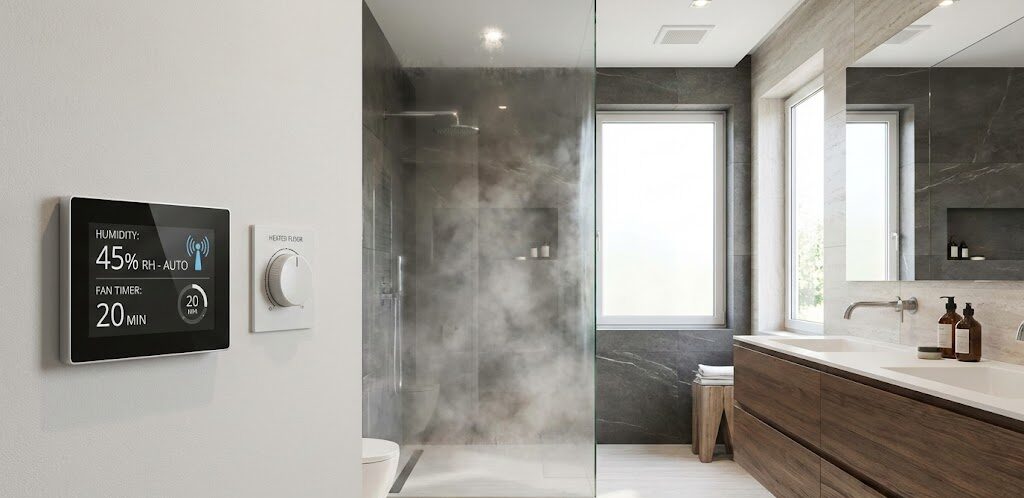
Humidity-Sensing Bathroom Fans?
Bathroom ventilation is one of those upgrades you only notice when it’s missing. A great exhaust fan clears humidity and odors fast, protecting paint, drywall, cabinetry, and tile from long-term moisture stress.
But here’s the catch: fans only work when they run long enough. That’s why “smart” controls—especially humidity-sensing bathroom fans and humidity-sensing switches—have become a popular upgrade.
In this homeowner-friendly pros/cons guide, you’ll learn:
- how a humidity sensing bathroom fan (or switch) actually works in real life,
- where the benefits are real—and where the hype gets ahead of the results,
- when a bathroom fan timer vs sensor comparison leans one way or the other,
- when a quiet bathroom fan upgrade is the best “automation” of all,
- and how to choose the simplest control you’ll actually use.
The Fortress Builders is a Utah design–build company built on one principle: strength through structure. That means our planning focuses on what holds up over time—systems behind the finishes, smart details, and clear decisions early so your remodel stays calm and predictable from concept to completion.
Helpful internal resources while you plan:
The best bathroom fan is the one that actually runs
If you’ve ever walked into a bathroom 20 minutes after someone showered and the mirror is still fogged, you’ve seen the most common ventilation problem:
The fan might be “installed,” but it isn’t running long enough to do its job.
Bathrooms generate a lot of water vapor fast. That moisture doesn’t just vanish when the shower turns off—it lingers in the air, then condenses on the coolest surfaces: mirrors, windows, ceiling corners, painted drywall, and sometimes even inside cabinetry.
Over time, too much lingering humidity can contribute to:
- peeling paint and bubbling drywall (especially ceilings),
- persistent musty odors,
- mildew on grout and caulk lines,
- swelling or warping in wood trim and vanities,
- and a bathroom that feels clammy even when it looks clean.
That’s why smart bath fan controls exist. The goal isn’t “fancy tech.” The goal is simple: consistent run time so moisture and odors clear quickly.
What is a humidity-sensing bathroom fan?
A humidity-sensing bathroom setup can be one of two things:
- A fan with a built-in humidity sensor (the sensor is part of the fan housing or grille).
- A humidity-sensing wall control (switch) that turns a standard fan on/off automatically based on humidity.
Either way, the principle is the same: the system monitors humidity in the bathroom and turns the fan on when humidity rises (and off when it drops back down).
Humidity basics (without the science headache)
Humidity sensors typically respond to relative humidity (RH), which is the percentage of water vapor the air is holding relative to what it could hold at that temperature. Warm air can hold more water vapor than cold air—so humidity and temperature are connected.
What matters for bathrooms is that showers cause a fast spike in humidity. A sensor can use that spike to trigger the fan automatically.
Two common ways sensors decide when to turn on
Different products work differently, but most humidity-based controls use one (or a combination) of these approaches:
- Fixed threshold: “Turn on when humidity goes above X%.”
- Rapid-rise detection: “Turn on when humidity rises quickly,” even if the absolute number isn’t huge.
Rapid-rise detection can be helpful because bathrooms can have different “baseline” humidity depending on season, climate, and HVAC settings. A control that looks for a fast change can be less prone to false triggers than a strict threshold.
Pros: when humidity sensing is genuinely useful
Humidity sensing can be a great upgrade when it solves a real homeowner problem: forgetting to run the fan, running it too briefly, or avoiding it because it’s noisy.
Pro #1: It protects finishes even when nobody remembers the fan
In many homes, the issue isn’t knowledge—people know they should run the fan. The issue is routine. Mornings are rushed. Kids forget. Guests don’t want to flip extra switches. A humidity sensor helps make “good ventilation habits” automatic.
Pro #2: It’s ideal for kids’ bathrooms and guest bathrooms
Bathrooms used by kids and guests are the perfect “set it and forget it” candidate:
- Kids often don’t notice humidity issues until there’s fog and dampness.
- Guests may not know your preference for fan run time.
- In shared bathrooms, people may assume someone else turned the fan on.
A sensor doesn’t rely on memory, manners, or habits.
Pro #3: It can help with mold prevention (as part of a bigger strategy)
Humidity control supports mold prevention by reducing the amount of time surfaces stay damp. It’s not a magic shield—waterproofing, material choices, and cleaning still matter—but reducing lingering humidity is a practical, widely accepted best practice.
If mold prevention is a priority in your remodel plan, this resource is helpful: Mold Prevention in a Bathroom Remodel: Design + Ventilation Basics.
Pro #4: It encourages the fan to run after the shower (when it matters most)
Many people turn the fan off as soon as they’re done showering—even though the humidity peak often lingers. A sensor can keep the fan running until humidity is actually reduced.
Pro #5: It pairs well with a quiet fan upgrade
Even “smart” controls won’t help much if people avoid the fan because it’s loud. If you’ve ever heard a bathroom fan that sounds like an airplane taking off, you already know why timers and sensors get ignored.
A quiet fan upgrade can be the simplest way to improve ventilation behavior: when the fan is quiet, it runs more often—because nobody hates it.
Cons: where humidity sensors can disappoint (or annoy you)
Humidity sensors are helpful, but they’re not perfect. Most of the “this is a gimmick” stories come down to a few predictable issues.
Con #1: False triggers (fan turns on when you didn’t expect it)
Humidity can rise for reasons besides showers:
- someone runs hot water at the vanity for a while,
- the bathroom shares air with a laundry area,
- seasonal humidity changes raise baseline moisture,
- or the HVAC system shifts humidity levels after cycling.
Depending on the sensor logic and settings, the fan may kick on at times that feel random.
Con #2: Not all sensors are equally “smart”
Some controls are simple threshold devices. If the threshold is set too low, the fan runs too often. If it’s set too high, it may not respond fast enough to showers. More advanced controls may use rapid-rise logic, adjustable sensitivity, or time delays—but product capabilities vary.
Con #3: Sensors can’t fix an undersized fan or bad ducting
This is a big one. If the fan is too small (CFM is low for the room) or the duct run is long, crushed, undersized, or filled with sharp turns, the fan might run “automatically” but still not clear humidity well.
If you’re not sure whether your fan is sized correctly, start here: Bathroom Vent Fan Sizing: How to Control Humidity and Odors.
Con #4: Sensors don’t really “smell” odors
Humidity controls are great for steam, but bathroom odors aren’t always humidity-driven. If someone uses the toilet without showering, humidity might not rise enough to trigger the fan. That’s why many homeowners still want a manual switch option or a timer.
Con #5: More electronics = more complexity
A standard fan on a basic switch is very straightforward. A humidity sensor adds more parts, more settings, and sometimes more wiring requirements. In some homes, upgrading a switch may require electrical updates (like a neutral wire in the switch box). What’s required depends on your existing wiring and the specific product.
Important: If your project involves electrical work, requirements can vary by location and scope. Confirm details with qualified professionals and local authorities.
Bathroom fan timer vs sensor: which control wins in real homes?
For most homeowners, the “best” choice isn’t about what’s most advanced—it’s about what’s most reliable and easiest to live with.
| Control Type | What It Does Well | Common Downsides | Best For |
|---|---|---|---|
| Basic switch | Simple, inexpensive, predictable. | Depends on memory and good habits; often turned off too soon. | Households that consistently run the fan long enough. |
| Timer switch | Forces adequate run time after showers without thinking about it; still predictable. | Still requires someone to press it; may be ignored in kids/guest baths. | Most bathrooms; great “value upgrade” for moisture control. |
| Humidity sensor | Automatic response to shower humidity; helpful when people forget. | Potential false triggers; may miss odor-only events; settings vary by product. | Kids’ baths, guest baths, high-use bathrooms, rentals. |
| Smart/connected automation | Custom logic (rapid-rise, schedules, remote control, scene integration). | More setup, more points of failure, depends on ecosystem and connectivity. | Tech-forward homeowners who want tailored control and already run a smart home setup. |
Fortress-style takeaway: If you want the highest reliability with the least fuss, a quiet fan + timer is hard to beat. If your main problem is “people never use the fan,” humidity sensing becomes much more valuable.
When a quiet bathroom fan upgrade is the smarter “control”
Before you spend money on sensors and smart controls, ask one honest question:
Do we avoid running the fan because it’s loud?
If yes, automation might not fix the real problem—because people may still override it, turn it off, or hate that it runs.
Why quiet matters more than people think
Noise is one of the biggest drivers of behavior in bathrooms. A loud fan “feels optional.” A quiet fan feels like background noise—and it stays on longer because it doesn’t interrupt conversation, bedtime routines, or early mornings.
What to look for in a quiet fan upgrade
- Sound rating (sones): Lower sones are generally quieter.
- Proper sizing (CFM): The fan has to move enough air for your space. (Quiet is great, but it still needs to work.)
- Good ducting: Restrictive ducting can make fans louder and less effective.
- Controls: Many premium fans offer built-in smart control options, but even a basic timer can be a strong setup.
Best use cases for humidity sensing bathroom fans
Humidity sensors are most valuable when they solve a predictable pattern: the fan doesn’t get used consistently, or the bathroom sees heavy daily moisture.
These are strong “yes” scenarios
- Kids’/teen bathrooms: Forgetfulness is the default setting.
- Guest baths: Guests rarely know your “run the fan 20 minutes” preference.
- Windowless bathrooms: No backup ventilation from a cracked window.
- High-use bathrooms: Multiple showers back-to-back (family mornings).
- Bathrooms with persistent fogging: Mirrors stay fogged long after the shower.
- Basement bathrooms: Basements can feel more humid and may need consistent ventilation planning.
- Rental or multi-occupant homes: Consistency matters more when users vary.
A quick “humidity sensor fit” checklist
If you answer “yes” to two or more, a humidity sensor is worth considering:
- Do people frequently forget to use the fan?
- Does the mirror stay fogged 15–30 minutes after showers?
- Is there a history of mildew on grout/caulk despite cleaning?
- Is the bathroom used by guests/kids most of the time?
- Do you want moisture control without relying on habits?
When a humidity sensor might be the wrong move
Sometimes a sensor is technically “cool,” but not the most satisfying solution.
Consider skipping (or being cautious) if…
- You already use a timer reliably. If your household has good habits, a sensor may not add much value.
- Your bathroom has frequent non-shower humidity spikes. For example, if the bathroom shares air with laundry or a humid area, false triggers may be annoying.
- You’re sensitive to fan noise. If the fan is loud, fix the noise first.
- The bathroom has odor needs without humidity. A sensor may not trigger for toilet use.
- The ducting is problematic. If the fan underperforms due to duct resistance, automation won’t solve the core issue.
Rule of thumb: Fix performance first (sizing, ducting, placement), then optimize controls. A sensor should be the “nice layer” on top—not the band-aid for a weak ventilation system.
Cost/value reality check: is a humidity sensor “worth it”?
Because product pricing varies by brand, features, and availability, the most helpful way to evaluate value is in “layers,” not exact dollars.
Where humidity sensing usually falls on the “cost ladder”
- Lowest cost: existing fan + basic switch (but also lowest reliability for run time).
- Low-to-moderate: upgrade to a timer switch (often the best bang-for-buck).
- Moderate: humidity-sensing switch controlling an existing fan (when wiring allows).
- Moderate-to-higher: quiet fan upgrade (better performance + comfort).
- Higher: premium fan with built-in sensor and smart controls (feature-rich, but not always necessary).
How to decide if the “extra spend” pays you back
Humidity sensing pays back in two ways:
- Reduced maintenance: less persistent dampness means less scrubbing mildew stains and less paint touch-up.
- Reduced risk: better moisture control reduces the chance of moisture-related damage over time (especially in bathrooms with heavy daily use).
It’s hard to put an exact number on that risk reduction—because it depends on your home, usage, and existing conditions—but it’s very easy to recognize the difference between a bathroom that dries fast and one that stays wet.
A practical value test:
- If your bathroom dries quickly today with a timer you use, you may not need a sensor.
- If your bathroom stays damp because the fan doesn’t run consistently, a sensor can be a simple “behavior fix.”
- If the fan is loud or weak, spend money on a quiet/performance upgrade before you buy more “brains.”
Smart bath fan controls: helpful… if you keep them simple
Smart home-style ventilation can be powerful. You can build logic like:
- turn the fan on when humidity rises quickly,
- run for a minimum time,
- then keep running until humidity drops to a target level,
- and allow manual override (because life happens).
That said, the more complex the system, the more it depends on apps, connectivity, and correct setup.
Fortress recommendation for smart control setups
If you’re going to go “smart,” we recommend two guardrails:
- Always include a manual/timer option. You want to be able to run the fan when you want—regardless of sensor logic.
- Avoid overly complicated rules. If the system takes a spreadsheet to understand, it’s more likely to be disabled later.
Installation considerations homeowners should know (without getting into contractor-level detail)
Most humidity-sensing projects are straightforward for qualified trades—but it helps homeowners know what questions to ask during planning.
1) Confirm the fan is sized correctly
Controls don’t replace capacity. A fan that’s too small won’t clear humidity quickly, no matter how smart the switch is. If you’re choosing between models, start with sizing first:
2) Confirm ducting supports real airflow
Ducting has a huge impact on performance. Best practice is to vent to the exterior with a duct route that’s as short, smooth, and straight as possible. (Long, sagging flex duct can reduce airflow dramatically.)
3) Confirm fan placement makes sense
Placement matters. Ideally, the fan is positioned to capture steam near the shower/tub zone without being blocked by odd ceiling geometry or separated rooms.
4) Electrical requirements can vary
Humidity sensor switches and smart controls sometimes require specific wiring conditions (like a neutral wire in the switch box). Requirements vary by product and home wiring.
Important: Electrical and permitting requirements can vary by city and project scope. If your remodel involves electrical changes, confirm requirements with qualified professionals and local authorities.
5) Plan controls before finishes go in
The cleanest time to add timers, sensors, and upgraded fans is during the remodel—when walls are open, duct routes can be optimized, and switch locations can be set intentionally.
That planning approach is part of why a design–build process helps: layout, electrical, mechanical, and finishes get coordinated instead of colliding at the end.
A simple decision framework: choose the simplest control you’ll actually use
Here’s a straightforward way to choose between a timer, a humidity sensor, and a smart control setup.
Option A: Quiet fan + timer (best all-around, “low drama” solution)
Choose this if: you want predictable, reliable moisture control with minimal tech.
- Quiet fan encourages use.
- Timer ensures adequate run time.
- Easy to explain to guests and kids (“hit 20 minutes”).
Option B: Quiet fan + humidity sensing (best for “people forget” households)
Choose this if: the bathroom is frequently used by kids/guests—or the fan is rarely used consistently.
- Automation reduces dependence on habits.
- Better chance the fan stays on after showers.
- Still include manual/timer override when possible.
Option C: Smart automation (best for tech-forward homeowners)
Choose this if: you already maintain a smart home setup and want custom control logic.
- Can combine rapid-rise detection + minimum run time + thresholds.
- Can integrate with schedules and scenes.
- But requires setup and occasional troubleshooting.
Bottom line: The “best” system is the one you won’t disable. If you love simple and predictable, go timer. If your household forgets, go sensor. If you love control and already run smart home systems, go smart—just keep it manageable.
Practical checklist: what to ask your remodeler (or what to confirm in your plan)
Use this checklist during planning—especially before tile and paint go in:
- Fan sizing: What CFM is recommended for this bathroom (size + ceiling height + fixtures)?
- Noise: What is the sone rating, and is the fan known to be quiet in real installations?
- Ducting: Where does it vent outside, what is the duct size, and how many turns/length does the run have?
- Controls: Timer, humidity sensor, or both? Is there a manual override option?
- Trigger behavior: If humidity sensing is used, is it adjustable (sensitivity/threshold), and how is it expected to behave?
- Electrical: Does the chosen control require a neutral wire or other wiring updates?
- Placement: Is the fan placed to capture shower humidity effectively?
- Maintenance: Is the fan accessible for cleaning and service?
Maintenance and “set-it-right” habits (yes, even for smart controls)
Even the best fan and smartest sensor can underperform if airflow is blocked by dust or the grille is clogged. A simple maintenance routine helps keep humidity control consistent.
Quick maintenance checklist
- Every month or two: wipe or vacuum dust off the grille if it builds up quickly.
- Every 6–12 months: remove the grille and wash it; vacuum dust from the fan housing (power off first).
- Seasonally: listen for changes in sound (rattles can mean the fan needs cleaning or tightening).
- If a sensor seems “off”: check settings/sensitivity and confirm the fan is actually exhausting outside (not blocked).
One simple habit that helps any system
If you don’t have a sensor (or even if you do), keep this routine in mind:
Run the fan during the shower and for 15–30 minutes afterward.
That “after” window is where moisture control often fails—because humidity lingers even when the water is off.
FAQ: common homeowner questions (SERP/PAA-style)
Do humidity-sensing bathroom fans replace timer switches?
Not necessarily. Humidity sensors are great for moisture spikes, but timers are predictable and work for odor events too (when you choose to run the fan). Many homeowners like having both: automatic humidity response plus a manual timer option.
Will a humidity sensor turn the fan on when I’m not showering?
It can, depending on your bathroom’s baseline humidity and the sensor logic/settings. Some sensors respond to rapid humidity rises, which can reduce false triggers. Others use thresholds that may be sensitive in certain conditions. If unexpected run time would annoy you, a timer may be the better fit.
Are humidity sensors worth it in a bathroom with a window?
Windows help, but they’re not consistent—especially in winter or during storms. A fan provides predictable ventilation. A sensor can still be helpful if people forget to run the fan or if the bathroom sees frequent showers.
Can I add a humidity-sensing switch to an existing fan?
Sometimes, yes—if the existing fan wiring and switch box wiring support the control you choose. Some humidity switches require a neutral wire. A qualified electrician can confirm feasibility and code requirements for your situation.
Will a sensor prevent mold by itself?
No single feature prevents mold on its own. Humidity control is one important layer. Waterproofing details, material choices, cleaning habits, and addressing any water leaks matter too. If you’re remodeling, it’s smart to treat mold prevention as a system, not a gadget.
What if my fan runs automatically but the bathroom still feels damp?
That usually points to a performance issue: the fan may be undersized, ducting may be restrictive, or placement may be poor. Automation can’t compensate for inadequate airflow. Start with sizing and ducting checks.
How this fits into a “built to last” bathroom remodel
At Fortress Builders, bathroom planning isn’t just about tile and fixtures. The best-looking bathrooms are backed by strong systems: waterproofing, ventilation, electrical planning, and durable material choices.
Ventilation decisions connect directly to:
- tile and waterproofing longevity (keeping assemblies dry supports long-term performance),
- paint and ceiling durability,
- comfort and odor control for daily routines,
- project sequencing (duct routes and wiring are easiest before finishes).
If you’re building a plan for a full bathroom refresh, these pages can help you connect the dots:
- Bathroom Ventilation & Moisture Control Done Right
- Bathroom Vent Fan Sizing
- Bathroom Waterproofing 101
- Bathroom Remodel Portfolio — Utah Homes
- Timeline and What to Expect
Conclusion: Worth it or a gadget?
A humidity-sensing bathroom fan isn’t automatically a “must-have,” and it isn’t automatically a gimmick either. It’s a tool—and like any tool, it’s worth it when it solves the right problem.
It’s worth it when:
- people don’t use the fan consistently,
- the bathroom sees frequent showers,
- you want hands-off moisture control in kids/guest bathrooms,
- and the fan/ducting is already designed to perform well.
It can feel like a gadget when:
- the fan is loud or undersized,
- ducting is restrictive,
- the sensor triggers unpredictably,
- or a simple timer would have solved the issue with less complexity.
If you take nothing else from this article, take this: choose the simplest control you’ll actually use. Consistency beats complexity—every time.
Want help choosing the right fan and controls for your bathroom?
If you’re remodeling in Davis or Weber County, Fortress Builders can help you plan ventilation the right way—from fan sizing and duct routing to control selection—before finishes go in.
Bring your bathroom dimensions, your current fan details (if you have them), and a quick description of how the bathroom is used (kids/guests/daily showers). We’ll help you build a plan that’s strong in structure and easy to live with.
Request a Design Consult Explore Bathroom Remodeling Ventilation & Moisture Control