

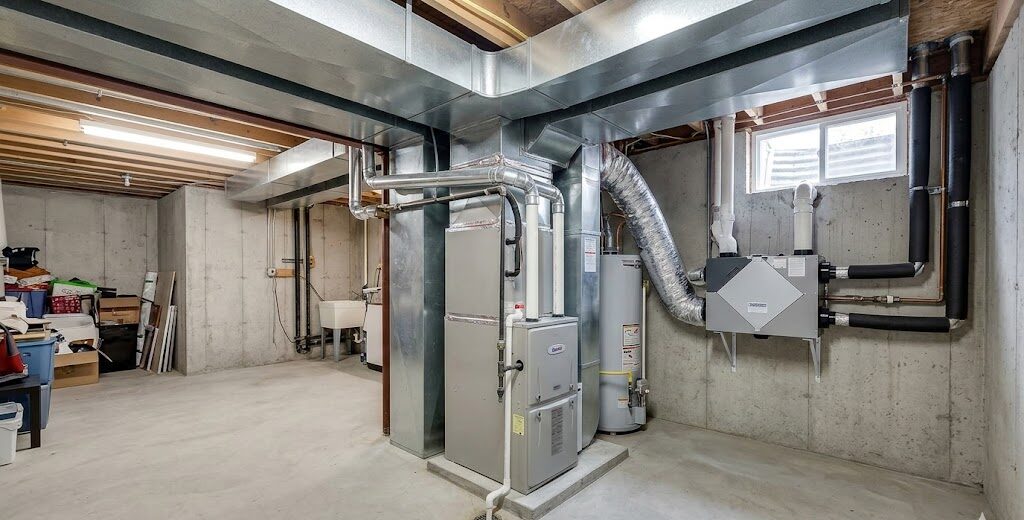
Basement HVAC planning: finished basement ventilation, airflow balance, and humidity control
Most “uncomfortable basement” complaints trace back to air planning—not finishes. A gorgeous basement can still feel clammy, stuffy, too cold in winter, or oddly warm in summer if the HVAC and ventilation strategy is an afterthought.
This guide focuses on basement HVAC planning with homeowner-friendly clarity: how to balance supply return airflow basement, how to approach finished basement ventilation, and how to prioritize basement temperature control and basement humidity control HVAC so the space stays comfortable in every season.
In this guide, you’ll learn:
- how to evaluate your existing system before you finish walls and ceilings,
- what “balanced” supply and return airflow means (and why it matters),
- zoning options that keep basements from fighting the rest of the house,
- how to plan dehumidification and fresh air the right way,
- thermostat placement tips that prevent false readings,
- and a commissioning checklist to confirm performance before you close everything up.
The Fortress Builders is a Utah design–build company built on “strength through structure.” That means the “behind-the-walls” systems—HVAC, ventilation, moisture control, and sound/insulation—are coordinated early so your finished basement performs like it looks.
Helpful internal pages while you plan:
- Basement Finishing in Utah: Space, Comfort & Value
- Comfort and Sound for Basements
- Basement Moisture Management & Protection Systems
- Basement Insulation Basics for Comfort and Sound Control
- Basement Moisture Checklist
- Bathroom Vent Fan Sizing (relevant for basement baths)
- Basement Lighting for Low Ceilings
- Basement Soundproofing Strategies
- Permits and Inspections for Basement Finishing
- Request a Design Consult
Comfort problems usually start with airflow—not the thermostat
Basements are different from the rest of the home. They’re below grade, they often have fewer windows, and they’re commonly shaped by soffits, beams, duct trunks, and mechanical rooms. Those conditions change how air moves and how temperature and humidity behave.
That’s why finished basement ventilation and supply return airflow basement planning should happen early—ideally during design, and definitely before ceilings are closed.
Simple truth: A basement can’t feel consistently comfortable if it doesn’t “breathe.” Comfort requires (1) supply air, (2) return air, and (3) humidity control working together.
Start with a reality check: what system do you have today?
Before you add new rooms downstairs, you need to know what your current HVAC system can realistically support. The goal isn’t to become an HVAC expert—it’s to ask the right questions early so you avoid expensive rework later.
What to document before design decisions
- Current equipment: furnace/air handler, AC, heat pump, any existing humidifier/dehumidifier.
- Existing duct layout: where trunks run, where supplies/returns exist, and where routing is constrained.
- Basement use plan: bedrooms, theater, in-law suite, gym, office—each has different airflow needs.
- Ceiling constraints: beams/ducts/soffits that affect register placement and return pathways.
- Moisture risk factors: history of dampness, musty smell, visible efflorescence, sump presence, etc.
Moisture belongs in the same conversation as HVAC. Before finishes, review: Basement Moisture Checklist and Basement Moisture Management.
Homeowner decision tip: If your basement will include a bedroom, bathroom, kitchenette, or in-law suite, treat HVAC like a “core system,” not an add-on. Comfort is part of livability.
Supply and return airflow: the “balance” that prevents hot/cold rooms
Most basements get supply vents. Fewer get well-planned returns. That imbalance causes common issues:
- some rooms feel stale or “closed off,”
- doors slam or get hard to close (pressure differences),
- the basement pulls air from upstairs in unpredictable ways,
- the space feels cold in winter and damp in shoulder seasons,
- the theater or bedroom feels stuffy with people inside.
What supply air should do
Supply air introduces conditioned air (heated or cooled) into the space. For basements, good supply planning typically means:
- each finished room has a planned supply path (not just the hallway),
- registers are placed to mix air effectively (not blocked by furniture),
- supplies support the “use zones” of the basement, not just the perimeter.
What return air should do
Return air is the “exit path” that lets the system circulate air. Without a return path, supply air can’t do its job well. Return strategies vary by home, but a solid plan usually answers:
- Where does air leave the basement to get back to the HVAC system?
- Do closed rooms have a return path (return duct, transfer grille, or undercut door strategy)?
- Will the theater or in-law suite trap air when doors are closed?
Common mistake: Adding supplies everywhere but relying on “air will find its way back.” It often doesn’t—at least not comfortably.
Zoning options: keeping the basement from fighting the rest of the house
If you’ve ever heard “the basement is always cold,” you’ve seen zoning problems in real life. Basements behave differently than upstairs spaces because of ground contact, solar gain differences, and airflow patterns.
Common zoning approaches (conceptual)
- Single-zone system (existing): simplest, but basements often need careful balancing and return planning.
- Damper-based zoning: separate zones controlled by dampers and thermostats (requires proper design and commissioning).
- Separate system for basement: in some cases, a dedicated system or ducted mini-split approach is used for better control.
Which approach is best depends on your existing equipment, duct access, basement scope, and local requirements. This is a “confirm with a qualified professional” moment.
When zoning becomes more important:
- a basement home theater that’s occupied in the evenings,
- a basement bedroom or in-law suite with closed doors,
- a kitchenette/wet bar zone that adds heat from appliances,
- a basement office that’s used all day (and needs consistent comfort).
Basement humidity control HVAC: why “cool air” isn’t always “dry air”
Basements can feel damp even when they’re cool. That’s because humidity comfort isn’t only about temperature—it’s about how much moisture is in the air and how surfaces behave below grade.
Basement humidity issues often come from a combination of:
- below-grade wall/floor conditions and moisture migration,
- air leaks and poor air sealing,
- insufficient ventilation or return airflow,
- and seasonal humidity changes.
Where humidity control typically comes from
- Source control: address bulk water, drainage, and air sealing first (see Basement Moisture Checklist).
- Ventilation strategy: bathrooms and laundry areas need proper exhaust and makeup air planning.
- Dehumidification: a dedicated dehumidifier is common in finished basements, especially if the space is heavily used.
- Balanced airflow: supply and return planning reduces stagnant zones where humidity lingers.
Homeowner takeaway: Don’t “finish over” humidity problems. If the basement feels musty now, it usually won’t magically improve after carpet and drywall.
Finished basement ventilation: bathrooms, laundry, and “stale air” prevention
Even if the HVAC system is solid, basement comfort can be undermined by poor ventilation—especially in enclosed rooms with doors closed.
Basement bathroom ventilation (high impact)
If your basement includes a bathroom, plan exhaust ventilation like it matters—because it does. Moisture and odors need an effective path out of the home, and ducting details matter just as much as fan rating.
- Related planning resource: Bathroom Vent Fan Sizing: How to Control Humidity and Odors
- Also helpful: Bathroom Ventilation & Moisture Control Done Right
Kitchenettes and wet bars: small appliances still create heat and moisture
A basement kitchenette or wet bar adds comfort demands—fridges reject heat, dishwashers add moisture, and microwaves add heat spikes. That’s why appliance zones should be considered in HVAC planning.
Thermostat placement: avoiding “false comfort signals”
Thermostats don’t measure your whole basement—they measure one spot. If that spot is misleading (near a supply, in a hallway, near a draft, or near a heat source), the basement can feel inconsistent.
Thermostat placement principles (general best practice)
- avoid placing thermostats directly in the path of supply air,
- avoid exterior walls that are cooler below grade,
- avoid locations near appliances or electronics that add heat,
- choose a representative location for the main “living zone.”
Thermostat strategy becomes more important if you add zoning or a dedicated basement system.
Noise, comfort, and airflow: don’t create a loud basement
Comfort isn’t only temperature—sound matters too. Poorly planned registers, undersized returns, or high-velocity airflow can create noise that ruins a theater or bedroom.
Common HVAC noise sources in basements
- air rushing through undersized returns,
- registers placed too close to seating areas,
- rattling duct runs, loose grilles, or poorly supported ductwork,
- mechanical equipment positioned adjacent to quiet rooms.
If your basement includes a theater or bedrooms, coordinate HVAC with your sound strategy early. Related read: Basement Soundproofing Strategies and Comfort and Sound for Basements.
Planning tip: A quiet room often needs “gentle airflow” — more thoughtful placement and balanced returns, not just more CFM.
Commissioning checklist: confirm comfort before ceilings are closed
Commissioning simply means: verify the system performs as intended. It’s easier (and cheaper) to make corrections when ducting and access points are still open.
Finished basement HVAC commissioning checklist:
- Supply coverage: each finished room has planned supply airflow (not just adjacent spaces).
- Return pathways: basement return(s) exist and closed rooms have an air path back (strategy confirmed).
- Air balancing: dampers/registers adjusted so one room doesn’t steal all airflow.
- Humidity plan: dehumidification approach confirmed if needed (especially for below-grade comfort).
- Bath ventilation: fans ducted correctly to exterior; controls (timer/humidity) confirmed.
- Noise check: airflow noise evaluated at registers and returns in quiet rooms.
- Thermostat behavior: verify control logic doesn’t overheat/overcool basement zones.
- Access preserved: critical dampers, cleanouts, and service points remain accessible.
Permits and inspections (confirm locally)
HVAC modifications, new bath ventilation runs, and mechanical changes may require permits and inspections depending on scope and local rules. Requirements vary by jurisdiction and project details. Confirm with qualified professionals and your local building department early—before construction begins.
Related: Permits and Inspections for Basement Finishing.
Conclusion: plan HVAC early—before ceilings are closed
A finished basement should feel like part of your home—not a different climate zone. The best results come from early basement HVAC planning: balanced supply and return airflow, a realistic zoning strategy, and a deliberate approach to humidity and ventilation. When those pieces are coordinated before drywall and ceilings go in, comfort becomes predictable—and your basement becomes genuinely livable year-round.
Want a basement that stays comfortable in every season?
If you’re finishing a basement in Davis or Weber County, The Fortress Builders can help coordinate layout, soffit planning, insulation/moisture strategy, and HVAC/ventilation decisions early—so comfort isn’t left to chance.
Request a Design Consult Explore Basement Finishing Comfort & Sound Planning
Bring your basement floor plan (even a rough sketch) and tell us how you want to use the space. We’ll help you map airflow, returns, and humidity control before the ceilings close.